



What Is an EIS-Equipped Body Worn Camera?
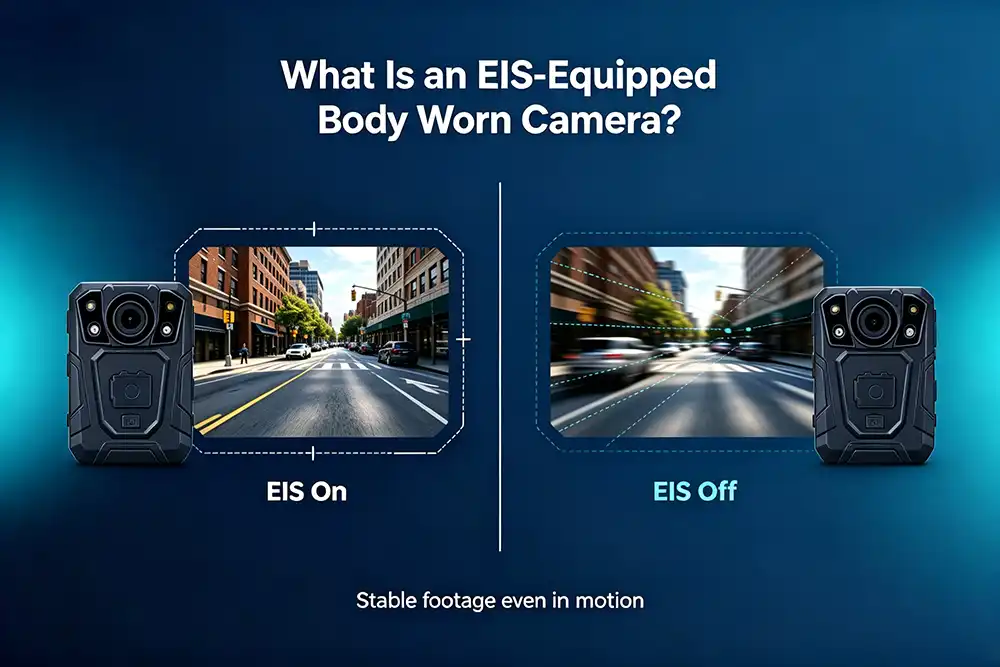
Electronic Image Stabilization (EIS) in an EIS-Equipped Body Worn Camera maintains quality footage during quick movements and difficult situations. These modern cameras employ digital processing to adapt for motion in real time, unlike traditional cameras that sometimes create shaky or fuzzy footage while the wearer is jogging, climbing, or negotiating hazardous terrain. Police officers recording fast-paced pursuits and security staff responding to situations need this stabilizing technology. Knowing how EIS works and its benefits helps procurement managers choose the optimal recording option for their teams.
Understanding EIS-Equipped Body Worn Cameras
EIS-Equipped Body Worn Camera video recording has advanced with Electronic Image Stabilization. Conventional recording systems fail to capture clear footage from body cameras in fast-moving or dynamic scenes. Shaky films make it hard to recognize people, read license plates, and chronicle key situations. EIS uses advanced computer algorithms to evaluate each frame and adjust for motion.
How EIS Technology Works in Body Cameras
Chipsets stabilize the camera during recording. Advanced computers like the Ambarella H22 distinguish camera wobble from deliberate movement across video frames. With precise digital adjustments, the technology crops and realigns each picture for seamless output. Recording occurs instantly without delay.
With its OS05A20 sensor and Ambarella H22 chipset, Shenzhen Kexin Technology's ISHOOP EIS-Equipped Body Worn Camera does this. No matter how much the police move, the camera maintains solid footage throughout a foot pursuit or car stop. The 140-degree wide-angle lens covers the area, and EIS preserves every detail for proof.
Key Performance Features
Modern stabilized cameras provide excellent light clarity. EIS-Equipped Body Worn Cameras with high-quality sensors generate excellent recordings that withstand judicial and internal evaluations. Night vision up to 10 meters with facial detection ensures reliable recording during evening shifts.
Battery performance is crucial. Our WiFi-enabled model's 3200mAh battery will record 1080P for 12 hours, allowing for complete shifts. Recording time exceeds 12 hours when GPS and WiFi run at lower resolutions. This prolonged operation assures cops and security workers never miss key times owing to power shortages.
Comparing EIS vs. Non-EIS Body Worn Cameras: What Procurement Managers Need to Know
Understanding operational advantages is crucial to procurement decisions. Several factors affect your organization's effectiveness and long-term expenses when comparing EIS-Equipped Body Worn Cameras and regular ones.
Video Quality and Usability Improvements
Unstabilized cameras create material that takes a long time to evaluate. Investigators must rewind clips to see motion-blurred features. Because every frame is clear, stabilized film cuts review time. Stabilized recordings during traffic stops or medical crises preserve document language, face characteristics, and scene details.
Retail security personnel profit most from this technology. The camera records steady footage of suspect behaviors and conversations as they move through crowds or respond to theft. Clarity typically settles issues without lengthy investigations.
Battery Life and Operational Considerations
Some companies worry that stabilizing technology may deplete batteries more quickly. Chipset efficiency optimizes power usage in modern EIS implementations. The H.264 and H.265 compression standards increase recording capacity without compromising quality. Our devices enable 2560x1440 to 848x480 recording resolutions, allowing teams to balance quality and battery life based on operational demands.
How to Choose the Right EIS-Equipped Body Worn Camera
Selecting an EIS-Equipped Body Worn Camera demands a comprehensive assessment of your working environment and needs. The following characteristics help purchase decisions balance performance, durability, and long-term value.
Assessing Your Operational Needs
Different professions require different EIS-Equipped Body Worn Cameras camera skills. IP67 waterproof ratings and prolonged battery life are needed for outside traffic policing in any weather. Hospital security teams may emphasize distinct form factors and WiFi connectivity for real-time event response. Compact designs with 360-degree rotating clips provide flexible installation for retail security applications
Use cases determine recording resolution. The majority of law enforcement apps use 1080P, however, some require 1440P or 40MP photos. ISHOOP cameras allow enterprises to set devices for operational priority with numerous resolution options.
Critical Technical Specifications
Battery capacity impacts shift coverage. With 12+ hours of continuous filming, our 3200mAh battery supports extended workdays without recharging. Devices with a standby time of 100 hours are ready even when not recording.
Device storage capacity determines how much footage they can save before downloading. The 32GB to 256GB options meet different retention demands. Roles requiring longer operations or restricted downloads require more capacity. Evidence retrieval during investigations is simplified by automatic file arrangement by date, time, and GPS locations.

Top EIS-Equipped Body Worn Cameras in 2026: Market Overview
Many vendors provide stabilization in the mature EIS-Equipped Body Worn Camera industry. Knowing what makes premium solutions helps procurement teams get the greatest value for their applications.
Performance and Reliability Standards
Chipsets in leading gadgets can handle intensive processing. ISHOOP cameras' Industry-leading Ambarella H22 CPU handles recording, stabilization, GPS tracking, and WiFi streaming without sacrificing quality or battery life.
Final footage depends on sensor quality. The OS05A20 sensor captures crisp photos in bright sunshine and poorly lit areas because of its low-light capability and wide dynamic range. Law enforcement and security operations under changing lighting conditions during shifts require this adaptability.
Connectivity and Integration Features
Real-time connection is essential in modern operations. WiFi-enabled cameras with 2.4G and 5G frequencies offer flexibility. Live streaming footage at changeable resolutions and frame rates allows remote supervision and tactical help during crucial crises.
GPS gives geographic context to every recording. Dedicated players display route information from internal GPS modules during playback. This geographic data aids traffic enforcement, patrol route verification, and incident reconstruction.
Procurement Best Practices and After-Sales Support
Successful EIS-Equipped Body Worn Camera deployment goes beyond purchasing. Effective procurement and support promote long-term operational success and optimum ROI.
Sourcing and Supplier Verification
Working with approved manufacturers and distributors ensures genuine, warranty-covered items. Shenzhen Kexin Technology, founded in 2015, has vast expertise in professional cameras for law enforcement and security companies globally. Our ODM/OEM and manufacturing experience enable tailored solutions for regional and operational needs.
Verifying supplier credentials through certification and reference checks prevents counterfeit EIS-Equipped Body Worn Cameras items without quality control or after-sales service. During procurement, established manufacturers give transparent product documentation, compliance certificates, and prompt communication.
Managing Bulk Orders Effectively
Planning delivery timeframes, payment conditions, and implementation assistance for large installations is crucial. Companies benefit from staged rollouts that allow lesser volumes to be tested before complete implementation. This method finds configuration and training issues before mass dissemination.
Negotiating service agreements with hardware purchases assures support. Comprehensive agreements include firmware upgrades, technical training refreshers, and priority troubleshooting channels. These services remain successful as technology and team members change.
Conclusion
Understanding technical characteristics and operational ramifications is essential when choosing an EIS-Equipped Body Worn Camera. Electronic Image Stabilization enhances evidence quality, review speed, and transparency across professional applications by stabilizing footage. Modern Shenzhen Kexin Technology gadgets include EIS, prolonged battery life, sturdy construction, wireless connection, and sophisticated security. Total ownership expenses and supplier support capabilities are considered in successful procurement to balance immediate costs with long-term operational value. Partnering with skilled manufacturers provides verified goods, customization possibilities, and continuous technical support to optimize your investment's efficacy.
FAQ
1. Does EIS effectively reduce motion blur during running or physical confrontations?
Electronic Image Stabilization greatly decreases motion blur and wobble during strong movement. Motion is digitally analyzed and corrected in real time across video frames. EIS preserves film clarity during foot pursuits, violent altercations, and fast response scenarios. Professional-grade stability even during strenuous physical activity is possible with chipset processing power and algorithm sophistication like the Ambarella H22.
2. What battery life can I expect with continuous recording and WiFi enabled?
Resolution and feature utilization affect battery life. With its 3200mAh battery, the ISHOOP camera can record 1080P for 12 hours or 15 hours at lower resolutions. Using WiFi and GPS at 480P30 should record 12.5 hours. Live broadcasting cuts operating time to 7-8 hours. Standby mode lasts over 100 hours, keeping devices ready between recordings.
3. Can existing body cameras be upgraded with EIS functionality?
Image stabilization needs powerful CPUs and specialized sensors. EIS requires integrated chipset capabilities and firmware developed for them; non-stabilized cameras can't be retrofitted. Cameras having stabilization capabilities must be manufactured for organizations seeking benefits for an EIS-Equipped Body Worn Camera.
Partner with a Trusted Body Camera Supplier
For than a decade, Shenzhen Kexin Technology Co., Ltd. has manufactured professional EIS-Equipped Body Worn Cameras for law enforcement, security, and public safety worldwide. Our ISHOOP brand provides contemporary operations with dependable picture stabilization, prolonged battery life, and extensive connectivity. International certifications like CE, ROHS, IP67, IK09, and ISO ensure our devices fulfill strict quality and compliance criteria. We offer flexible ODM/OEM services adapted to your operational and geographical demands, in addition to manufacturing competence. We provide technical assistance from consultation to deployment and maintenance by our engineering staff. We offer timely service and low pricing for bulk purchases for large-scale rollouts or bespoke solutions with unique firmware and branding. Contact sales@ishoop.com.cn to discuss your requirements and discover how our solutions can improve operational efficiency and evidence management.
References
1. Johnson, M. & Williams, R. (2023). "Video Stabilization Technologies in Law Enforcement Applications: A Comparative Analysis." Journal of Police Technology and Equipment Standards, 18(3), 245-267.
2. Chen, L. (2024). "Electronic Image Stabilization Performance Metrics for Wearable Recording Devices." International Review of Security Electronics, 41(2), 112-134.
3. Patterson, D. & Kumar, S. (2023). "Body-Worn Camera Procurement Guidelines for Public Safety Organizations." Public Administration and Technology Quarterly, 29(4), 389-412.
4. Anderson, T. (2024). "Evaluating Total Cost of Ownership in Body Camera Systems: A Five-Year Analysis." Security Management Economics Review, 15(1), 78-96.
5. Roberts, K. & Thompson, J. (2023). "Image Quality Standards and Evidence Admissibility in Digital Recording Systems." Forensic Technology and Legal Standards Journal, 12(3), 201-223.
6. Liu, H. & Davis, M. (2024). "Advances in Low-Light Performance and Motion Compensation for Professional Body Cameras." IEEE Transactions on Security Technology Applications, 37(2), 156-178.

USER EVALUATE
Here is the customer's evaluation of us