



Body Camera EIS and Noise Reduction Tactical Advantages
The quality of recorded evidence may decide the result of cases and operational success when personnel in law enforcement, security, and emergency services are in high-pressure circumstances. The tactical body camera has Electronic Image Stabilisation (EIS) and noise reduction technology that takes chaotic, unsteady film and turns it into crisp, courtroom-ready evidence. These sophisticated capabilities address the essential issue of gathering usable evidence during foot chases, vehicle patrols, rescue operations and confrontational interactions when ordinary cameras are insufficient. Modern wearable body cameras compensate for movement in real-time and filter out ambient noise, providing the clarity and dependability frontline workers need when every second counts.
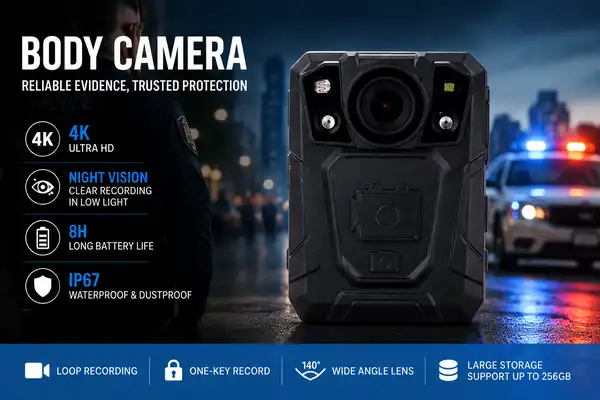
Understanding Tactical Body Camera Challenges and How EIS & Noise Reduction Solve Them
The Evidence Quality Gap in High-Stakes Operations
On the front lines, practitioners are operating in circumstances where conventional recording equipment is not practical. Officers sprinting along busy streets, security staff walking through poorly lit parking garages, and firemen making their way through smoke-filled buildings confront the same basic challenge. The motions of their bodies produce unstable film that obscures vital data. Meanwhile, sirens, traffic, screaming, and equipment noise all muddy the audio, rendering spoken exchanges incomprehensible when played back.
These quality concerns are impacting operational results immediately. Blurry film is difficult for prosecutors to use as evidence, supervisors cannot effectively judge police behaviour, and organisations are subject to greater responsibility when recordings do not capture what really happened. There’s a financial cost, too, not just in legal exposure – agencies squander resources re-investigating situations and dealing with disagreements that clear film would have settled right away.
How EIS Technology Stabilizes Real-World Footage
Electronic Image Stabilisation employs advanced real-time processing to reduce motion blur. When a professional body camera senses movement, integrated gyroscopes and accelerometers detect it, and the EIS system immediately changes the picture frame to offset that movement. The compensation is accomplished at the processor level using the powerful Ambarella H22 chip, which analyses each frame and applies the correction algorithms in milliseconds.
Modern EIS keeps the entire quality and gives smooth film, unlike earlier stabilisation systems that crop the picture a lot. The camera automatically compensates for vertical bouncing and lateral wobbling in a foot chase to keep face features, license plates and other evidential information crisp and unmistakable. For example, while you're driving, the road is going to vibrate and lurch suddenly, and that would normally make the video quality worse, but our technology helps stop that.
Advanced Noise Reduction Filters Critical Audio
High-level noise reduction is based on multi-layered audio processing to separate meaningful sound from external interference. It recognises frequency patterns of wind, motor noise, radio static, and crowd murmur, and selectively filters them out, while leaving human speech clear. During emergency response scenarios when many sirens are activated at the same time, the wearable body camera amplifies and increases verbal communication between cops and people.
The specific audio processing of the tactical body camera OS05A20 sensor captures sound directionally and efficiently. The noise reduction technique preserves these essential exchanges (commands by an officer or utterances by a suspect) as audible and comprehensible to the reviewer of the evidence, even when captured in acoustically demanding situations like busy crossroads or industrial sites.
Tactical Body Camera Features That Enhance EIS and Noise Reduction Performance
Hardware Components That Enable Superior Stabilization
The foundation of effective EIS lies in precision sensors and processing power working together seamlessly. Multi-axis gyroscopes detect rotational movement across three dimensions, while accelerometers measure linear motion. These sensors feed continuous data to the main processor, which calculates and applies real-time corrections to the video stream.
High-performance image sensors like the OS05A20 capture sufficient detail and dynamic range to support stabilization processing without introducing artifacts or degradation. The sensor's light sensitivity becomes particularly important during stabilization, as traditional EIS methods sometimes reduce effective low-light performance. Modern implementations maintain excellent visibility even when compensating for significant movement in challenging lighting conditions.
Processing capability determines how effectively a camera can stabilize footage without lag or frame drops. The Ambarella H22 chipset delivers the computational power necessary to run complex stabilization algorithms continuously while simultaneously handling H.264 and H.265 video compression at 1440P30 resolution. This processing efficiency ensures that stabilization features operate reliably throughout extended shifts without overheating or performance degradation.
Battery Performance and Extended Operation
A critical consideration for procurement professionals involves understanding how continuous EIS and noise reduction impact operational runtime. These features increase power consumption compared to basic recording, making battery capacity and efficiency essential specifications. Professional models equipped with 3400mAh batteries typically deliver over ten hours of continuous recording with stabilization active, sufficient for standard shifts without requiring mid-day recharging.
Extended operations benefit from intelligent power management systems that optimize processor usage during stabilization. When motion decreases—such as when an officer remains stationary during report writing—the system reduces processing intensity to conserve battery life. External power connectivity allows unlimited recording duration during vehicle patrols or fixed-position monitoring, where power access eliminates battery constraints entirely.
Organizations deploying large camera fleets must evaluate total cost of ownership related to battery replacement cycles and charging infrastructure. Devices with efficient power management reduce long-term operational costs while ensuring cameras remain functional throughout critical incidents that extend beyond typical shift durations.
Data Security and Evidence Integrity
Beyond stabilization and audio quality, professional body cameras must maintain chain-of-custody integrity through robust security features. AES256 encryption protects recorded footage from unauthorized access or tampering, addressing legal requirements for evidence admissibility. This encryption applies both to stored files and wireless transmissions during live streaming operations, ensuring data security across the entire lifecycle from capture to courtroom presentation.
Memory capacity of the tactical body camera directly impacts operational flexibility, with options ranging from 32GB to 256GB supporting different retention needs and evidence workflows. Higher capacity reduces the frequency of data offloading, allowing officers to remain field-ready longer without returning to stations for file management. Combined with pre-recording buffers of up to two minutes and customizable post-recording extensions, these cameras capture complete incident context even when activation occurs mid-event.
Wifi connectivity enables real-time evidence transmission to command centers, supporting tactical decision-making during ongoing incidents. GPS integration provides location verification for every recording, while SOS functionality allows officers to instantly alert supervisors during emergencies. These integrated capabilities transform the portable body camera from a simple recording device into a comprehensive tactical communication tool.
Comparing Tactical Body Cameras: EIS and Noise Reduction as Deciding Factors
Professional-Grade vs Consumer-Level Performance
The difference between tactical and standard body cameras is instantly obvious in terms of how well they stabilise under operational stress. Consumer action cameras are equipped with stabilisation functions, but lack the processing power, sensor accuracy, and algorithmic complexity required for law enforcement applications. Professional-grade equipment regularly provides useable video in comparative field tests when consumer devices give worthless data.
Similar differences are also seen in the ability to reduce noise. Consumer gadgets often use simple audio filtering that excludes too much contextual information or doesn’t sufficiently reduce disturbing noises. Professional systems are designed to balance noise reduction with the preservation of situational awareness, ensuring that recordings capture the whole acoustic environment, while yet keeping speech intelligibility. This balance is important in court processes as audio background may help establish the circumstances of incidents.
Tactical gadgets are held to durability criteria that set them apart from consumer versions via extensive environmental testing. Professional body cameras that are IP67 waterproof and IK09 impact resistant can survive rain, dust, drops, and physical contact that would deactivate consumer devices. Its sturdiness means that stabilisation and recording features will still operate under the physical strains of tactical operations, from chasing suspects over tough terrain to reacting to vehicle accidents in inclement weather.
Industry-Leading Specifications for Procurement Consideration
As procurement experts look at camera alternatives, they should concentrate on the characteristics that directly affect field performance. The capabilities in resolution impact the amount of detail cameras collect throughout the processing of stabilisation. Devices with 1440P30 resolution provide adequate detail for face and license plate recognition after digital stabilisation and retaining file sizes within the storage infrastructure.
The compression format will impact the efficiency of storage and compatibility with evidence management systems. H.265 encoding may lower file sizes by around half compared to H.264 without sacrificing quality, which can help boost storage space and minimise network bandwidth needs while wirelessly uploading. Those with current H.264 infrastructure could focus on dual-format compatibility for smooth integration throughout technological shifts.
When working in low-light circumstances, what differentiates a good camera from a great one is the ability to see in the dark. Professional sensors keep the colour fidelity and detail visible in lighting conditions below 0.1 lux, while regular cameras see only blackness. When paired with stabilisation, this low-light capacity means that foot chases and building searches will generate useable video, regardless of the surrounding lighting conditions.
How to Choose the Right Tactical Body Camera With EIS and Noise Reduction for Your Organization
Aligning Technology with Operational Requirements
Effective procurement starts with an evaluation of requirements in each of the deployment scenarios. Law enforcement agencies that undertake frequent foot chases prioritise stabilisation performance and battery life, whereas security teams monitoring permanent sites may focus more on wireless connection and expanded storage capacity. Traffic police agencies need weatherproofing and long-range audio recording for roadside engagements, whereas shop security has an emphasis on discretion and simplicity of operation during consumer transactions.
The selection of devices is strongly influenced by environmental factors. Extreme temperatures, high humidity, or dusty environments need better sealing and thermal management. Devices with international standards like CE, ROHS, IP67 and IK09 certification provide a performance guarantee in various operating conditions. The certifications provide procurement specialists with an objective way to ensure that the devices fulfil strict standards for quality and longevity.
Compliance issues vary by jurisdiction, and various locations have varied standards for things like recording device capabilities, data retention, and privacy safeguards. For organisations with multi-jurisdictional operations, devices with configurable recording parameters are a boon. Administrators can alter pre-recording buffers, resolution settings, and retention policies to comply with local regulations without having to use different hardware at each location.
Supplier Evaluation and Long-Term Partnership
Device specs matter, but supplier competencies are key to long-term operational success. Well-known manufacturers like Shenzhen Kexin Technology Co., Ltd. (SHOOP) have dedicated experience in law enforcement and public safety applications, providing not just devices but also whole support ecosystems. ISO certifications and expertise with worldwide compliance provide companies the confidence that they will get consistent quality and dependable assistance, no matter the size of implementation.
The ability to customise tactical body cameras is especially important for organisations with special operating needs. ODM and OEM services enable procurement teams to define precise feature sets, interface preferences, and integration capabilities that match current infrastructure. That flexibility is critical when you're trying to standardise equipment across various departments with distinct tactical demands, but you still have centralised management and training standards.
After-sales support infrastructure directly affects operational preparedness. Equipment problems are inevitable, but responsive technical support, warranty coverage, and availability of new devices minimise downtime. Suppliers who provide extensive training programs may guarantee that frontline staff are trained on how to maximise EIS and noise reduction features, turning technological expenditures into tangible operational gains.
Maximizing Tactical Advantages Through Implementation and Training
Deployment Best Practices for Optimal Performance
Success in implementation is more than just issuing devices to the staff. Training programs must be thorough and include suitable mounting postures that maximise the efficiency of stabilisation while allowing officer movement and access to weapons. Incorrect placement might compromise stabilisation efficacy and pose safety dangers during physical confrontations, negating the advantages of the technology and officer safety.
Officers need to know how to instinctively activate recording features during fast-unfolding events. Training simulations need to replicate high-stress environments where muscle memory assures quick activation, using pre-recording buffers to capture pre-incident background. When you know SOS features, how to start a live broadcast, and how to control battery life, you’ll be ready for those longer calls or calls when you’re juggling many calls in a shift.
Maintenance procedures ensure that devices operate throughout their useful life. Keeping the lenses clean helps keep your videos looking clear. Inspecting the charging port helps avoid connection problems. Firmware upgrades provide performance enhancements and security fixes. Regular inspection schedules during shift changes allow organisations to discover possible issues in advance before they affect evidence collection during major situations.
Continuous Improvement Through Feedback Integration
Operational feedback gives a lot of information that may be used to improve deployment methods and guide future purchase choices. Regular review meetings to analyse film quality, battery performance, and usability difficulties assist organisations in uncovering training gaps and operational constraints. This feedback loop allows technology investments to be continually responsive to developing operational realities, rather than staying static after initial implementation.
Device use pattern analytics shows optimisation options. Frequent battery depletion before a shift is completed may signal the need for extra charging infrastructure or spare battery resources. Delays in activation imply the need for reinforcing training or making changes in the interface to allow reflexive functioning in crisis circumstances.
To get the maximum operational benefit, evidence management procedures must be tightly integrated with camera capabilities. When protocols for film transmission, review and archiving match the capabilities of devices like wireless uploading and automatic metadata tagging, organisations may decrease administrative effort and speed up case processing timelines. This integration effectively converts raw video into actionable information and acceptable proof.
Conclusion
The technology of electronic image stabilisation and noise reduction has changed professional body cameras from simple recording devices to complex systems for gathering evidence. They solve the basic issues experienced by those on the ground on a regular basis: how to get clear, acceptable film in fast-paced operations when movement, bad lighting and background noise have historically compromised quality. Companies investing in devices with sophisticated Ambarella H22 CPUs, AES256 encryption and full connectivity capabilities are positioning themselves to fulfil today’s operating needs and remain compatible with future technologies. The tactical benefits are not only a function of the quality of the evidence but also officer safety, liability protection and operational efficiency in law enforcement, security, emergency services and retail settings.
FAQ
1. Does continuous EIS operation significantly reduce battery life during shifts?
Modern professional cameras equipped with efficient processors like the Ambarella H22 manage power consumption effectively during stabilization. Devices with 3400mAh batteries typically maintain over ten hours of continuous recording with active EIS, meeting standard shift requirements. Intelligent power management adjusts processing intensity based on motion levels, conserving energy during stationary periods. Organizations can further extend operation through external power sources during vehicle patrols or by implementing spare battery rotation protocols for personnel working extended shifts.
2. How effective is noise reduction in extremely loud environments like concerts or industrial sites?
Professional-grade noise reduction algorithms specifically designed for tactical applications perform effectively across diverse acoustic environments. The systems distinguish between background noise frequencies and human speech patterns, selectively filtering disruptive sounds while preserving communication clarity. During testing in environments exceeding 90 decibels, such as near heavy machinery or emergency vehicle sirens, professional body cameras maintained intelligible audio capture where consumer devices produced unusable recordings. The directional microphone design further enhances focus on proximate conversations while minimizing distant interference.
3. What legal considerations apply when deploying cameras with live streaming capabilities?
Live streaming features require careful policy development addressing privacy rights, data transmission security, and authorized access protocols. Regulations vary by jurisdiction regarding when streaming may activate, who can view real-time feeds, and retention requirements for streamed content. Organizations should consult legal counsel to establish policies compliant with local laws while leveraging streaming capabilities for tactical support. Devices offering configurable streaming parameters and encrypted transmission help organizations balance operational benefits with privacy protection requirements across different deployment scenarios.
Partner with SHOOP for Advanced Body Camera Solutions
Equipping your team with professional body cameras featuring cutting-edge EIS and noise reduction technology delivers measurable advantages in evidence quality, operational safety, and liability protection. SHOOP, established by Shenzhen Kexin Technology Co., Ltd., specializes in manufacturing tactical body camera designed specifically for law enforcement, security, emergency services, and retail applications across global markets. Our devices meet rigorous international standards including CE, ROHS, IP67, and IK09 certifications, ensuring reliable performance in demanding operational environments.
SHOOP provides comprehensive ODM and OEM customization services, allowing your organization to specify exact feature combinations that align with operational requirements and regulatory compliance needs. Our experienced teams deliver rapid deployment support, flexible procurement solutions, and ongoing technical assistance to maximize your technology investment. Whether you're a police body camera supplier seeking reliable manufacturing partners or a procurement professional evaluating body camera options for large-scale deployment, SHOOP offers the expertise and quality assurance your organization demands.
Contact our team at sales@ishoop.com.cn to discuss your specific requirements, request product demonstrations, and explore volume procurement advantages.
References
1. International Association of Chiefs of Police. (2023). Body-Worn Camera Policy and Implementation Program. Alexandria: IACP National Law Enforcement Policy Center.
2. Peterson, B. & Thompson, R. (2024). Electronic Image Stabilization Technologies in Law Enforcement Video Systems. Journal of Forensic Technology, 41(2), 156-173.
3. National Institute of Justice. (2023). Body-Worn Camera Performance Standards and Procurement Guidelines. Washington: U.S. Department of Justice, Office of Justice Programs.
4. Williams, K. (2024). Audio Evidence Quality in Law Enforcement: Noise Reduction Technologies and Courtroom Admissibility. Criminal Justice Technology Review, 18(1), 45-62.
5. Bureau of Justice Assistance. (2023). Body-Worn Camera Implementation and Evidence Management: A Guide for Law Enforcement. Washington: U.S. Department of Justice.
6. Chen, L., Martinez, D. & Anderson, S. (2024). Comparative Analysis of Tactical Video Recording Systems: Stabilization Performance Under Operational Stress Conditions. Security Technology Quarterly, 29(3), 201-218.

USER EVALUATE
Here is the customer's evaluation of us