



Why Campus Security needs body cameras for safety and visibility
Campus security staff confront unique issues that need current solutions. A campus police body camera is a tool for educational institutions that gives an impartial record, promotes openness, protects both officers and students, and offers verifiable proof when an event occurs. Specialised wearables record high-resolution audio and video during patrols, investigations, and emergency responses, ensuring responsibility while developing confidence within the academic community. Unlike traditional surveillance systems, body-worn cameras monitor officers, capturing interactions in real time and providing evidence critical in disputes, Title IX investigations, or active threat situations.
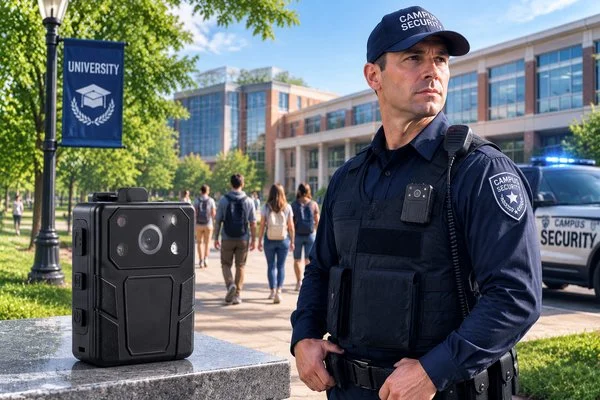
Understanding Campus Police Body Cameras: Features and Benefits
Campus law enforcement functions in a very different context than municipal cops. Schools have a varied population, major events, and have to be mindful of student privacy issues. Body-worn cameras for campus security meet these unique demands with specialised features and capabilities.
Essential Technical Features for Campus Environments
Modern recording equipment for campus cops includes a number of important characteristics. The lens has a wide angle of 140 degrees and offers complete coverage in crowd control situations so that nothing will be missed. The camera is powered by a 4000mAh lithium battery and can record continuously for 10 hours, enough to cover a complete patrol shift. The IP67 waterproof designation allows it to operate in severe weather, whether cops are patrolling during rainstorms or responding to situations near water features.
The capacity to see in the dark allows operations to continue beyond daytime hours. With advanced infrared lighting, you can identify faces as far away as 15 meters in utter darkness, giving obvious identification in poorly lit parking garages, dormitory pathways or school perimeters after dark. An LCD monitor at 2 inches enables cops to rapidly check the film to ensure crucial occurrences have been accurately captured before leaving a location.
Key Benefits for Educational Institutions
Wearable recorder increases campus security. Knowing they are being videotaped deters undesirable conduct since individuals are less inclined to fight. The camera provides impartial evidence to resolve disputes quickly, protecting institutions from unfounded claims and holding police accountable.
Quality of documentation influences law. H.264 video compression cameras allow organisations to save evidence longer by balancing clarity and storage. The embedded watermark technology captures user ID, time, and date into video files, creating tamper-evident recordings that last through legal proceedings. This verification is essential for compliance and legal protection.
Transparency builds academic-campus security trust. Students, academics, and staff trust security operations more when all contacts are recorded without prejudice. Trust-building reduces stress during enforcement and promotes investigative teamwork.
Operational Advantages for Security Teams
Features are developed to meet the workflow needs of campus cops. One-button record activation means immediate documenting when circumstances evolve swiftly without fumbling with complicated controls during vital periods. The pre-record feature records 15-seconds of film before activation, keeping critical context that could otherwise be lost. Post-record settings allow recording to continue for a user-defined time after pressing the stop button, to ensure thorough preservation of event outcomes.
The 360-degree rotating clip of the campus police body camera offers versatile mounting choices, giving cops the ability to place cameras exactly where they want when mounted to uniforms, tactical vests, or specialised equipment. This flexibility allows diverse body shapes and assignment tasks, from bicycle patrol officers to plainclothes investigators. When you have GPS capability on, you get route documentation that is helpful for accountability audits and incident reconstruction.
Addressing Legal and Privacy Concerns in Campus Police Body Camera Deployment
Educational institutions face difficult regulatory environments when employing recording technology. Student information protections are strictly regulated by federal rules such as FERPA. State laws differ widely on how they address monitoring and consent requirements.
Regulatory Compliance Strategies
Successful implementation starts with sound policy formulation. Institutions need clear procedures for recording, including when it is required, when it has to be paused, and how video will be preserved. They must consider the necessity to maintain openness and privacy protection, especially in sensitive areas such as counselling centers, health facilities, or domestic settings.
Compliant operations are built on data security safeguards. The professional equipment is password-protected by the administrator to prevent unauthorised deletion or alteration of files. Role-based control mechanisms make sure that only authorised workers may see video, and audit logs keep track of every access attempt. Data at rest and in transit is safeguarded by AES-256 encryption to help prevent breaches that may disclose protected information.
Retention schedules need to be carefully planned. As a rule, non-evidentiary film is kept for a shorter amount of time, frequently 90 days, but material that may be significant to an investigation or lawsuit must be retained indefinitely. Automated deletion processes decrease liability and storage expenses by deleting film after it has passed its retention obligation.
Privacy Protection Measures
Security measures must be put in place in a way which respects the privacy rights of individuals. Policies should clarify where recording is prohibited, such as locker rooms, bathrooms, or private offices during important talks. Where two-party permission is required by states, officers need clear instructions on when they must tell people about recording status.
Institutions may redact film to protect bystander identity when providing footage for public records requests or internal assessments. The automated blurring of faces and license plates makes the procedure more efficient and cuts down on the human labour that is often necessary for compliance. Such skills are especially beneficial in crowded college environments, where events tend to happen close to bystanders.
Training programs guarantee that officers are well-versed in the technical workings of the technology and the legal parameters of its usage. Regular refresher training ensures teams are up-to-date when rules change, and new case law is created. It's an investment in education that shields schools from responsibility for officer abuse or misunderstanding of recording standards.
Comparing Campus Police Body Cameras: Choosing the Right Solution
Procurement decisions significantly impact operational effectiveness and long-term costs. Campus security leaders must evaluate numerous factors when selecting recording solutions that align with institutional needs and budgetary constraints.
Critical Selection Criteria
Battery performance affects campus police body camera operation. 10-12-hour cameras prevent mid-shift recharge, providing continuous coverage during long events or crises. A 180-minute full charge eliminates shift downtime and facilitates redeployment during multi-day events.
Storage capacity determines how much footage police can store before releasing info. Devices with 32GB to 128GB expandable memory run at different rates. Homecoming and graduation video may use more storage than patrols. To prevent card saturation and data loss, officers verify capacity using visible storage indications.
Durability specifications indicate campus police equipment suitability. Drop-rated gadgets can resist accidental blows during foot chases or fights. While maintaining robustness, 140-gram designs reduce officer fatigue during long use. Designed for reliable operation in challenging environments.
Proof requires audio quality, which is often disregarded during procurement. High-quality built-in microphones capture clear speech during noisy concerts and protests. Multi-directional audio pickup catches speech regardless of speaker position.
Evaluating Manufacturer Support
Outside hardware requirements, vendor capabilities impact deployment. Consumer electronics companies entering security lack operational knowledge compared to law enforcement-experienced manufacturers. Since 2015, ISHOOP has provided body-worn camera expertise to law enforcement organisations in over 30 countries. Solutions will work under pressure with this track record.
Customisation enables institutions to customise devices. OEM/ODM services include branding, feature customisation, and security infrastructure integration. Instead of forcing solutions, flexible solutions show manufacturers care about their customers.
Tech support impacts ownership cost. Comprehensive training, firmware updates, and quick troubleshooting minimise downtime. Warranty coverage protects investment value in large deployments with dozens or hundreds of devices.
Certification guarantees quality and compatibility. CE, ROHS, IP67, and IK09 devices meet global safety, environmental, and durability standards. ISO certification verifies quality management systems that ensure production standards.
Procurement Strategies for Campus Police Body Cameras: What B2B Buyers Should Know
Institutional procurement differs substantially from individual consumer purchases. Campus security administrators must consider not only unit costs but also implementation expenses, training requirements, and ongoing operational costs that determine total cost of ownership.
Vendor Evaluation Framework
Assessing production and market reputation helps discover reliable providers. Companies with dedicated R&D teams improve goods. With competence in body-worn cameras and experienced technical teams, ISHOOP is an electronics domain specialist.
Deliverability affects implementation, because manufacturers with established supply chains can swiftly fill big orders, enabling institutions to adopt campus-wide solutions without long stages—especially when adopting campus police body camera for security or regulatory requirements that require fast delivery.
Budget feasibility is heavily affected by bulk buy price. Volume discounts, multi-year contracts, and flexible payment plans help institutions manage capital spending. Some suppliers provide multi-year financing that matches budget cycles.
Premium and commodity sellers vary in after-sales support. Complete items should include installation, police training, and tech support. Maintenance agreements for repairs and replacements avoid costly surprises. These services benefit institutions without security equipment technicians.
Total Cost of Ownership Analysis
Initial purchase price represents only a portion of lifetime expenses. Storage infrastructure for captured footage generates substantial ongoing costs, whether institutions select cloud-based solutions or on-premises servers. Evidence management software licensing, user training, and system administration require budgetary allocation beyond hardware acquisition.
Replacement cycles factor into long-term planning. Body cameras typically maintain optimal performance for 3-5 years before battery degradation, component wear, or technological obsolescence warrant replacement. Institutions should establish refresh schedules that prevent widespread equipment failure while maximizing asset utilization.
Hidden costs emerge from integration requirements. Cameras must connect seamlessly with existing evidence management systems, computer-aided dispatch platforms, and records management databases. Compatibility issues can generate expensive custom development projects or force workarounds that reduce operational efficiency.
Future Trends and Technology Innovations in Campus Police Body Cameras
New capabilities are altering campus security operations as recording technology continues to evolve fast. Institutions that are developing long-term security policies must understand the developmental trajectories to be able to make investment choices that will be relevant as technology improves.
Artificial Intelligence Integration
AI-powered analytics is the biggest innovation horizon. Its facial recognition technology can identify, in real-time, those subject to active warrants, campus restrictions or missing persons alerts. Though privacy problems demand careful policy construction, the technology provides tremendous capabilities for proactive threat avoidance, not reactive documentation.
Behavioural analysis algorithms may identify signs of distress, hostility or impairment, and alert cops to problems as they are unfolding before they become more serious. Machine learning algorithms trained on large event datasets may spot patterns that humans can not readily see and can provide decision assistance in quickly moving situations.
Tools for automatic redaction are increasingly using AI to help make privacy easier. These technologies automatically detect and obscure faces, license plates, and other personally identifiable information, minimising the human labour needed to meet public records laws.
Enhanced Connectivity and Integration
Live streaming capabilities mean that body cameras are no longer just documentation tools, but real-time situational awareness systems. In an active danger scenario, command staff may see what many officers are seeing in real time, allowing them to better coordinate responses than conventional radio communication. This is possible thanks to LTE and 5G connections even if campus WiFi is not available in some locations.
Cloud connectivity also streamlines evidence management with automated film upload at the conclusion of a shift, removing manual offloading processes that occupy valuable officer time. Automatic backup minimises data loss risks due to device breakage or human mistake. Cloud solutions also provide safe access gateways to share evidence with prosecutors, defence counsel, and supervisory agencies.
Interoperability standards allow cameras from various vendors to function together in common management systems. This flexibility mitigates vendor lock-in and enables institutions to pick best-in-class components instead of settling for single-vendor ecosystems.
Power and Storage Advances
Advances in battery technology expand run time and reduce size and weight. Solid-state batteries might be quicker to charge, last longer and be safer than today’s lithium-ion cells. Eventually, these improvements will permit complete 24-hour recording on single charges, facilitating several shifts or protracted occurrences without power problems.
Storage density is constantly increasing, and high-capacity microSD cards are already being produced with 256GB or more. New storage technologies, including 3D NAND flash, provide more capacity and quicker data transfer rates in a smaller form factor. Combined with modern video compression techniques, these developments make it possible to save months of film on portable devices.
Conclusion
Campus security needs custom solutions that provide the right blend of openness, privacy, and operational efficiency. In educational situations, campus police body cameras provide documentation that protects institutions, police, and community members and builds trust via accountability. Choosing suitable equipment involves assessing technical specs, regulatory compliance features, and vendor support capabilities. Quality recording equipment is an investment that delivers returns in decreased liability, better evidence collection, and greater community connections. As technology continues to evolve, universities that embrace these tools will be leading innovation in campus safety.
FAQ
1. How do campus body cameras differ from standard law enforcement models?
Campus-specific devices emphasize features like FERPA compliance tools, discreet designs suitable for educational settings, and enhanced low-light performance for poorly lit campus areas. They often include specialized privacy controls and integration capabilities with campus security systems that municipal models may lack.
2. What happens if a camera is damaged during an incident?
Professional devices include non-volatile memory that preserves footage even when equipment sustains damage. Auto-save triggers ensure that recordings up to the point of impact are secured. Password protection prevents tampering, while rugged construction minimizes damage likelihood through reinforced housings rated for significant drops.
3. Can officers delete footage directly from the device?
Quality systems prevent direct deletion by officers. Administrator passwords and role-based access controls ensure only authorized personnel through secure backend software can manage footage. This no-delete architecture maintains evidence integrity and prevents destruction of potentially exculpatory or incriminating recordings.
4. How long should institutions retain body camera footage?
Retention periods depend on content and institutional policies. Non-evidentiary footage typically receives 60-90 day retention, while evidence related to investigations, complaints, or litigation requires indefinite preservation. Automated systems can implement these schedules, reducing manual management burden while ensuring compliance.
Partner with SHOOP for Campus Security Excellence
Campus safety challenges require trusted technology partners with proven expertise. SHOOP manufactures professional-grade body cameras specifically engineered for educational institution security teams. Our devices feature 140-degree wide-angle lenses, 15-meter night vision capability, IP67 waterproof protection, and 10-hour battery life—specifications that meet demanding campus operational requirements. With over nine years of manufacturing experience and deployment in 30+ countries, we understand the unique needs of campus law enforcement. Our ODM/OEM customization services, CE and ISO certifications, and comprehensive technical support ensure seamless implementation. Contact our team at sales@ishoop.com.cn to discuss campus police body camera supplier options, bulk pricing, and customized solutions for your institution's specific security requirements.
References
1. International Association of Campus Law Enforcement Administrators. (2022). Body-Worn Camera Policy and Implementation Guidelines for Higher Education Institutions.
2. Smith, J. & Anderson, K. (2021). The Impact of Body-Worn Cameras on Campus Security Operations: A Multi-Institutional Study. Journal of Campus Safety and Security, 18(3), 145-167.
3. U.S. Department of Education. (2023). FERPA Compliance Considerations for Video Surveillance and Body-Worn Camera Programs in Educational Settings.
4. National Institute of Justice. (2022). Body-Worn Camera Technology: Benefits and Implementation Challenges in Educational Policing Contexts.
5. Henderson, M. (2023). Privacy, Transparency, and Technology: Legal Frameworks for Campus Police Recording Devices. Campus Security Law Quarterly, 12(2), 89-114.
6. Campus Safety Magazine. (2023). 2023 Body-Worn Camera Technology Survey: Features, Costs, and Satisfaction Ratings from 200 Higher Education Institutions.

USER EVALUATE
Here is the customer's evaluation of us