



Body-Worn Cameras: The Technology behind the Lens
Body worn cameras are crucial to accountability, evidentiary integrity, and operational openness in public safety and security. These small wearable recorders have revolutionised field operation documentation for law enforcement, security, and emergency services. Wearable recording devices capture high-definition video and audio evidence in real time, enabling accurate event reconstruction, false claims reduction, and institutional credibility in difficult enforcement settings.
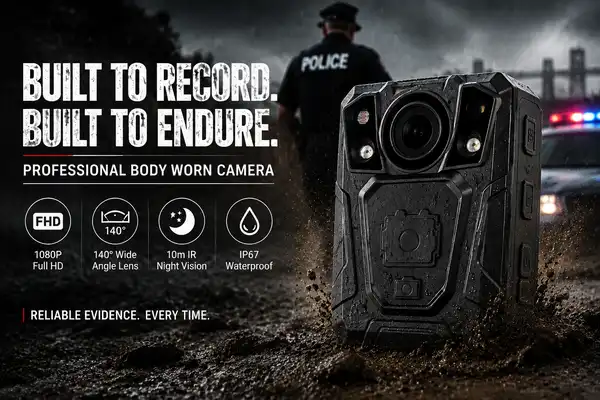
Understanding Body-Worn Camera Technology
Advanced engineering combines mobility and professional performance in wearable recording devices.
Core Hardware Components That Define Performance
Professional wearable recording devices use complex chipset architecture. A high-tech processor like the Ambarella H22 can compress video in H.264 and H.265 codecs. This decreases file sizes while retaining evidence-authentication-critical visual clarity. Despite poor illumination, the OS05A20 CMOS sensor delivers detailed images from 720P to 1440P at varied frame rates. Our 3200mAh power batteries allow cops to record 1080P for over 10+ hours of continuous recording, assuring entire shifts.
Storage flexibility meets different operating needs. Based on expected shift lengths and video quality, organisations may pick 32GB, 64GB, 128GB, or 256GB memory. Wide-angle 140-degree F2.0 lens captures scene context, minimising blind areas that might damage evidence. Infrared lighting improves night vision to 10 meters, allowing face identification in full darkness.
Critical Software Features for Evidence Integrity
Pre- and post-recording capture crucial event moments. These features buffer footage from 5 seconds to 2 minutes before manual activation, preserving context officers may overlook in high-stress situations. Timestamp and GPS watermarking encode tamper-evident information into video files for chain-of-custody verification.
AES256 encryption safeguards critical video during recording, storage, and transmission. Password-protected administrator controls prohibit field deletion, preserving evidence throughout trials. Wireless data offloading to secure servers eliminates workflow delays caused by physical cable transfers using WiFi (2.4G and 5G bands).
Durability Standards for Demanding Environments
Professional wearable recorders must operate in harsh environments. IP67 waterproofing protects against rain, snow, and brief immersion. Drop resistance testing confirms survivability after 200-centimeter falls onto concrete. This sturdy housing can tolerate vibration, temperature extremes, and physical impacts in law enforcement, firefighting, and industrial inspection.
Benefits and Challenges of Body-Worn Cameras in Modern Security Operations
Wearable recording technology improves operations and requires management.
Operational Advantages Across Multiple Sectors
Improvement in evidence quality is the main benefit. High-definition video with synchronised audio captures facial expressions, environmental conditions, and exact verbal exchanges that witness statements miss. This evidence strengthens prosecution and defence equally by reducing subjective recollection.
Deterrent effects of body worn camera improve worker safety. Aggressive behaviour drops significantly while recording is engaged. Video footage speeds complaint investigations and reduces officer-reported violent altercations. When agencies have clear footage review and release rules, transparency builds community confidence.
Retail security utilise wearable cameras to film theft and customer disputes, giving incontrovertible proof that protects staff and organisations from fraudulent liability claims. During training, firefighters study rescue operation film to find lifesaving changes. Medical emergency teams record high-pressure treatment practices to ensure quality and reduce misconduct.
Legal and Compliance Considerations
Different jurisdictions have different privacy laws. In two-party consent states, organisations must get express permission to record private conversations. For legal compliance, restricted recording zones—medical institutions, schools, private residences—require specific operating rules.
Data retention regulations weigh evidence preservation, storage costs, and privacy. Unless marked for investigations or lawsuits, agencies keep film for 60–180 days. International operations are complicated by European GDPR data minimisation and subject access requirements.
Technical and Logistical Management
Multi-shift operations need battery management. To ensure charging rotations, departments need enough devices and docking stations. Firmware changes must be scheduled to avoid operational interruptions. Cloud storage options are flexible but need subscriptions to grow with fleets.
Technical assistance affects long-term TCO. Troubleshooting, replacement, and training resources from responsive manufacturers are more valuable than low-cost options with little post-purchase assistance.
Market Overview and Comparative Analysis of Leading Body-Worn Cameras
Procurement decision-makers evaluate multiple factors when selecting wearable recording solutions for large-scale deployment.
Distinguishing Features Among Market Leaders
Established brands like Axon have built comprehensive ecosystems integrating cameras, evidence management software, and cloud storage subscriptions. Their devices prioritize user interface simplicity and backend integration, appealing to departments seeking turnkey solutions. Motorola emphasizes ruggedization and radio interoperability, targeting agencies with existing communication infrastructure investments. Panasonic focuses on battery longevity and 4K resolution, serving customers prioritizing extended recording times and maximum image quality.
SHOOP positions itself strategically within this landscape by offering professional-grade specifications at competitive price points. Our devices match or exceed major brand technical parameters—Ambarella processors, high-capacity batteries, military-grade encryption—while providing customization flexibility that standardized products cannot accommodate.
Key Selection Criteria for Procurement Teams
Battery endurance versus video quality represents a fundamental tradeoff. Higher resolutions consume more power, reducing recording duration. Organizations conducting shorter shifts may prioritize 1440P quality, while departments with extended patrols benefit from optimized 720P efficiency settings extending runtime to 15 hours.
Integration capabilities of body worn camera determine workflow efficiency. Devices supporting automatic offloading via docking stations save significant administrative time compared to manual data transfers. GPS tracking adds location context valuable for multi-officer coordination and incident mapping. Night vision performance varies dramatically between models—inferior infrared systems fail to capture usable evidence in darkness, undermining investment value.
Warranty coverage and support responsiveness separate reliable partners from transactional vendors. Comprehensive service agreements including rapid replacement, on-site training, and technical consultation reduce operational disruptions and maximize fleet availability.
Procurement Strategies and Best Practices for B2B Clients
Strategic purchase maximises ROI while minimising implementation risk.
Defining Clear Operational Requirements
Assessing needs is key to successful deployments. Organisations should record shift lengths, environmental conditions, integration needs, and storage capacity predictions. These standards help choose models and avoid expensive mid-deployment adjustments.
Pilots verify compatibility before launch. Devices tested in actual operating circumstances show hidden issues—mounting clip durability, button placement ergonomics, wireless connection reliability—that spec sheets cannot foresee.
Leveraging Volume Purchasing and Negotiation
Bulk purchases get big savings and good conditions. As bargaining leverage, procurement managers could seek tiered pricing, longer warranties, and bundled accessories. Multi-year purchasing agreements provide favourable service conditions and budget stability.
Commercial models adapt to financial restrictions. Organisations with unpredictable finances save on initial capital cost using rental agreements. Costs are stretched over operating timescales using financing, boosting cash flow.
Customization and Supplier Selection
Custom hardware and firmware meet operational needs. Agencies may configure buttons, interface languages, video watermarks, and wireless security standards. Spare batteries, mounting clips, and protective cases are packaged to facilitate procurement.
Post-sale assistance should be a supplier assessment priority. Manufacturing companies with US-based technical teams solve problems quicker than offshore-only ones. ISO compliance proves production uniformity, while CE, ROHS, IP67, and IK09 certifications verify quality. Globally distributed companies in 30+ countries demonstrate operational scalability and international support.
IT infrastructure must be considered in integration planning. Costly parallel systems are avoided by compatibility with evidence management, network security, and data preservation standards.
The Future of Body-Worn Camera Technology: Trends and Innovation
Emerging technologies will change wearable recording and procurement.
Artificial Intelligence Integration
Experimental AI features are becoming production-ready. Facial recognition technologies pinpoint people on film, speeding investigations. Weapon draws, vehicle chases, and rising voices trigger cameras to capture without operator intervention. Supervisors must examine emotionally charged encounters identified by sentiment analysis.
These capabilities raise ethical and technological issues. Recognition algorithm bias needs continual evaluation. Device prices and battery usage rise with processing power. Privacy activists want clear surveillance procedures from authorities.
Connectivity Improvements Allow Real-Time Operations
5G network integration turns wearable cameras into live situational awareness tools. Command centers use numerous officer streams to dynamically direct resources during events. Real-time video analytics warn adjacent staff to questionable behaviour trends.
This link demands strong cybersecurity. End-to-end encryption, certificate-based authentication, and intrusion detection safeguard important live feeds.
Battery and Sustainability Innovations
Next-generation power systems reduce environmental impact and lengthen operation. Solid-state batteries claim 50% capacity increases in same form factors. Solar-assisted charging expands distant deployment. Modular batteries allow field changes, reducing downtime.
Manufacturing companies are using recyclable materials and sustainable manufacturing procedures to meet corporate environmental responsibility and disposal requirements.
Conclusion
Wearable recording technology of body worn camera has gone from experimental to operational in law enforcement, security, emergency services, and industry. Modern gadgets' sophisticated CPUs, high-capacity storage, military-grade encryption, and durable build enable dependable evidence capturing in harsh conditions. These systems' performance must be weighed against operational needs, legal compliance, and overall ownership costs. Strategic procurement using volume negotiations, pilot testing, and supplier partnerships maximises investment value. Early adopters will reap operational efficiency and evidence quality benefits as AI, 5G, and battery breakthroughs advance.
FAQ
1. How does video quality affect storage requirements?
Higher resolutions consume significantly more storage capacity. Recording in 1440P generates files approximately three times larger than 720P footage. Organizations should calculate daily footage volume based on officer count, shift duration, and selected resolution, then specify memory capacity accordingly. H.265 compression reduces file sizes by 30-50% compared to H.264 without quality degradation, extending effective storage capacity.
2. Can wearable cameras stream live video to command centers?
Modern professional devices support real-time streaming via WiFi and cellular networks. Our systems transmit 1080P video at configurable bitrates from 300 Kbps to 5000 Kbps, balancing quality against bandwidth availability. Live monitoring platforms enable multi-camera viewing, GPS tracking, and two-way audio communication, enhancing tactical coordination during critical incidents.
3. What maintenance procedures ensure long-term reliability?
Regular firmware updates address security vulnerabilities and add features. Lens cleaning prevents image degradation from dirt and moisture. Battery health monitoring identifies cells requiring replacement before field failures occur. Annual recertification testing validates waterproofing, drop resistance, and recording accuracy, maintaining evidentiary standards.
Partner with a Trusted Body Worn Camera Manufacturer
SHOOP delivers professional-grade wearable recording solutions engineered for demanding security operations. Established in 2015, Shenzhen Kexin Technology Co., Ltd. has built a reputation for innovation, reliability, and responsive customer support across 30 international markets. Our devices feature Ambarella H22 processors, 3200mAh batteries providing 10+ hours of operation, AES256 encryption, and IP67 waterproofing—all backed by CE, ROHS, and ISO certifications.
We offer comprehensive ODM/OEM customization services tailored to specific operational requirements. Whether you need modified firmware, custom mounting solutions, or integrated software packages, our engineering team collaborates closely to deliver optimal configurations. Procurement managers appreciate our flexible commercial models, volume pricing, and technical consultation throughout the implementation lifecycle.
Discover how our body worn camera solutions can enhance your security operations, strengthen evidence integrity, and improve personnel safety. Contact our team at sales@ishoop.com.cn to discuss your requirements and request detailed product specifications. Fast global shipping through DHL, UPS, and FedEx ensures rapid deployment, while our one-year warranty and ongoing technical support protect your investment.
References
1. Miller, L., Toliver, J., & Police Executive Research Forum. (2014). Implementing a Body-Worn Camera Program: Recommendations and Lessons Learned. Washington, DC: Office of Community Oriented Policing Services.
2. White, M. D., & Fradella, H. F. (2016). Stop and Frisk: The Use and Abuse of a Controversial Policing Tactic. New York: NYU Press.
3. Goodall, M. (2017). Body-Worn Cameras and Accountability in Law Enforcement. Journal of Police Science and Management, 19(3), 142-156.
4. International Association of Chiefs of Police. (2019). Body-Worn Camera Model Policy. Alexandria, VA: IACP Law Enforcement Policy Center.
5. Ariel, B., Farrar, W. A., & Sutherland, A. (2015). The Effect of Police Body-Worn Cameras on Use of Force and Citizens' Complaints Against the Police: A Randomized Controlled Trial. Journal of Quantitative Criminology, 31(3), 509-535.
6. Jennings, W. G., Lynch, M. D., & Fridell, L. A. (2015). Evaluating the Impact of Police Officer Body-Worn Cameras (BWCs) on Response-to-Resistance and Serious External Complaints: Evidence from the Orlando Police Department. Journal of Criminal Justice, 43(6), 480-486.

USER EVALUATE
Here is the customer's evaluation of us