



Live Streaming Correctional Officer Body Camera: A Complete Guide for Detention Facilities
Detention conditions must be considered while choosing a correctional officer body cam. Correctional facilities have limited space, variable illumination, and more security concerns than patrols. A functional body camera system must record clear evidence during inmate contacts, cell extractions, and emergencies while enduring physical and environmental difficulties. Procurement teams require devices with high-resolution recording, long battery life, sturdy construction, and secure data management that meets regulatory criteria and protects police and convicts via accurate documentation.
Understanding the Core Requirements of Correctional Officer Body Cams
The Role of Body Cameras in Detention Environments
Body-worn cameras provide objective evidence in conflict-prone prisons. These gadgets safeguard cops against false accusations and ensure professional conduct. Inmates may rapidly settle disputes using video footage of excessive force or wrongdoing. Transparency boosts institutional legitimacy and cuts litigation costs. Camera programs reduce use-of-force instances because cops and convicts change their behaviour when recorded.
Essential Device Features for Correctional Settings
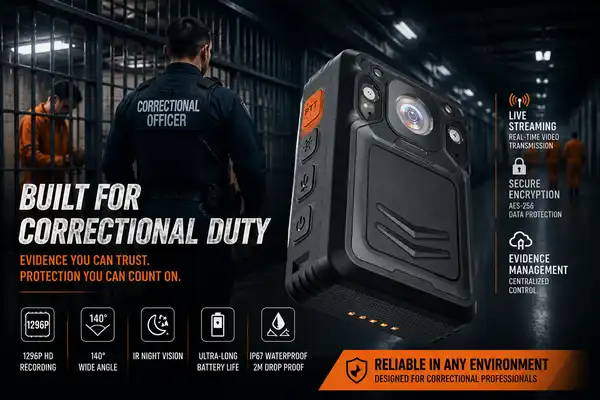
Correctional body cams operate differently from street patrol. Indoor facilities range from well-lit communal spaces to dark cells. Clear recording in low-light conditions requires infrared night vision. ISHOOP's professional-grade cameras include infrared up to 10 meters and visible face recognition to help cops capture situations in poor lighting. The 140-degree wide-angle lens catches cell interiors and hallway contacts without losing peripheral activity that may be important during investigations.
Operating efficiency depends on battery performance. Correctional officers perform 8–12-hour shifts, longer during crises or personnel shortages. Mid-shift camera failures undermine evidence chains and subject institutions to liability. Advanced lithium battery systems record for 10+ hours, ensuring coverage during shifts. ISHOOP devices use a 3200mAh battery for prolonged duration, while audio-only modes enhance runtime when video recording isn't needed.
Correctional cameras are more durable than consumer ones. Officers may fight over cameras that are hit, grabbed, and exposed. Military-grade IP67 waterproofing protects electronics during facility cleaning or yard surveillance. Drop-resistant designs survive high-impact strikes that would damage regular electronics. Reinforced clips in secure mounting systems prevent convicts from pulling gadgets during fights.
Privacy and Legal Compliance
While being transparent, correctional camera systems must manage complicated privacy laws. Recording practices should follow state consent, audio, and film retention requirements. Some cities limit audio recording or require signs. Data encryption and password-protected systems ensure only authorised staff may see important video. AES256 encryption gives critical case departments bank-level protection.
Chain-of-custody requires tamper-proof storage. Professional systems watermark video files with unique identifiers, timestamps, and officer IDs to prevent editing. Centralised management software records every access attempt and video watch. Courts and internal investigations can verify that this audit trail shows evidence was not changed from capture to presentation.
Critical Decision Metrics for Selecting Correctional Officer Body Cams
Video Quality and Recording Capabilities
HD quality turns body camera video from fuzzy recordkeeping to courtroom-ready proof. Modern detention facilities need 30fps 1296P resolution cameras to be able to see face detail and slight movement that standard definition devices cannot see. ISHOOP’s leading CMOS sensor technology delivers best-in-class clarity in difficult lighting conditions, capturing intricate features such as tattoo-identifying markings or illicit objects during searches. The H.264 video standard compresses data without losing quality, such that the maximum storage capacity is achieved while yet keeping the evidential value.
The restricted field of view of a correctional officer body cam doesn’t provide us with as much scene information as the wide-angle lens does. The 140-degree recording angle captures the individual immediately in front of the officer, as well as neighbouring prisoners and ambient conditions. Peripheral coverage has been important during investigations since it may show variables that the officer would not consciously notice in a high-stress scenario. Facilities may choose from a range of recording resolutions to suit their own requirements for quality and storage use.
Battery Life and Power Management
Long battery life removes the fear of dying mid-shift. Facilities should focus on cameras that can record 8+ hours continuously at operational resolution levels. ISHOOP battery solutions provide up to 10 hours of continuous recording with smart power management for longer shift durations. Low-battery warnings enable officers to swap devices or connect external power sources before shutdown. Some of the higher-end versions are compatible with portable power banks, therefore eliminating runtime restrictions during crucial occurrences that need ongoing documentation.
There’s no need to give equal weight to charging infrastructure. Multi-unit charging and data transmission docking stations simplify administrative operations. A facility that operates several shifts should have adequate extra batteries and charging capability to be able to operate 24 hours a day, 7 days a week without running out of devices.
Storage Solutions and Data Management
Storage capacity directly affects operational flexibility. Facilities should compute daily recording volumes depending on officer numbers, shift lengths, and retention procedures. The 32GB storage will allow for around 8 hours of 1080P recording, while the 64GB or 128GB versions give an additional buffer for facilities with longer retention demands or higher quality requirements. ISHOOP cameras provide various storage options from 32GB to 256GB that may be used for a variety of operations, from tiny prisons to huge detention complexes.
Secure storage management protects against accidental deletion and unauthorised manipulation. Professional systems have password protection to prevent footage from being deleted or modified without administrator credentials. Officers can view the recordings, but cannot delete them so that evidence is not compromised. Cloud-based backup methods offer redundancy against loss or destruction of the device, but agencies must consider bandwidth capacity and continuing subscription costs versus security advantages.
Durability and Environmental Resistance
Correctional cameras are beat up in ways that would kill consumer electronics. IP67 certification allows equipment to withstand water immersion and dust exposure typical during facility maintenance. It’s drop-resistant, certified to withstand drops of 2 meters, so that the internal electronics are protected from damage in the case of physical confrontations or accidental impacts. Reinforced mounting methods are not easily removable. These are strong-duty clips or magnetic mounts developed for high-stress scenarios where convicts may try to take items from police.
Non-climate-controlled buildings have an issue with temperature tolerance. Cameras should be designed to work reliably throughout temperature ranges from -20°C to +55°C, whether in refrigerated storage spaces, outside yards in the heat of summer, or unheated locations in the winter. ISHOOP devices are not sensitive to high temperature changes – they can operate reliably under all environmental conditions.
Comparing Market-Leading Body Cam Solutions
Leading Manufacturers in Correctional Technology
Several manufacturers dominate the correctional body camera market, each offering distinct advantages. Axon provides comprehensive ecosystem integration with evidence management platforms, though premium pricing may challenge budget-conscious facilities. Motorola leverages decades of public safety experience, offering rugged devices with reliable performance. Digital Ally focuses on versatile mounting options and competitive pricing structures. ISHOOP distinguishes itself through exceptional value, combining professional-grade specifications with flexible customization options and competitive pricing that accommodates facilities with constrained budgets.
Key Specifications Comparison
When evaluating correctional officer body cam options, compare critical specifications directly. Battery life varies significantly between models—some entry-level devices provide only 4-6 hours of recording while professional units deliver 10+ hours. Resolution standards range from basic 720P to advanced 1296P or 4K, with higher resolutions consuming more storage and battery power. Night vision capabilities differ substantially, with some devices offering limited 3-meter infrared range while advanced models like ISHOOP's provide clear 10-meter visibility in complete darkness.
Warranty coverage reflects manufacturer confidence and long-term support commitment. ISHOOP provides comprehensive 18-month warranty protection, surpassing industry-standard 12-month coverage. This extended protection reduces total cost of ownership by minimizing replacement expenses during the warranty period while demonstrating commitment to product durability and customer satisfaction.
Real-World Performance Feedback
Correctional facilities implementing ISHOOP camera systems report high satisfaction with device reliability and evidence quality. The one-button recording activation proves particularly valuable during emergency situations, allowing officers to begin documentation instantly without navigating complex menu systems. The 2-inch LCD screen provides clear status confirmation, ensuring officers know recording is active through visual, audible, and tactile feedback. This multi-modal confirmation prevents the common problem of officers believing they're recording when devices remain inactive.
Procurement Strategies for Correctional Body Cameras
Assessing Facility Needs and Budget Constraints
Good procurement starts with a realistic evaluation of what you need to run and what money you have at your disposal. Determine the total number of officers. Common shift schedules. Need to deploy at the same time. You need enough cameras to cover a full shift with 15 to 20 officers every shift in a 200-bed facility, with spares for equipment rotation during charging and maintenance. Decide if your facility will need the highest recording resolution or longer battery life, since they may impact model selection and cost per unit.
Budget planning should include the overall cost of ownership, not simply the item purchase price. Include storage media, charging infrastructure, software licensing for evidence management, officer training time, and continuous maintenance. Some suppliers provide whole packages while others charge individually for components, making real costs difficult to compare without careful investigation.
Bulk Purchasing and Flexible Financing
Normally, on volume buys, you get some good savings from the producers. Large-quantity purchasers (20+ units) generally get price savings of 15-30% over smaller-quantity buys. ISHOOP provides reasonable bulk pricing models that assist institutions in stretching their restricted budgets while implementing complete camera programs. Regional buying cooperatives enable smaller institutions to combine orders with neighbouring jurisdictions to get bulk rates not accessible to individual agencies.
Leasing models provide alternate procurement routes for facilities that are constrained by capital. Monthly payment models distribute expenses across fiscal years, avoiding high upfront costs that might overwhelm yearly budgets. Some leases automatically build in tech upgrades every 3-5 years so facilities get the latest gear without worrying about obsolescence. Review lease conditions carefully and calculate total payments vs outright purchase expenses to evaluate whether strategy offers superior long-term value.
Building Supplier Partnerships
In the long run, reliable suppliers provide more value than the first sales alone. Long-standing partners understand the unique demands of your institution and will respond with technical help should challenges emerge. The ISHOOP customer support team provides continuous consulting to assist facilities in optimising camera placement and resolving operational difficulties. Suppliers with deep inventory guarantee that replacement parts are readily available, reducing downtime when devices need to be serviced.
OEM & ODM customisation possibilities for individual facility needs. The ISHOOP technical team works with a customer to tweak a software interface, change recording settings, or add a unique mounting solution. This adaptability allows camera systems to be integrated into existing security infrastructure and operational processes, rather than facilities having to accommodate the restrictions of the devices.
Best Practices to Maximize Body Cam Effectiveness
Policy Development and Officer Training
Policies that are comprehensive articulate clear expectations for use of the camera. Record when police must turn on devices, legitimate reasons for turning them off, and what happens if they break the rules. Be mindful of circumstances such as medical emergencies or confidential informant encounters when recording may not be suitable. Clear rules remove uncertainty and guarantee the guidelines will be implemented the same way no matter the shift or supervisor.
Technical operation and policy compliance need to be included in training sessions. Officers should also get hands-on experience in activating the device, battery management, and basic troubleshooting. Role-playing activities allow workers to internalise activation procedures under high-stress circumstances when cognitive load is greatest. Regular refresher training helps to reaffirm best practices and introduce new features as technology improves.
Data Security and Privacy Protection
Sensitive video is protected by strong encryption against unauthorised access. The data is encrypted with AES256, so even if someone were to intercept it, they would not be able to make use of it without the decryption keys. This is good protection against outside hackers as well as any malicious insider. Have very tight restrictions on access and rules about who sees film and when. Audit trails of all access provide accountability to discourage improper viewing and to record correct management of evidence.
Retention rules must combine legal obligations with storage costs. Most jurisdictions have minimum retention periods for use-of-force events or cases under investigation. Routine film that has little evidential value may typically be destroyed after shorter durations, freeing up storage space. Automated deletion solutions lessen the administrative load while guaranteeing compliance with defined retention periods.
Maintenance and Technology Upgrades
Routine maintenance prolongs equipment life and avoids operational breakdowns. Establish a program for examination of mounting clips, lens covers, and battery connections. Replace worn-out parts before breakdowns occur during key situations. Have enough spare devices to do repairs without leaving cops without equipment.
With technology changing constantly, there are always new capabilities coming along. Keep up with industry trends by joining professional groups and receiving vendor communications. Plan for technology refresh cycles to balance the functioning of existing equipment with greater capabilities of newer equipment. Planning for frequent updates in your budget helps guarantee that your facility does not end up with outdated equipment that ultimately becomes unsupported.
Conclusion
Choosing correctional officer body cam cameras for correctional facilities involves balancing competing priorities, such as video quality, battery life, physical durability, and budget constraints. Successful deployments rely on purpose-built detention devices instead of repurposing ordinary police cameras. Key characteristics include long battery life to enable complete shifts, rugged design to endure physical impacts, good night vision to accommodate different lighting situations, and secure data management to ensure evidence integrity. All of these must-have features are available in ISHOOP professional-grade cameras at reasonable prices, with the flexibility to customise. Thoughtful procurement techniques, thorough procedures and continuous maintenance maximise technology investments while increasing officer safety and institutional responsibility.
FAQ
1. What battery life should correctional body cameras provide?
Correctional cameras should deliver 8-10 hours of continuous recording to cover standard shifts without mid-shift charging. Extended shifts or facilities with limited charging infrastructure benefit from devices offering 10+ hours or supporting external power banks. ISHOOP's 3200mAh battery system provides up to 10 hours of recording, with extended runtime in audio-only modes reaching 11+ hours for maximum operational flexibility.
2. How important is night vision for indoor correctional facilities?
Night vision remains critical despite indoor environments. Cells, segregation units, and utility areas often have minimal lighting. Infrared capability ensures clear recording during nighttime bed checks, emergency responses in darkened areas, or situations where inmates disable lighting. Quality infrared systems provide face recognition at 10+ meters in complete darkness, maintaining evidentiary value regardless of lighting conditions.
3. What certifications should correctional body cameras have?
Look for IP67 waterproofing, military-grade shock resistance, and relevant safety certifications like CE and ROHS compliance. These standards ensure devices withstand correctional environment demands, including moisture exposure, physical impacts, and temperature extremes. ISHOOP cameras meet CE, IP67, and IK09 certification requirements, demonstrating compliance with international quality and durability standards.
Partner with SHOOP for Your Correctional Officer Body Cam Needs
Your facility deserves body-worn camera technology specifically designed for correctional environments. ISHOOP delivers live streaming body camera solutions combining HD recording, real-time video transmission, secure evidence management, and rugged protection for demanding correctional environments.Our 18-month warranty surpasses industry standards, while our experienced engineering team provides OEM/ODM customization, adapting devices to your unique operational requirements. Whether you need comprehensive systems for large detention complexes or focused solutions for smaller facilities, ISHOOP offers flexible configurations from trusted correctional officer body cam suppliers. Contact our team at sales@ishoop.com.cn to discuss your specific needs, request product demonstrations, or receive detailed quotations. We'll work directly with your procurement team to deliver body camera solutions enhancing officer safety, institutional transparency, and operational accountability.
References
1. National Institute of Justice. "Body-Worn Cameras in Correctional Settings: Policy and Implementation Guidelines." U.S. Department of Justice, 2021.
2. American Jail Association. "Technology Standards for Body-Worn Cameras in Detention Facilities." Correctional Technology Journal, 2022.
3. International Association of Chiefs of Police. "Best Practices for Body Camera Deployment in Corrections." Law Enforcement Technology Report, 2020.
4. Bureau of Justice Assistance. "Evidence-Based Practices for Body-Worn Camera Programs in Jails and Prisons." Federal Corrections Technology Review, 2021.
5. National Institute of Corrections. "Body-Worn Camera Technology: Impact on Correctional Officer Safety and Accountability." Institutional Security Research Series, 2022.
6. Correctional Technology Association. "Comprehensive Buyer's Guide for Detention Facility Recording Systems." Professional Standards Publication, 2023.

USER EVALUATE
Here is the customer's evaluation of us