



What to Look for When Buying a Body Worn Camera
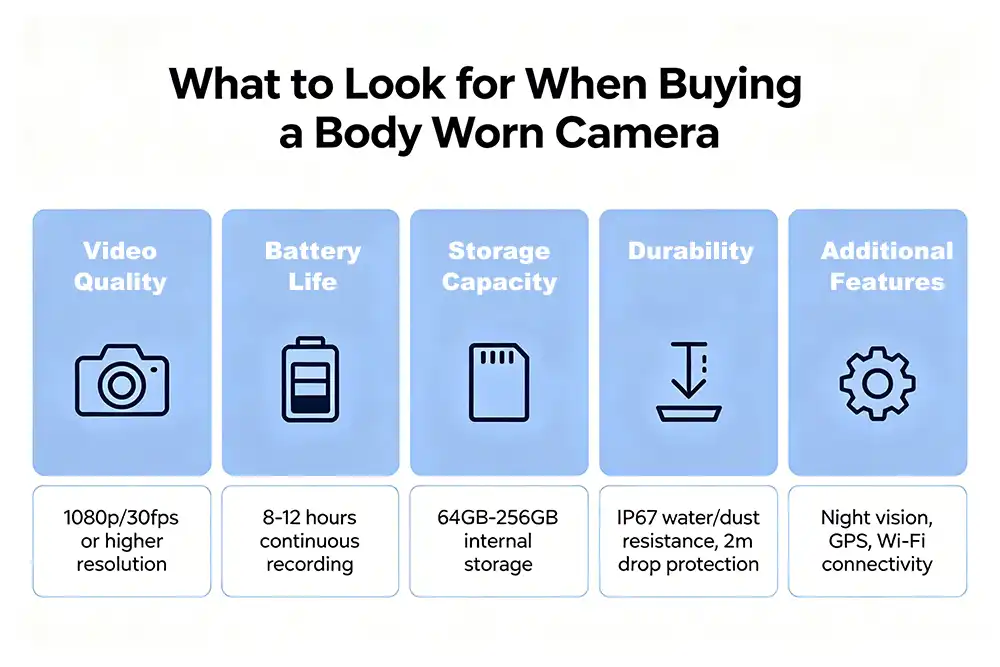
Professionals must examine many key criteria when buying a Body Worn Camera to guarantee it satisfies operational needs. High video resolution, dependable battery performance, robust data security through encryption, appropriate storage space, and durability for harsh conditions are essential for the correct camera. Understand your industry's requirements—law enforcement, security, healthcare, or retail—to limit technological parameters like resolution standards, WiFi and GPS connection, and privacy compliance. Combining these factors with vendor reputation, total cost of ownership, and post-sales support provides long-term value and operational reliability.
Understanding the Core Needs and Use Cases of Body Worn Cameras
To choose the right wearable recording equipment, consider how various professions will utilize it every day. In each business, distinct problems determine what qualities matter most.
Law Enforcement Applications
Recorders let police collect real-time evidence during patrols, investigations, and emergencies. Low light, physical conflicts, and harsh weather commonly characterize these exchanges. Cameras must trigger promptly, record steadily throughout movement, and preserve footage for trial presentation. Video documentation increases openness, accountability, and police and civilian safety by accurately recording events.
Security and Private Sector Use
Continuous incident recording is essential for commercial, residential, transit, and event security personnel. These gadgets assist firms in improving security management and documenting disagreements. Supermarket personnel and security teams use cameras to prevent theft, resolve customer complaints, and maintain order during busy hours. Conflict is typically reduced by deterrence alone.
Key Features to Evaluate When Buying a Body Worn Camera
Technical parameters affect a recording device's professional performance. Careful feature evaluation prevents operational disappointments.
Video Quality and Resolution Standards
Evidence clarity depends on Body Worn Camera video resolution. Modern professional cameras should offer 1080P at 30 fps, while 1440P is better for facial recognition and license plate identification. Professional-grade processors like the Ambarella H22 chipset compress video effectively without compromising image quality. This chipset supports H.264 and H.265 compression, which improves quality at smaller file sizes, increasing storage capacity and lowering video upload bandwidth. Still photography with 4M to 40M megapixels documents scenes and evidence in depth.
Battery Performance and Power Management
Operating reliability depends on battery capacity. A 3200mAh battery can record without interruption for over 10 hours, covering complete shifts. Externally powered devices allow infinite recording from vehicles or fixed situations. Pre- and post-recording buffers—configurable from 5 seconds to 2 minutes—capture important moments before and after manual activation to prevent evidence gaps in high-stress circumstances. These qualities are crucial when cops cannot record immediately following abrupt conflicts.
Comparing Different Types and Models of Body Worn Cameras
Knowing available technologies helps match devices to operational needs. Different models have merits for certain use scenarios.
Connectivity Options and Integration
WiFi devices support remote live video streaming and real-time command. GPS integration tags every recording, helping reconstruct event timelines and coordinate multi-officer responses. Officers can use SOS to send emergency notifications hands-free. Command centers may monitor field conditions in real time using live streaming, increasing tactical decision-making and officer safety. Cameras become active communication instruments with these connection characteristics.
Brand Positioning and Market Options
With complete ecosystem solutions, Axon, Motorola, and WatchGuard dominate North America. Specialized manufacturers like Shenzhen Kexin Technology Co., Ltd. provide competitive solutions with flexible customisation. These manufacturers satisfy CE, ROHS, IP67, and IK09 standards and offer ODM/OEM services suited to regional or organizational needs. Evaluate recognized brands and specialist producers to get the complete range of features and prices.
Procurement Strategies and Vendor Selection for Bulk Purchases
Strategic vendor relationships and buying maximize large-scale deployment value. Effective planning eliminates costly implementation errors.
Supplier Certification and Reputation
ISO, CE, and ROHS certifications show reliable Body Worn Camera vendors meet international quality requirements. Product reliability and support quality are assured by similar company track records. Direct manufacturer contacts offer greater customisation and cost than multi-layer distribution systems. Evaluate supplier financial stability to avoid vendor discontinuity. Examples from similar companies provide real-world performance and support insights.
Financial Considerations and Payment Terms
Sometimes, 20-30% off list pricing is available for bulk orders. Contracting for longer due dates, milestone payments, or performance guarantees enhances cash flow management. Exploring leasing options turns capital costs into operating expenses, alleviating budget limits while retaining technology. Some companies provide outdated equipment trade-ins to defray upgrading expenses. Implementation and budget compliance are easier with procurement financial flexibility.
Best Practices and Considerations for Long-Term Use
Data management, ethics, and technology advancement are needed to maximize equipment value. Sustainability protects investments and ensures compliance.
Secure Data Handling and Chain of Custody
Secure storage, regulated access, and a documented chain of custody are required for Body Worn Camera footage management. Audit trails track every access, and encrypted storage safeguards critical data. Automated retention procedures remove film legally, lowering storage costs and liabilities. Cloud platforms allow accessibility and disaster recovery, while local servers preserve data control. Hybrid methods combine these strengths and handle their drawbacks.
Privacy Considerations and Ethical Use
Smart regulations and training are needed to balance transparency and privacy. Clear procedures for mandated, discretionary, and forbidden recording enable police to handle complicated circumstances. Where legal, public announcement of recording presence shows organizational openness. Employee training on respectful usage and privacy decreases abuse. Community participation in program goals and safeguards promotes confidence. Ethical camera use turns surveillance into a responsibility that benefits everyone.
Adapting to Technological and Legal Evolution
Technology develops quickly—firmware upgrades add features, models increase performance, and standards change. Phased improvements every three to five years extend infrastructure investments and retain competitive advantages. As privacy laws change, operating countries monitor regulatory changes to guarantee compliance. Industry associations alert members to new best practices and technologies. These forward-looking techniques protect investment value and operational efficiency in a changing environment.
Conclusion
Balance technological capabilities, operational needs, and long-term strategy while choosing a recording solution such as a Body Worn Camera. Effective gadgets depend on video quality, battery life, encryption, and environmental resilience. Prioritizing features depends on your industry's needs—law enforcement openness, security incident reporting, or emergency service training. Value is sustained beyond purchase by assessing the total cost of ownership, vendor reputation, and integration capabilities. Data management rules, ethical usage standards, and adaptation techniques extend equipment life and ensure compliance. Purchases become strategic investments in safety, accountability, and operational excellence when partnered with experienced manufacturers that understand these challenges.
FAQ
1. How long should a Body Worn Camera battery last during typical shifts?
Body-Worn Camera batteries should last how long during regular shifts? Professional devices with 3200mAh batteries can record for over 10 hours, covering ordinary shifts without recharging. Environment, resolution, and connection options like WiFi and GPS affect battery life. While driving, devices with external power can record forever. Evaluating your longest normal shift plus a safety buffer assures battery capacity. Some departments keep backup batteries or chargers for longer use.
2. What privacy regulations affect body camera use in the United States?
Privacy regulations vary widely by state and municipality. Many laws limit data retention, demand notification before recording in private settings, and prevent recording children or victims without authorization. HIPAA affects healthcare, while workplace recording regulations influence retail and security. Locally knowledgeable lawyers assure compliance. Reputable suppliers help configure devices for jurisdictional needs. Policies are reviewed often to comply with changing legislation.
3. Can body cameras integrate with existing security systems?
Standard video formats and open APIs allow modern devices to integrate with evidence management, command center, and security infrastructure. GPS integration with dispatch systems tracks position. Monitoring centers get live streaming. Vendor selection should consider system compatibility to avoid integration issues. Many manufacturers provide pilot programs for testing in your infrastructure before large-scale purchasing.
Partner with Shenzhen Kexin Technology Co., Ltd. for Your Body Worn Camera Needs
Body Worn Camera maker Shenzhen Kexin Technology Co., Ltd. has over a decade of expertise servicing law enforcement, security, healthcare, and retail globally. Our gadgets have Ambarella H22 chipsets, AES256 encryption, 1440P resolution, WiFi, GPS, and live streaming. Our CE, ROHS, IP67, and IK09 certifications guarantee worldwide quality. Our ODM/OEM services are customizable to regional needs and operations. We assist companies in deploying dependable recording systems that improve transparency, accountability, and safety with timely delivery, dedicated support teams, and competitive bulk pricing. Sales@ishoop.com.cn can help you meet your procurement goals with a tailored proposal.
References
1. Department of Justice, Bureau of Justice Assistance. "Body-Worn Camera Toolkit: Implementation Guide for Law Enforcement Agencies." Washington: Government Printing Office, 2021.
2. International Association of Chiefs of Police. "Body-Worn Camera Model Policy and Concepts." Alexandria: IACP Law Enforcement Policy Center, 2020.
3. Miller, Lindsay, Jessica Toliver, and Police Executive Research Forum. "Implementing a Body-Worn Camera Program: Recommendations and Lessons Learned." Washington: Office of Community Oriented Policing Services, 2019.
4. National Institute of Standards and Technology. "A Primer on Body-Worn Camera Technologies." Gaithersburg: U.S. Department of Commerce, 2022.
5. Police Foundation. "Self-Awareness to Being Watched and Socially-Desirable Behavior: A Field Experiment on the Effect of Body-Worn Cameras on Police Use-of-Force." Washington: Police Foundation Research Reports, 2020.
6. White, Michael D., and Aili Malm. "Cops, Cameras, and Crisis: The Potential and the Perils of Police Body-Worn Cameras." New York: New York University Press, 2020.

USER EVALUATE
Here is the customer's evaluation of us