



Top 7 Body-Worn Camera Use Cases That Save Lives & Secure Evidence
Body Worn Camera technology has changed how experts in numerous fields film key contacts and preserve evidence. These little recording devices, worn on uniforms or chest mounts, record real-time video and audio for accountability enforcement and training development. Wearable camera systems have protected law enforcement, emergency services, private security, healthcare, industrial staff, and the public. Through clear documentation, the system lowers conflicts, helps with legal procedures, and saves lives through enhanced response protocols and valid records.
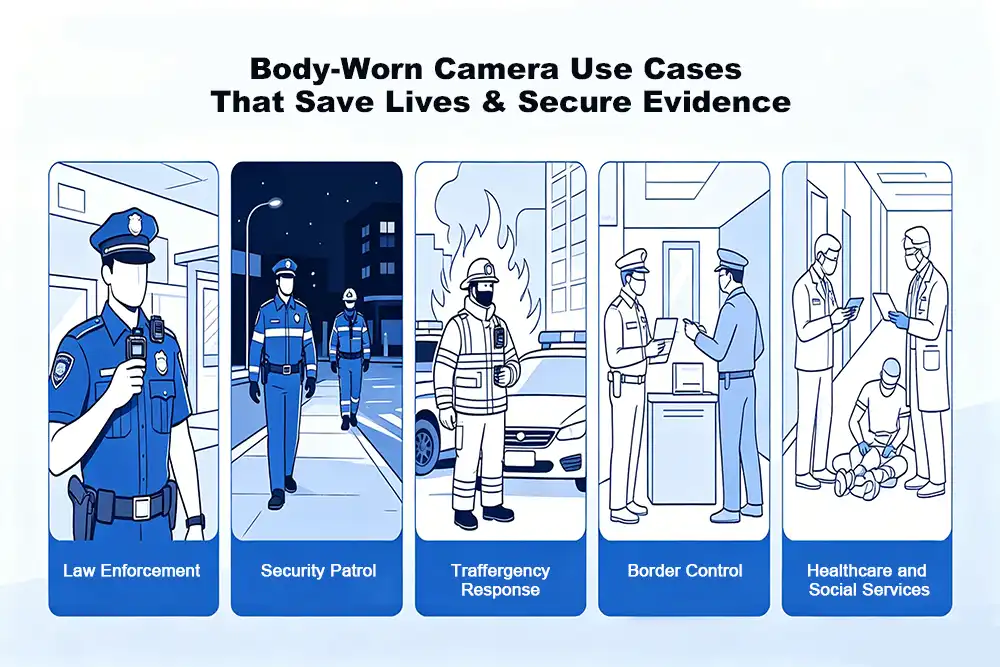
Enhancing Law Enforcement Accountability and Transparency
Modern police need instruments for officer protection and community confidence. Since using wearable recording systems, US law enforcement accountability has improved significantly.
Reducing Misconduct and Building Public Trust
Video evidence shields cops from false charges and holds them accountable. Recording technology reduces complaint rates by 90% in some sectors, said research. When neighborhood members realize interactions are recorded, confrontations lessen, and cops perform more professionally. This understanding makes interactions safer for everyone.
Legal Compliance and Evidence Integrity
Police procurement staff confront hard decisions when choosing equipment. Devices must follow state consent, data retention, and public disclosure laws. Professional cameras use the Ambarella H22 chipset for steady performance over long shifts and AES256 encryption for critical footage. These technological standards comply with legal requirements across countries, protecting departments from compliance failures that might jeopardize cases or subject agencies to responsibility.
Improving Emergency Medical Response and First Responder Safety
Firefighters and EMTs make split-second choices in chaotic, dangerous circumstances. Wearable recording technology aids these experts beyond documentation.
Capturing Critical Incident Data
Rapid changes occur during rescue efforts. Smoke-filled buildings, unstable constructions, and medical emergencies make note-taking hard. Body Worn Camera devices with night vision and great audio record these moments for post-incident investigation. Teams may study film to determine what worked, what didn't, and how to improve future emergency response.
Extended Battery Performance for Long Operations
Emergencies have unpredictable timescales. A 3200mAh battery allows continuous recording for over 10 hours, vital for multi-operational disasters. Even when activation happens after an event begins, pre- and post-recording features (adjustable from 5 seconds to 2 minutes) capture important moments. This enhanced operational readiness lets first responders save lives instead of maintaining equipment.
Securing Evidence in Private Security and Corporate Environments
Private security guards at business buildings, residential communities, transit hubs, and event sites use wearable recording devices to capture their views and interactions.
Deterring Criminal Activity and Workplace Incidents
Visible cameras alone prevent theft, vandalism, and aggression. Individuals reconsider wrongdoing when they know their activities are being filmed. Security guards benefit from this deterrence and false accusation protection. Modern gadgets are lightweight and small, making them pleasant to wear throughout long patrols without hindering mobility or causing weariness.
Secure Data Management for Corporate Compliance
Corporate settings require data privacy compliance. Built-in WiFi allows upload to secure servers, and 32GB to 256GB storage options meet organizational demands. Whether businesses use cloud or local storage, encrypted footage remains intact. In internal investigations, evidence manipulation might skew results.
Enhancing Industrial Safety and Compliance Monitoring
Manufacturing, warehousing, and logistics facilities must meet strict safety requirements that must be monitored. Supervisors and safety officers utilize wearable cameras to check protocol compliance.
Real-Time Safety Protocol Verification
Walking across a factory floor with recording capabilities lets safety staff record infractions instead of taking notes. Workers record good equipment use, ergonomics, and hazardous material handling. Unsafe activities are taught using visual examples rather than abstract discourse.
Integration with IoT and Safety Systems
Monitoring systems are increasingly connected in advanced industrial contexts. Modern Body Worn Camera devices have GPS so they can monitor location during site inspections and collect observations. If incidents happen in remote places, SOS features let personnel notify for help instantly. Comprehensive situational awareness is unavailable from independent systems without integration.
Revolutionizing Traffic Enforcement and Fleet Security
Traffic cops performing roadside stops, accident investigations, and vehicle inspections benefit from perspective-focused recording that dashboard cameras cannot.
Officer Perspective vs. Dashboard Cameras
Dashboard cameras record road views but overlook important interactions beside or behind vehicles. An officer's chest-mounted camera records discussions, document exchanges, field sobriety tests, and suspect behavior from the enforcement perspective that courts value. The personal perspective clarifies contradictory narratives and gives insight that fixed-position cameras miss.
Outdoor Durability and Environmental Resistance
We police traffic in rain, snow, high heat, and freezing. IP67 waterproofing and IK09 impact resistance keep gadgets working when cops need them. The sturdy design resists drops, vibrations, and other hazards that would impair consumer gadgets. Highway patrol officers need dependable documentation from morning briefing to evening shift conclusion.
Supporting Healthcare and Social Services Fieldwork
Wearable cameras assist emergency medical and hospital security staff in meeting specific difficulties while maintaining patient confidentiality.
Protecting Healthcare Workers and Patients
Psychiatric and emergency rooms have higher conflict risks. Recording encounters protects medical workers from hostile conduct and documents patient remarks and situations during crisis interventions. Cameras typically de-escalate difficult situations before physical conflict, making treatment safer.
Privacy and Regulatory Compliance
Healthcare apps must follow HIPAA and patient consent rules. Subtle camera designs reduce psychological impact on fragile patients while filming. Encrypted storage protects health data. Healthcare procurement specialists should favor equipment with granular privacy protections that allow situation-sensitive recording.
Facilitating Audit Trails and Quality Assurance in Manufacturing and Logistics
Supervisors and quality inspectors in production and distribution hubs are wearing Body Worn Camera devices to capture procedures and check standards.
Real-Time Process Monitoring
Quality assurance workers traversing manufacturing lines can record assembly, packing, and material handling processes for verification. Real-time monitoring detects issues before production runs finish. Supervisors analyzing film can detect process breakdowns for targeted changes to prevent recurrence.
Video Analytics and Long-Term Storage
Over time, companies build footage collections. Without manually reviewing hours of film, advanced analytical techniques may identify particular occurrences, safety breaches, and quality issues. High-capacity memory configurations and effective compression formats provide long-term storage for regulatory audits or insurance claims.
Supply Chain Transparency
Documented loading, shipment verification, and delivery confirmation help logistics. Recorded proof settles damage or missing item arguments. Distribution partners like recording because claims can be validated rather than argued, enhancing business ties via responsibility.
Conclusion
The seven use examples show how wearable recording technology may save lives, secure evidence, and improve operational performance across varied professional areas. Reduced liability, improved training, and confirmed responsibility make these devices valuable for law enforcement transparency and industrial safety monitoring. Organisations contemplating adoption should consider battery capacity for shift duration, resolution for evidence clarity, encryption for data security, and durability for environmental conditions. Live broadcasting, GPS monitoring, and expanded storage boost application options as technology advances.

FAQ
1. What features should procurement teams prioritize when selecting cameras for law enforcement?
Battery life of 10 hours allows full shift operation without recharging. 1440P30 HD catches face characteristics and registration plates. Protecting critical evidence from cyberattacks with AES256. Pre- and post-recording features prevent missing important times during delayed activation. GPS and WiFi provide real-time data transfer and position tracking. Durable IP67 waterproofing and IK09 impact resistance endure tough operational circumstances. Suppliers with extensive warranties and timely technical assistance reduce operational interruptions.
2. How do wearable cameras differ from fixed security systems?
Wearable gadgets record first-person views of employees moving around facilities. This mobility records encounters, inspections, and incidents. Portable format suits dynamic situations where staff patrol, respond to crises, or perform field operations. Fixed cameras excel at perimeter surveillance, while wearable devices fill coverage gaps and provide context that stationary cameras cannot.
3. What are the main benefits of using a Body Worn Camera in public safety operations?
A Body Worn Camera helps improve transparency, capture real-time evidence, and support accurate incident documentation. It is widely used by law enforcement, security personnel, emergency responders, and field workers to record interactions, reduce disputes, and enhance accountability. In critical situations, recorded footage can also assist investigations, training, and courtroom evidence management.
Partner with a Trusted Body Worn Camera Supplier for Your Organization
Companies seeking dependable wearable recording solutions may trust Shenzhen Kexin Technology Co., Ltd.'s almost a decade of specialized production. The powerful Ambarella H22 chipset delivers 1440P30 resolution with effective H.264/H.265 compression to increase storage capacity. Each camera is tested for CE, ROHS, IP67, IK09, and ISO certifications to ensure performance in harsh operational situations. We know procurement teams need customized solutions to meet jurisdictional norms and operational procedures. Our ODM/OEM services are flexible and suited to your needs. Our expert engineering and sales teams help you choose specifications, verify compliance, and plan deployment for police, emergency, private security, and industrial safety cameras. Talk to sales@ishoop.com.cn about how our Body Worn Camera manufacturer may help your organization's accountability, safety, and evidence management goals.
References
1. Miller, L., Toliver, J., & Police Executive Research Forum. (2014). Implementing a Body-Worn Camera Program: Recommendations and Lessons Learned. Washington, DC: Office of Community-Oriented Policing Services.
2. White, M.D., & Fradella, H.F. (2016). Stop and Frisk: The Use and Abuse of a Controversial Policing Tactic. New York: NYU Press.
3. Goodall, M. (2017). Guidance for the Police Use of Body-Worn Video Devices. London: Home Office Science.
4. Stratton, G., Powell, M., & Cameron, R. (2017). Body-Worn Cameras and the Criminal Justice System: A Review of the Literature. Australian Institute of Criminology Research Report.
5. Henstock, D., & Ariel, B. (2017). Testing the Effects of Police Body-Worn Cameras on Use of Force During Arrests: A Randomised Controlled Trial in a Large British Police Force. European Journal of Criminology, 14(6), 720-750.
6. Lum, C., Stoltz, M., Koper, C.S., & Scherer, J.A. (2019). Research on Body-Worn Cameras: What We Know, What We Need to Know. Criminology & Public Policy, 18(1), 93-118.

USER EVALUATE
Here is the customer's evaluation of us