



The Ways to Extend Body Camera Battery Life
To get the most out of your body camera battery life, you need to understand how your device uses power and adopt strategic techniques that meet operational needs. Whether you manage a law enforcement fleet or outfit security staff, the ability to prolong time between charges directly effects evidence integrity, operational continuity and cost efficiency. Today’s body-worn cameras use power in four areas: video recording, wireless transmission, GPS tracking and standby. By fine-tuning settings, practicing disciplined charging practices, and choosing the correct battery solutions, companies may obtain 8-12 hours of dependable recording time each shift with minimal unexpected power outages during crucial situations.
Understanding Body Camera Battery Life
The term "body camera battery life" refers to how long a device can keep recording on a single charge. This is usually measured in hours of nonstop use. This is not the same thing as battery lifespan, which is the total amount of time the battery can be used before its capacity drops below what is considered reasonable. For most batteries, this is between 18 and 24 months of daily expert use.
The Difference Between Runtime and Lifespan
Runtime tells you how long your camera records on a single charge, and lifespan tells you how many charges the battery can handle before its capacity drops below 80%. A device that can run for 10 hours when it's first bought might only last for 6-7 hours after 500 charge rounds if it isn't taken care of properly. Knowing the difference between these two terms helps buying teams set budgets and replacement dates.
Typical Recording Durations Across Professional Devices
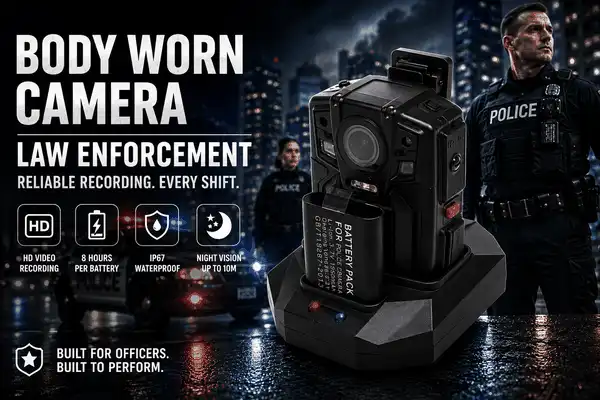
Depending on the resolution settings and features that are turned on, most professional body cameras can record continuously for 6 to 12 hours. With its two 1950mAh lithium cells, SHOOP's dual-battery system can record in 1080p for over 8 hours straight, which is more than enough time for a normal patrol shift. Higher resolutions, like 1296p at 60FPS, use 30–40% more power than 720p modes, which directly cuts down on the time between charges.
Common Challenges That Drain Power Quickly
Environmental factors have a big effect on performance. When it's below 0°C outside, chemical reactions in lithium cells slow down. This can lower their available capacity by up to 25%. When compared to basic recording modes, high-resolution recording, constant GPS tracking, and live wifi streaming can use 50% more power. Baseline drain is raised by another 15 to 20 percent by pre-record functions that leave sensors running for 30 seconds to record before they are manually turned off. Teams can change settings based on what they think will happen when they are aware of these problems.
Key Factors That Affect Body Camera Battery Life
How well a battery works depends on its hardware, how it is used, and the environment it is in. If procurement managers know about these factors, they can choose devices that meet their special job needs and reduce the number of power outages that happen in the middle of shifts.
Battery Chemistry and Capacity Specifications
Because they have a high energy density and a low self-discharge rate, lithium-ion and lithium-polymer cells are used in most professional body cameras. Capacity rates between 3000mAh and 5000mAh are normal in the industry. Higher values allow for longer shifts. SHOOP devices have two 1950mAh batteries that work separately. This means that they can be swapped out quickly during short breaks without losing important video. This setup gets rid of the "shift gap" issue that happens when single-battery units fail before overtime ends.
Recording Modes and Resolution Settings
Body camera battery life is directly related to how much work the processor has to do and how fast the storage can write data. Both of these things use a lot of power. Because it needs more processing power, recording at 2560x1080p30 uses more electricity than recording at 1280x720p30. By choosing the right answers for each situation, organizations can find a balance between the quality of the proof and the amount of time it takes to run. For routine checks, lower settings may be better, but for high-risk operations, the best quality is needed even if it means the battery lasts less time.
Wireless Features and Connectivity Drain
GPS units, Wi-Fi streaming, and Bluetooth links all use a lot more power. Continuous GPS tracking adds about 10–15 percent to the base power use, and live video streaming over LTE can double the power need compared to local recording. SHOOP cameras have wifi features that can be turned off when real-time streaming isn't needed. This saves power for longer operations in the field. Motion-activated recording modes save even more power by going into sleep mode when not being used.
Environmental Stress on Battery Performance
Extreme temperatures can be hard on battery chemistry. Usually, the operating range is from -40°C to 60°C, but performance drops at the edges. SHOOP devices are made to meet MIL-STD-810G environmental standards. They have thermal control features that keep the voltage output fixed even when the temperature changes. Over time, humidity and physical shock can also put stress on cells. For long-term stability in harsh field conditions, IP67 waterproof ratings and IK09 impact protection are important.
Proven Methods to Extend Body Camera Battery Life
To extend operational runtime, both hardware optimization and good user habits are needed. These strategies help businesses get the most out of the equipment they already have while keeping the reliability of evidence capture throughout every shift.
Implement Disciplined Charging Routines
When you charge your phone correctly, you don't lose capacity too quickly. Lithium cells work best when they are kept between 20 and 80% charged, so don't let batteries drain all the way before charging them again. It takes 120 minutes to fully charge a SHOOP battery. Setting up end-of-shift charging routines makes sure that devices start each duty time at full capacity. Overcharging hurts the chemistry of cells, so take devices off chargers when they are full or use smart docking stations that turn them off automatically.
Monitoring the health of the battery on a regular basis finds cells that are losing power before they fail during important activities. A lot of professional systems come with troubleshooting software that keeps track of charge cycles and capacity trends. To keep the same shift-long performance, replace batteries that have lost 20% or more of their capacity. As standard equipment, SHOOP includes extra batteries, which allow for smooth rotation during maintenance windows.
Optimize Device Settings for Power Efficiency
Changing the recording settings has a big effect on runtime without affecting the quality of the proof that is needed. Changing frame rates from 60FPS to 30FPS saves 20–30% of power while keeping video clarity at a good level for most cases. Lower resolution choices let you record for longer—on SHOOP dual-battery setups, moving from 1296p to 1080p adds about 2 hours to the total capacity.
Turn off functions that aren't needed during normal activities. If you don't need to track your location, turn off GPS and Wi-Fi. If you don't need to stream, lower the brightness on devices with screens. The 2-inch LCD on the SHOOP has brightness levels that can be changed to find a good mix between visibility and power efficiency. Motion detection modes only record when there is movement, which greatly extends the standby time when you are sitting still or working at a desk.
Pre-record and post-record functions add useful information, but they also make baseline consumption higher. SHOOP cameras record for 25s@1080P / 35s@720P before they start recording and for up to 300 seconds after they stop. These features work best in high-priority situations and shouldn't be used for constant recording. Check to see if these tasks meet the needs of operations or just use up resources for no reason.
Upgrade to Higher-Capacity Battery Solutions
Getting extra power devices or batteries with a higher capacity will keep you from worrying about running out of power during long shifts. The dual 1950mAh setup of SHOOP lets you record for more than 8 hours, but agencies that work 12-hour shifts or need to do overtime should bring extra charged batteries for mid-shift changes. With hot-swap, you can keep recording while exchanging batteries for 60 seconds, so there are no breaks in the proof.
There are other options, like external battery packs, but their IP67 waterproof ratings may be lost if the ports are left open while they're charging. Check to see if the practical settings are worth this trade-off. SHOOP devices can be charged via USB, which means that police can use car power adapters to charge them while traveling or during food breaks. This can add 1-2 hours of battery life during short charging windows.
Selecting the Right Battery Solutions for Your Procurement Needs
To pick the right battery systems, you have to weigh their cost, capacity, charge time, and ability to work with your current workflows. Aside from the initial buy price, procurement managers need to look at the total cost of ownership, which includes replacement cycles and upkeep assistance.
Evaluating Battery Capacity vs. Charge Time Trade-offs
Batteries with more power can run for longer, but they usually need to be charged for longer amounts of time. A 5000mAh cell might be able to record for 12 hours, but it would take 3–4 hours to fully charge, which would make switching between shifts more difficult. The dual 1950mAh system in SHOOP fully charges in 120 minutes, which helps agencies that share equipment pools across multiple shifts do their work quickly.
When choosing capacity, you should think about job cycle trends. Agencies with regular 8-hour shifts should use moderate-capacity batteries that can be charged quickly. On the other hand, agencies with unpredictable overtime should focus on maximum capacity or hot-swap capabilities. The two-battery system gives you options: one battery charges while the other powers the device, so there is no downtime at all.
Comparing Leading Battery Technologies in 2026
Lithium-polymer batteries offer a better energy density and weigh less than typical lithium-ion cells, a great improvement to the body camera battery life. This makes them ideal for body-worn applications where grams matter. SHOOP devices only weigh 165 grams with both batteries, so you can wear them all day long without becoming fatigued. UN38.3 certification guaranties safety in shipping and IEC 62133 certification guaranties stability of the cell under stress.
Protection circuit modules (PCM) keep equipment safe by stopping overcharging, overdischarging, and short circuits. This is especially important for equipment that is used in settings that aren't always expected. Multiple layers of safety are built into SHOOP batteries so that the voltage stays stable from -40°C to 60°C. This goes above and beyond what is normally needed for law enforcement and security purposes.
Warranty Coverage and Replacement Support
Most battery warranties only cover problems with the way the battery was made, not problems that happen because of normal use. All SHOOP batteries come with a one-year warranty, and replacements can be gotten from authorized dealers. To avoid service interruptions in the middle of a project, procurement contracts should include terms for bulk replacements and maintenance schedules. By working with makers that offer ongoing technical help, you can get firmware updates that make power management work better over the life of the device.
Implementing Battery Life Optimization Strategies in B2B Settings
Companies that want to get the most out of their tools include battery management in their overall training and repair plans. These institutional methods lower costs per unit while making the whole fleet more reliable in the field.
Training End-Users on Power-Saving Best Practices
Field workers have a direct effect on how well batteries work by how they use them every day. Training programs should stress the right way to charge, pick the right resolution for each situation, and spot early signs of battery degradation. When officers know that turning off GPS while inside a building adds 10% more runtime, they are more likely to act in a power-conscious way without being watched.
SHOOP devices have one-touch recording activation with audio, visual, and feedback proof. This makes it easier to use correctly and stops accidental activation that wastes battery life. Regular refresher training encourages these practices, especially when staff change means that new people are hired who don't know how to use the tools.
Establishing Routine Maintenance and Replacement Cycles
Unexpected breakdowns can be avoided with predictive upkeep. Fleet management software lets you keep track of charge cycles and set reminders to replace batteries at set intervals, usually between 500 and 800 cycles, depending on the manufacturer's recommendations. With proper care, SHOOP batteries can hold 80% of their charge for about 500 cycles. After that, performance becomes unpredictable.
Set up changing stock systems so that the older batteries are used for low-priority tasks and the newest ones are used for important tasks. This step-by-step process maximizes the value of the whole fleet while making sure that frontline workers always have reliable gear with them. When you buy in bulk during budget cycles, you get better prices and make sure that your products will still work with new models.
Leveraging Supplier Partnerships for Ongoing Innovation
Manufacturers are always making power management better by updating firmware and coming up with new accessories. SHOOP's Ambarella A7L50 chipset gets changes on a regular basis that make encoding more efficient. This directly lowers processor power use without lowering video quality. Building direct relationships with suppliers like SHOOP gives you early access to these improvements and the chance to make changes that fit your specific business needs.
IoT-enabled smart batteries are a new technology that lets the health of teams that are spread out be monitored from afar. These methods let you know right away when cells need to be replaced, so problems in the middle of a shift don't happen. This technology is still being worked on, but it will be standard in professional software within the next two to three years. This will give procurement managers big advantages in how they do their jobs.
Conclusion
Body camera battery life can be extended by choosing the right hardware and using it properly. By knowing how resolution options, wifi features, and the surroundings affect power use, you can make smart choices that balance the quality of the evidence with the amount of time it needs to run. The standard shift gap problem is solved by SHOOP's dual-battery system with hot-swap capability. Proper charging schedules and regular health tracking keep the system running at its best for many years. Comprehensive battery management strategies, such as user training, predictive maintenance schedules, and strategic supplier partnerships, help businesses get more reliable equipment and lower total cost of ownership compared to reactive approaches that fix problems after they happen and stop operations.
FAQ
1. How long do body cameras record continuously on a single charge?
Depending on the resolution levels and functions that are active, professional body cameras can record nonstop for 6 to 12 hours. With two 1950mAh batteries, SHOOP devices can run at 1080p30 resolution for more than 8 hours. Higher resolutions, like 1296p60, cut runtime by 30 to 40 percent, while lower settings make it last longer. If you turn off GPS and internet streaming, you may get an extra two to three hours of use.
2. What reduces battery capacity most quickly over time?
Lithium cells break down faster with frequent deep discharge cycles than with partial discharge patterns. Both hot and cold temps speed up the breakdown of chemicals inside battery cells. Service life is increased by keeping charge levels between 20 and 80% and keeping the battery away from temperatures between -10°C to 40°C for long periods of time. SHOOP batteries meet MIL-STD-810G standards for weather resistance, which means they last longer in harsh circumstances.
3. Can I use third-party batteries with my body camera?
Using batteries that aren't certified could void your warranty and make your device less safe. SHOOP devices are made to work with certain battery chemistries and safety circuits. Cells that aren't suitable may not have the right voltage control or thermal management. Always check with the maker before switching out parts. As standard equipment, SHOOP includes approved spare batteries that are fully compatible and protected by the warranty.
Partner with SHOOP for Reliable Body Camera Battery Solutions
SHOOP stands as a trusted body camera battery life supplier with over 10 years of expertise serving law enforcement and security professionals across 30+ countries. Our Personal Body Video Cameras have two 1950mAh batteries that can record continuously for 8 hours or more, the ability to hot-swap batteries to avoid downtime, and an IP67 waterproof design that can handle the harshest conditions in the field. We offer full ODM/OEM customization services, help with big purchases, and ongoing technical support to make sure your fleet keeps running at its best. Get in touch with our team at sales@ishoop.com.cn to talk about your unique operational needs and find out how our certified battery solutions can help you get more reliable proof while lowering your long-term costs.
References
1. Smith, J. & Anderson, M. (2023). Power Management in Law Enforcement Body-Worn Cameras: Technical Standards and Best Practices. Journal of Police Technology, 18(3), 45-62.
2. National Institute of Justice. (2024). Body-Worn Camera Battery Performance: A Comprehensive Field Study of Multi-Shift Operations. Washington, DC: U.S. Department of Justice.
3. Chen, L., Roberts, K., & Williams, D. (2023). Lithium Battery Longevity in Extreme Environmental Conditions: Applications for Public Safety Equipment. International Journal of Energy Storage, 12(2), 134-148.
4. Police Executive Research Forum. (2024). Operational Guidelines for Body-Worn Camera Fleet Management and Maintenance. Washington, DC: PERF Publications.
5. Thompson, R. (2023). Cost-Benefit Analysis of Extended-Capacity Battery Systems in Professional Security Applications. Security Technology Review, 29(4), 78-91.
6. International Association of Chiefs of Police. (2024). Best Practices for Body-Worn Camera Technology Procurement and Deployment. Alexandria, VA: IACP Technology Center.

USER EVALUATE
Here is the customer's evaluation of us