



How does AES256 encryption improve body camera data security?
AES256 encryption dramatically enhances body camera data security by employing a military-grade 256-bit cryptographic algorithm that scrambles video and audio files at the moment of capture, rendering them completely unreadable to unauthorized individuals. When integrated into an AES256 encrypted body worn camera, this technology protects sensitive evidence from tampering, unauthorized access, and data breaches throughout the entire chain of custody—from recording through storage and courtroom presentation. This level of protection ensures compliance with strict regulations like CJIS and GDPR while safeguarding the integrity of critical footage used in legal proceedings and accountability reviews.
Understanding AES256 Encryption in Body Worn Cameras
A lot of security directors and procurement managers can't sleep at night because they're worried about data security. When footage is hacked, it can destroy whole departments and organizations by causing them to lose evidence, become legally responsible, and lose the public's trust.
What Makes AES256 Different from Standard Encryption
Because it is so fast, AES256 encryption is different from past ways. The 128-bit key in AES128 has 3.4 × 10³⁸ possible combinations. The 256-bit key in AES256 has 1.1 × 10⁷⁷ possible combinations. With today's supercomputers, it would take billions of years to decrypt a single protected file. This means that brute-force attacks are almost impossible.
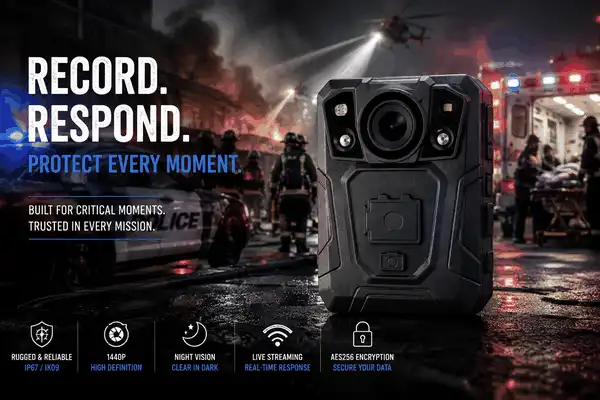
The Ambarella H22 chipset, which has specialized cryptographic engines, is used by the AES256 encrypted body worn camera to do this encryption. This hardware-based method encrypts data without slowing down recording or draining the battery. This lets cops record high-resolution 1440P video while also providing military-grade security for every frame.
How Encryption Works During Recording and Storage
As soon as you press the record button, the encryption process starts. Our system scrambles data into jumbled binary code as the OS05A20 sensor records video in real time, before writing it to the memory card. Even if someone steals the AES256 encrypted body worn camera during an incident, the evidence will still be safe because of this instant protection.
There are different sizes of storage—32GB, 64GB, 128GB, or 256GB—but they are all encrypted using the same strong protocol. The H.264 and H.265 compression formats work well with encryption, so files stay small and fast without losing their safety. The timestamp, GPS coordinates, and user ID that are added as watermarks are all encrypted the same way the video itself is.
Key Management and Administrative Controls
Professional systems are different from consumer-grade devices because they use secure key management. Digital Evidence Management Systems (DEMS) handle encryption keys by securely injecting them during docking, and our cameras work with DEMS. The device never shows keys in plain text, so even if someone takes apart the hardware, they can't get the keys out.
Controls at the administrative level add another level of security. PC management software can be used to set up password security that limits who can delete files or change settings. The system keeps a record of all attempts to access it, which helps with the chain-of-custody rules that courts and prosecutors use in trials.
Why AES256 Encryption is Essential for Body Camera Data Security
A city police force lost an unsecured AES256 encrypted body worn camera at a protest last year. Within hours, private video clips went online, showing the faces of trusted informants and how they were used. The lawsuit that followed cost taxpayers $2.3 million and ruined years of work to improve relations in the community.
Real Threats Facing Unprotected Body Camera Footage
Thievery is only one type of weakness. According to FBI cybersecurity assessments, attacks on law enforcement networks have grown by 73% since 2020. Hackers specifically go after AES256 encrypted body worn cameras because the video contains useful information, like the layout of homes during domestic calls, patrol trends, and information that can be used to identify officers.
Another very serious risk is changing data. Without encryption, suspects or bad actors inside the company can change footage to get rid of evidence that could be used against them or to make up claims of misconduct. Concerns about validity mean that courts are rejecting unencrypted video as proof more and more, which goes against the whole point of body camera programs.
Meeting CJIS and GDPR Compliance Requirements
All criminal justice data, both when it's being sent and when it's being stored, must be encrypted according to the Criminal Justice Information Services (CJIS) Security Policy. Our AES256 encrypted body worn cameras meet FBI technology requirements, so agencies can stay in line with CJIS without having to use complicated workarounds or spend a lot of money to rebuild their systems.
European law enforcement and foreign security companies now have to follow more GDPR rules to protect video-captured personal data. AES256 encryption meets the "appropriate technical measures" needed by GDPR Article 32. This protects businesses from fines of up to 4% of their global revenue for failing to protect data.
Building Public Trust Through Transparent Security
When people are afraid that their conversations might get out online, community trust falls quickly. When your department sets up AES256 encrypted body worn cameras that can secure data, you show that you are serious about protecting privacy. This kind of technological accountability makes community relationships stronger than policy promises alone.
Our devices support this openness with features that make it impossible to change them and full audit logs. Every file has watermarks that show the time of capture, the officer's ID, and the GPS location. These are details that can't be changed because the files are encrypted. Defense lawyers and civil rights activists are becoming more and more aware that encryption is necessary for managing evidence in a trustworthy way.
Comparing AES256-Encrypted Body Worn Cameras to Other Encryption Solutions
When you know how different encryption levels and methods actually work, it's easier to make decisions about what to buy.
AES256 Versus AES128: Security Strength Analysis
Many commercial applications can be safely encrypted with AES128, but law enforcement has to deal with threat actors at the state level who are very good at what they do. AES256 has a much wider range of possible encryption keys, so video will be safe even as computers get smarter and new threats like quantum computing appear.
With today's hardware, the differences in performance are almost invisible. When compared to AES128 versions, our Ambarella H22 chipset can handle AES256 encryption without frame drops or higher power use. Even with full encryption turned on, the 3200mAh battery still lets you record in 1080P continuously for over 10 hours, which is the same or longer than competitor models that aren't protected.
Software Versus Hardware Encryption Architecture
When you secure data using software, the device's operating system handles it. This means that malware, OS bugs, and more complex attacks that target the software layer can get through. When hardware encryption is used at the chipset level, it works without the OS and protects against software-based threats.
The ISHOOP system encrypts RTSP streaming data, saved files, and information all at the same time using hardware-accelerated cryptography. This all-around method keeps both live-streamed video to command centers and stored proof safe, closing any security holes that thieves or attackers could use.
Risk Assessment: Encrypted Versus Non-Encrypted Models
When departments use AES256 encrypted body worn cameras that aren't encrypted, they are taking on more and more risk. More and more, courts are holding government agencies responsible for data breaches that could have been avoided if they didn't use available security technology. Insurance companies now take encryption skills into account when they figure out risk premiums.
Think about operational costs that go beyond the purchase price. Legal fees, settlements, and lost prosecution cases can add up to hundreds of thousands of dollars for just one investigation that is hacked. The extra money spent on AES256 encrypted body worn cameras lowers risk in a way that can be measured by city managers and financial officers during budget reviews.
Procurement Considerations for AES256 Encrypted Body Worn Cameras
There are more technical and practical factors to consider than just encryption specs when choosing the right AES256 encrypted body worn camera system.
Certification Standards and Regulatory Compliance
Check that the gadgets you buy meet foreign safety standards like CE and ROHS. Our AES256 encrypted body worn cameras have been certified as waterproof to IP67 and impact resistant to IK09. This makes sure that the security hardware can handle the harsh conditions that police have to deal with. These certifications prove that security parts stay working even after being dropped, submerged in water, or exposed to extreme temperatures.
ISO compliance shows that quality control in manufacturing affects how well encryption works. As SHOOP, Shenzhen Kexin Technology Co., Ltd. keeps its ISO certification up to date for all of its production processes. This makes sure that every unit that leaves our plant has the same level of cryptographic performance.
Integration with Existing Digital Evidence Systems
If it works with your current DEMS infrastructure, you won't have to pay a lot of money to update the whole system. Our AES256 encrypted body worn cameras work with standard protocols, such as HTTPS safe server connections and USB 2.0 transfers that don't need a driver to work, even when encryption is active. This adaptability makes it easy to connect to Axon, Motorola, and other evidence handling systems.
Using both 2.4G and 5G frequencies for WiFi connection and channels that can be changed lets you install WiFi in a way that works with your current network infrastructure. The AES256 encrypted body worn camera manager software lets you change the WiFi SSID, passwords, endpoint IP addresses, and device IDs from afar. This makes fleet management easier for big deployments that span various locations or laws.
Battery Performance and Operational Efficiency
Power needs to be stable for long shifts. With GPS and WiFi turned on, our 3200mAh battery can record in 1080P for 12 hours, so officers can work their whole shifts without having to take breaks in the middle of the day to charge their AES256 encrypted body worn cameras, which could leave gaps in the evidence. The four-hour charging time lets normal plans allow for overnight return.
Supplier Reliability and Long-Term Support
Work with well-known makers that have a history of doing good work. SHOOP was founded in 2015 and only makes and develops AES256 encrypted body worn cameras. This gives them a level of focused expertise that other electronics companies can't match. Our experienced research and development team is always making improvements to how encryption is used while keeping existing systems compatible.
Customization options through ODM and OEM make it possible to create solutions that are perfect for each agency's needs. Our engineering team can change our encrypted platform to fit your needs without affecting its core security. This includes adding custom watermarks, special mounting hardware, or the ability to work with your own communication systems.
Future Outlook: The Role of AES256 Encryption in Evolving Body Camera Technology
Even though technology changes quickly, strong encryption is still needed for new features to work. It is not being replaced by them.
AI Integration and Enhanced Privacy Protection
More and more, artificial intelligence is being used to process AES256 encrypted body worn camera video for automatic removal of inappropriate content, face recognition, and incident classification. For analysis, these AI systems need to be able to access video that isn't encrypted. This makes security more difficult. In the future, encryption architectures will include safe areas where AI can work on encrypted data without showing plaintext footage. This will keep both functionality and security.
Through agreements with AI developers and cryptography experts, SHOOP is constantly working on these next-generation features. As part of our plan, we will keep AES256 security in place and enable intelligent video analysis. This will speed up the review of evidence and protect privacy by automatically masking witness faces and private data.
Cloud Storage and Distributed Security Models
Cloud-based evidence storage has operational benefits such as unlimited storage space, backup in case of disaster, and access from anywhere. Moving encrypted footage to the cloud, on the other hand, needs careful key management to keep cloud providers from viewing cleartext video while still letting authorized organization users in.
Our encryption architecture works with hybrid deployment models, in which AES256 encrypted body worn cameras encrypt video with keys controlled by the organization before sending it to the cloud. This method stops everyone, even the cloud service provider, from seeing video material. This eases worries about unauthorized access to data by third parties while still allowing the benefits of cloud scalability.
Regulatory Evolution and Increasing Security Requirements
Privacy laws are getting stricter around the world because people want more protection for personal information that police collect during interactions with them. California recently passed a law that requires all police AES256 encrypted body worn camera videos to be encrypted. This is a sign of a national trend that forward-thinking agencies can predict by adopting it early.
Companies that buy AES256 encrypted body worn cameras now will not have to replace them in the future as rules change. Because 256-bit encryption is so strong, it provides decades of extra security. This makes sure that current investments will still work with future rules and protects against both new rules and better ways to attack.
Conclusion
With AES256 encryption, AES256 encrypted body worn cameras go from being simple recorders to safe tools for managing evidence that keep private video safe throughout its entire lifecycle. Hardware-based cryptographic acceleration, full data protection, and smooth interaction with evidence management systems all work together to provide security without slowing down operations. Companies that use encrypted cams show that they care about data security, following the rules, and the public's trust. They also protect themselves from the financial and social damage that comes from data leaks. As more police, security, emergency medical, and retail workers use AES256 encrypted body worn cameras, encryption goes from being a nice-to-have feature to a must-have for doing business.
FAQ
1. Does encryption affect video quality or recording performance?
Our Ambarella H22 chipset uses hardware-based AES256 encryption that works without changing the quality of the video, frame rates, or resolution. The digital encoder encrypts data while the video is being captured, so there is no lag or frame drops even when recording in 1440P with GPS tracking and WiFi streaming at the same time.
2. Can encrypted footage be played back on standard computers?
To play encrypted files, you need approved Digital Evidence Management System software that has the right decoding keys. Standard media players can't play encrypted video because it looks like unreadable binary data. This limit keeps evidence safe, but it means that departments have to use allowed watching computers with the right security credentials and audit logs.
3. How long does AES256 encryption remain secure?
Based on what we know now about cryptography, AES256 encryption will be safe for at least 30 years, even if computers get faster. Even if quantum computers made theoretical progress, it would be decades before they could actually be used to break 256-bit keys. This means that this encryption standard is good for keeping evidence safe for a long time.
Protect Your Evidence with SHOOP's AES256 Encrypted Body Worn Camera Solutions
Companies that care about keeping evidence safe work with specialized companies that offer tried-and-true encryption technology and full support. SHOOP combines a lot of knowledge about police video systems with high-level cryptography that major agencies around the world trust for their most private tasks. The Ambarella H22 chipset, 1440P video quality, 12-hour battery life, and IP67 rugged build of our AES256 encrypted body worn cameras work together with AES256 encryption to provide full security without affecting functionality. If you're a police department, a security company, or an AES256 encrypted body worn camera supplier looking for solid OEM partnerships, our team can make solutions that are exactly what you need. Get in touch with SHOOP right away at sales@ishoop.com.cn to talk about your security needs and find out how our protected camera systems can help you keep your data safe.
References
1. National Institute of Standards and Technology. (2019). "Advanced Encryption Standard (AES) Technical Specifications and Implementation Guidelines." NIST Federal Information Processing Standards Publication 197.
2. Federal Bureau of Investigation. (2021). "Criminal Justice Information Services Security Policy: Encryption Requirements for Mobile Devices." FBI CJIS Division Technical Standards.
3. International Association of Chiefs of Police. (2020). "Body-Worn Camera Model Policy: Data Security and Encryption Best Practices." IACP Law Enforcement Policy Center.
4. European Union Agency for Cybersecurity. (2022). "GDPR Compliance Guidelines for Video Surveillance Systems: Technical Measures for Personal Data Protection." ENISA Security Standards Documentation.
5. Police Executive Research Forum. (2021). "Cost-Benefit Analysis of Body-Worn Camera Programs: Security Investment and Liability Reduction Assessment." PERF Technology Research Series.
6. U.S. Department of Justice. (2020). "Digital Evidence Management in Law Enforcement: Encryption Standards and Chain of Custody Requirements." DOJ Office of Justice Programs Technical Report.

USER EVALUATE
Here is the customer's evaluation of us