



How do I choose a body camera based on storage capacity and video quality?
Choosing the right body camera hinges on understanding how body camera storage capacity aligns with your recording needs. The decision isn't just about picking the highest number—it's about matching memory size to your operational reality. A 64GB device may suffice for retail security staff working eight-hour shifts at 1080p resolution, while traffic police documenting accident scenes in 1296p might need 128GB or more. Video quality directly impacts how quickly storage fills up, making it essential to balance clarity requirements with practical recording duration. This guide walks through the technical and operational factors that matter most when evaluating devices for law enforcement, security teams, firefighters, and medical personnel.
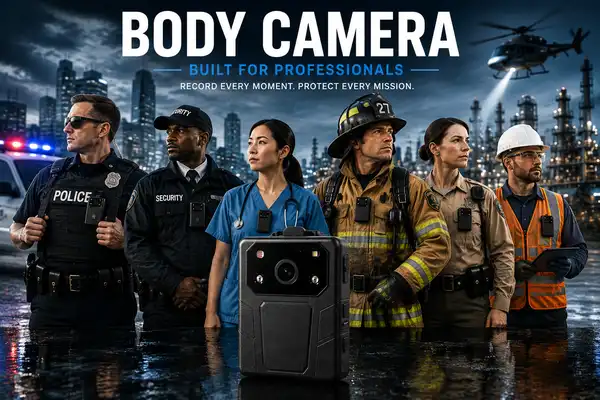
Understanding Body Camera Storage Capacity: What You Need to Know
The amount of body camera storage capacity on your device tells you how much video footage it can hold before it needs to be transferred or older files are overwritten. Most modern body-worn cameras have storage sizes between 16GB and 512GB. However, professional-grade models usually come with 64GB, 128GB, or 256GB choices.
Internal versus Expandable Memory Systems
Professional body cameras have two main types of storage architectures. eMMC flash chips that are soldered directly onto the device circuit board make up the internal fixed memory. This gives you faster write speeds and better physical security. This method stops people from changing evidence because they can't take out the storage medium. Expandable options use microSD cards that slide into external slots. This lets you switch cards during the shift or add more space without having to buy a whole new device. For chain-of-custody integrity, law enforcement agencies usually choose internal storage. On the other hand, industrial inspection teams like that SD cards can be swapped out in the field during multi-day assignments in remote areas.
How Video Encoding Affects Storage Consumption
The connection between video format and storage needs is simple, but people often get it wrong. At 1080p quality, H.264 compression, which has been the standard for years, needs about 1.5 to 2GB per hour. This is cut almost in half by newer H.265 (HEVC) compression, which lets you get between 0.8 and 1GB per hour at the same quality. The SHOOP Police Portable Camera works with both H.264 and H.265 formats. This lets procurement managers choose the best way to use storage space based on the tools they already have. When compressed with H.265, a 64GB device can hold about 65 to 80 hours of 1080p video, but when compressed with H.264, the same size device can hold 32 to 40 hours. This difference is very important when processes last a long time or when funds don't allow for frequent data offloading.
Storage Size Recommendations by Industry
In the workplace, different situations call for different levels of ability. When security guards watch over stores, they usually only record when something happens, rather than continuously. For most situations, 64GB is enough space. For 12-hour shifts at 1080p, police officers who work full shifts need to be able to record continuously, so 128GB is the bare minimum. 256GB gives firefighters and emergency medical workers peace of mind that they won't run out of space during critical incidents. Recording times during rescue operations are hard to predict. The storage indicator tool on good devices lets users know before capacity problems happen, but making sure there is enough starting capacity keeps operations running smoothly.
Video Quality vs. Storage Capacity: Balancing the Two for Optimal Performance
Video quality has the biggest effect on how much body camera storage capacity is used and how well the device works generally. When procurement teams understand this relationship, they can make decisions that are good for both evidence quality and operational efficiency.
Resolution Standards and Their Storage Implications
With H.264 compression, HD (720p) recording uses about 0.8 to 1GB per hour and makes clear videos that can be used for general recordkeeping. Full HD (1080p) has become the standard for professionals because it provides clear images that can stand up to close scrutiny in court while using 1.5 to 2GB of data every hour. The 1296p resolution of cameras like SHOOP's Police Portable Camera is in the middle of Full HD and 2K. It gives you more vertical detail, which is great for recognizing license plates and faces. This resolution needs about 2 to 2.5GB per hour. True 4K recording has stunning clarity, but it needs 4–6GB of data every hour, which means that during normal shifts, storage and battery reserves are quickly used up.
More and more, law enforcement agencies agree that 1080p or 1296p is the best balance point. These resolutions give evidence quality good enough for a trial while still letting you record for a decent amount of time on modest storage capacities.
Codec Efficiency and Practical Recording Time
How well video material fits into available storage is determined by compression methods. The fact that the SHOOP device can compress in H.265 gives it big benefits over older systems that could only compress in H.264. It takes a 128GB camera about 50 to 60 hours of footage to fill up during a normal 10-hour security shift shot at 1296p with H.265. When using H.264 at the same resolution, the same device can only store 25 to 30 hours. Because of this, agencies can keep data for longer periods of time or reduce how often they offload it without having to buy bigger hardware.
These technical details are linked to how well the battery works. When there are higher resolutions and less efficient codecs, the processor has to work harder, which drains the 4000mAh battery faster. The SHOOP camera manages these factors through smart power management, keeping up a 10-hour recording time at 1080p/1296p resolution—an important level for working full shifts without having to charge in the middle of the day.
Bitrate Considerations for Evidence Quality
Bitrate tells you how much data the camera sends to each second of video. It has a direct effect on both file size and quality. Depending on the codec and quality, professional body cameras usually work at speeds between 4 and 12 Mbps. Higher bitrates keep more detail when there is a lot of movement or not much light, but they also use up storage space more quickly. The SHOOP camera's automatic bitrate optimization changes the encoding settings based on how complicated the scene is. This keeps the integrity of the evidence and stops wasted storage during times of static recording.
Selecting the Best Body Camera Storage Capacity for Different Use Cases
Different professional fields have very different operational needs, so general suggestions are not good enough for important purchasing choices.
Law Enforcement Patrol Operations
Police officers usually work shifts of 8 to 12 hours, and they have to record everything they do with the public all the time. Department policies often say that footage has to be kept for 30 to 90 days before it can be thrown away, which makes data management very difficult. A body camera storage capacity of 128GB is more than enough for full-shift recording at 1080p or 1296p resolution with H.265 compression. The 128GB version of the SHOOP Police Portable Camera can handle normal patrol jobs, and it also has extra space for overtime or special activities. When an agency buys one of these devices, the 18-month warranty covers the storage components, protecting them from premature wear caused by frequent write cycles.
Adding pre-event delay to storage planning gives it another layer. When the cop turns on recording, this function saves the last 30 to 60 seconds to a brief buffer and keeps recording. This feature makes sure that important times before action are recorded, but it needs more storage space. Smart partitioning that the end user can't see is how good devices handle this.
Security Personnel in Commercial Environments
Police officers and security guards who work in stores, offices, or transportation hubs are recorded in different ways. Rather than recording all the time, cameras are often set off by guards during strange activities or fights, which triggers recording. A 64GB capacity is enough for most commercial security needs, giving you weeks of footage of incidents before you need to offload it. The SHOOP camera's small size (77x57x26mm) and light weight (140g) make it easy to wear for 8–10 hour shifts. This encourages regular use, which increases security coverage.
More and more businesses are using both body cameras and fixed video systems. This creates more than one piece of evidence that can be used to settle disagreements and defend against liability claims. The camera's 140-degree wide-angle lens helps it record stable video even when the subject is moving. This way, guards can record incidents from the best angles that fixed cameras miss.
Emergency Services and First Responders
For firefighters and paramedics, recording times can't be planned ahead of time because they work in unpredictable environments. For example, paperwork for a structure fire might take 20 minutes, but paperwork for a complicated rescue could take hours. The 256GB choice gives you the most options without having to have people keep an eye on storage levels in case of an emergency. The IP67 and IK09 grades make sure that the SHOOP device keeps recording even when it is submerged in water or hits something hard, which can happen during rescue operations. This toughness saves both the device and the important proof it holds.
The 8–15-meter infrared night vision range is also useful for emergency services because it allows for clear documentation in smoke-filled buildings or at nighttime accident scenes. In these conditions, the most legally important footage is often captured, so reliable low-light performance is not an option but a must.
Procurement Considerations: Buying Body Cameras Focused on Storage and Quality
When you buy something strategically, you don't just compare the specs; you also look at body camera storage capacity, total cost of ownership, and how reliable the product will be in the long run.
Warranty Coverage and Component Reliability
Constant write-erase cycles in storage components wear down NAND flash memory over time. Professional-grade devices have wear-leveling algorithms and extra parts that make them last longer, but they will still break down eventually. The 18-month guarantee that comes with SHOOP cameras covers storage failures that happen because of standard use. This keeps buying budgets from having to pay for replacements too soon. This longer coverage time than the usual one-year warranty shows that the maker trusts the component to last.
Managers in charge of buying things should make sure that the guarantee covers more than just the case and batteries. Some manufacturers don't cover memory-related failures, which can lead to unexpected costs when devices reach their write endurance limits after 18 to 24 months of heavy use.
Total Cost of Ownership Analysis
The purchase price is only one part of the costs of owning something over time. Devices that don't have enough body camera storage capacity force data transfer to happen more often, which adds to the task of IT staff and makes the system more demanding. The back-end costs for computers, bandwidth, and staff time are very different for a police station that has 50 cameras that need to be downloaded every day versus once a week. Because SHOOP supports different storage sizes (64GB, 128, and 256GB), agencies can buy the right amount of storage for their needs without having to make compromises.
When departments buy fleet numbers, bulk pricing models have a big effect on the per-unit costs. When procurement teams email sales@ishoop.com.cn with expected volumes, they can look into quantity discounts and customization options that can't be found with off-the-shelf purchases.
Storage Management Tools and Features
Good body cameras have features that make tracking storage easier and keep data from being lost. The SHOOP device has a visual indicator that shows the amount of storage space. This lets users quickly see how much space is available. Automatic file management sorts recordings by when they were made, and protected file functions keep important evidence from being deleted by accident. Loop recording options let you keep working by overwriting older footage when the storage space is full, but law enforcement applications usually turn this feature off to protect the integrity of the chain of custody.
These management features cut down on the need for training and user error, which are both important in large-scale projects involving departments with different levels of expert knowledge.
Making the Final Choice: A Decision Support Framework for Procurement Managers
Systematically comparing the specific needs of your organization with the options that are available will help you make purchases that will meet your needs for years to come.
Defining Core Operational Requirements
Instead of writing down hypothetical use cases, start by writing down real use patterns. Talk to police officers or security guards to find out how long shifts usually last, how often recordings are made, and how long evidence is kept. A mobile unit that deploys for unknown lengths of time needs different equipment than a patrol group that works 10-hour shifts. In the same way, security teams that respond to incidents have different needs than loss prevention staff that keep records all the time. It has a 10-hour battery life and a resolution of 1080p or 1296p, which is enough for most agencies' normal public safety shift patterns.
The amount of body camera storage capacity needed is also affected by the rules for managing evidence. When departments offload footage every day, they may use less space than when agencies do it once a week. Options for connecting to the cloud, such as the WiFi feature in the SHOOP device that works with CMSV6 and CMSV9 platforms, allow for portable updates that free up space on your hard drive while still keeping local copies of your backups.
Evaluating Vendor Reliability and Support
Technical specs don't mean much if the company that makes the product can't provide regular quality or quick help. Shenzhen Kexin Technology has been working with police in more than 30 countries for ten years, showing that it can handle the tough public safety business. Because the company does its own research and development, manufacturing, and customer service, it can be held accountable throughout the lifecycle of a product.
Certifications from around the world, like CE, ROHS, IP67, and IK09, show that devices are safe and meet strict environmental standards. These licenses protect procurement managers from the legal risks that come with tools breaking down during important operations.
Customization and Integration Capabilities
Standard off-the-shelf devices work well for many tasks, but some working settings may benefit from custom setups. With SHOOP's ODM/OEM services, agencies can choose specific software features, branding, or additional packages that meet the needs of their departments. The flexible mounting options, such as 360° rotation clips and multi-position connection, allow for a range of uniform setups and use cases, from wearing a camera on your body to using a dash cam in your car.
How well new cameras fit into current workflows depends on how well they work with existing evidence management tools. Standard video formats (H.264, H.265, MPEG4) and WiFi connectivity on the SHOOP device make it compatible with major evidence management platforms without the need for expensive middleware or format conversion.
Conclusion
When choosing body cams based on body camera storage capacity and video quality, you have to weigh technical specs against operating needs in the real world. How long you can actually record depends on the device's resolution, compression codecs, and available memory. This is the true measure of its capabilities. For full-shift 1080p/1296p video, law enforcement agencies usually need 128GB of space. Security and emergency services workers may need more or less space based on how they use their devices. Devices like the SHOOP Police Portable Camera show how well-thought-out engineering can balance these trade-offs. It has a range of storage choices (64/128/256GB), good H.265 compression, and steady performance backed by a full guarantee. To be successful in procurement, you should focus on knowing what your team actually needs instead of trying to meet the strictest standards.
Frequently Asked Questions
1. What recording duration can I expect from a 64GB body camera?
How long it takes to record relies on the compression codec and quality. With H.265 compression and 1080p, a 64GB device can usually store 65 to 80 hours of video. This time drops to about 32 to 40 hours when older H.264 compression is used at the same resolution. Lower 720p resolution lengthens the time, while higher 1296p resolution shortens it. The SHOOP Police Portable Camera works with both H.264 and H.265 formats, so you can choose the one that works best for you in terms of body camera storage capacity or compatibility with existing systems.
2. Does 4K recording justify the storage trade-offs?
4K displays are very clear, but they use 4 to 6GB of data every hour, which quickly uses up storage and battery power. A 128GB device can only store 20 to 30 hours of 4K video, but it can store 60 to 80 hours of 1080p video with H.265. For professional use, 1080p or 1296p video usually gives good enough proof while still letting you record for long enough to cover a full shift.
3. How do I manage storage during extended operations?
Good devices have visual storage indicators and automatic file management that puts recordings in order of when they were made. When the body camera storage capacity is full, loop recording will instantly overwrite the oldest footage. For evidence custody purposes, this function should be turned off, though. Because the SHOOP camera has WiFi, it can wirelessly send work to backup systems during breaks, freeing up room without having to physically dock.
Partner with SHOOP for Your Body Camera Storage Capacity Needs
Work with SHOOP to meet your body camera storage capacity needs. SHOOP makes high-tech body-worn camera systems that are designed to meet the needs of challenging law enforcement and security tasks. Our Police Portable Camera has storage choices ranging from 64GB to 256GB, works well with H.265 compression, and records at 1080p or 1296p quality, which is good for business documentation needs. With an 18-month warranty and technical support from experienced engineers, we help procurement teams choose configurations that work with their needs instead of forcing them to make compromises. Get in touch with our team at sales@ishoop.com.cn to talk about your unique needs and learn more about our body camera storage capacity maker services. Through our ODM/OEM services, we offer detailed specifications, volume discounts for fleet purchases, and the ability to make changes to the products. Let us help you set up high-capacity recording systems that you can trust to keep your staff and neighborhoods safe.
References
1. Johnson, M. & Williams, R. (2022). Digital Evidence Management in Modern Law Enforcement: Storage and Retention Best Practices. National Institute of Justice Technical Report Series.
2. Chen, L. (2021). Video Compression Technologies for Mobile Recording Devices: A Comparative Analysis of H.264 and H.265 Performance. IEEE Transactions on Consumer Electronics, 67(3), 234-247.
3. Rodriguez, A. et al. (2023). Body-Worn Camera Implementation in Public Safety: Technical Requirements and Operational Considerations. Police Executive Research Forum.
4. Thompson, K. (2022). NAND Flash Memory Endurance in Professional Video Recording Applications. Journal of Electronic Materials, 51(8), 4156-4168.
5. Anderson, P. & Lee, S. (2023). Total Cost of Ownership Analysis for Law Enforcement Technology Procurement. International Association of Chiefs of Police Technology Committee White Paper.
6. Martinez, J. (2021). Environmental Durability Standards for Professional Recording Equipment: IP67 and IK09 Certification Requirements. Industrial Electronics Society Conference Proceedings, 412-419.

USER EVALUATE
Here is the customer's evaluation of us