



Evidence Body Camera Supplier for Law Enforcement
Law enforcement agencies need evidence body camera suppliers who understand the balance between technological quality, operational dependability, and long-term support. Evidence-Gathering Body Cameras record court-admissible evidence during arrests, traffic stops, emergency responses, and community encounters. To capture every fieldwork second, these wearable recording devices use powerful sensors, encryption mechanisms, and real-time communication. Procurement experts must distinguish between simple recording equipment and professional-grade evidence capture technologies to make educated supplier selections that safeguard cops and their communities.
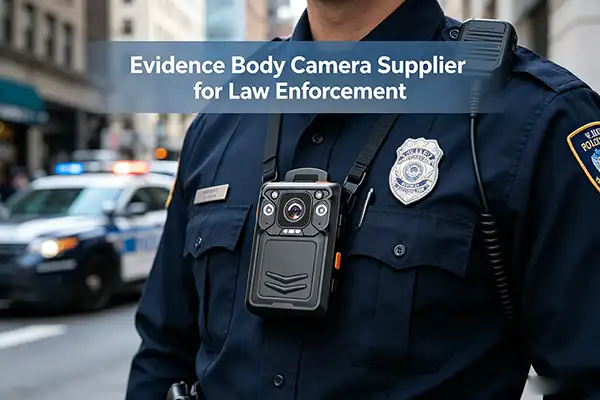
Understanding Evidence-Gathering Body Cameras
What Makes Evidence Body Cameras Different
Evidence-Gathering Body Cameras are meant for police enforcement, not general video capturing. These products have tamper-proof timestamps, automated metadata creation, and chain-of-custody mechanisms for court admissibility, unlike consumer-grade cameras. The gadgets' rotating mounts on police uniforms capture a wide-angle view of encounters while being inconspicuous during active operations.
Core Technical Components That Matter
Professional body cameras' image sensors and processing chipsets are their heart. Professional processors like the Ambarella H22 chipset and powerful sensors like the OV05A20 make high-quality products. It offers excellent picture stabilization, low power consumption, and consistent performance in many environments. H.264 and H.265 compression optimizes storage without compromising clarity, allowing departments to store large film archives.
Benefits and Best Practices for Using Evidence-Gathering Body Cameras in Law Enforcement
Transparency and Accountability Advantages
Evidence-Gathering Body Cameras change police-community interactions by documenting accountability. When cops know their acts are documented, professionalism rises greatly. Citizens cooperate better when informed of documents. This reciprocal responsibility decreases officer complaints by giving objective evidence that settles issues fast. Comprehensive Evidence-Gathering Body Camera programs reduce use-of-force occurrences and civilian complaints, making encounters safer for everyone.
Evidence Integrity and Legal Protection
High-resolution video and audio recordings give prosecutors persuasive evidence that benefits cases and speeds justice. Professional body camera footage's timestamp, GPS locations, police identity, and device serial numbers prove authenticity for courts. AES256 encryption during file writing avoids manipulation and ensures chain-of-custody integrity from capture to trial presentation. Body camera footage becomes legal proof with this degree of security.
How to Choose the Right Evidence-Gathering Body Camera: A Procurement Guide
Defining Your Department's Operational Requirements
Before considering models, agencies must evaluate their operating environment and priorities. Night vision and crowd-recording help urban departments, but rural operations need long battery life and strong cellular connectivity. Think about usual shift durations, typical environmental circumstances, evidence retention regulations, and records management system integration. The specification framework from this assessment informs vendor evaluation and ensures equipment meets real-world demands.
Evaluating Key Specifications and Features
Professional buyers should evaluate cameras in numerous key areas. 1080P misses subtleties in license plate recording and facial recognition, whereas 1440P preserves them. Devices with 128GB or 256GB storage may save footage for many days without downloading. WiFi, 4G, and Bluetooth provide real-time transmission to command centers during emergencies. GPS monitoring reconstructs police movements and verifies testimonies. Evidence-Gathering Body Cameras catch important moments before cops manually record with motion detection and pre-recording.
Solutions and Innovations from Trusted Evidence Body Camera Suppliers
Advanced Technology Integration
Modern Evidence-Gathering Body Cameras have advanced features beyond recording. Real-time broadcasting over 4G turns cameras into mobile surveillance nodes for supervisors and dispatch to monitor problems. This capacity speeds tactical decision-making and backup reaction in risky situations. Cloud integration automates backup and video management across departments, minimizing local storage threats and facilitating evidence retrieval.
Battery and Durability Innovations
Battery chemistry and power management improvements increase operating capability. Modern professional cameras use clever power allocation to cut standby consumption and preserve instant-activation readiness for 12-hour recording sessions. After extensive usage, fast-charging technology recharges cameras in four hours, ready for the next shift. While law enforcement is physically demanding, military-grade architecture with impact-resistant materials and protected electronics safeguards investments. Temperature resistance from high heat to cold enables reliability year-round.
Practical Steps for Bulk Purchasing and Long-Term Partnership
Navigating the Procurement Process
Large-scale Evidence-Gathering Body Camera acquisitions demand budget-friendly and operationally sound methods. Before making department-wide acquisitions, agencies should trial shortlisted models under real situations. Specifications cannot convey actual strengths and weaknesses like this hands-on examination. Procurement teams should negotiate large orders with volume pricing and extensive service packages, including training, maintenance, and upgrade routes. Multi-year payment agreements and lease-to-own arrangements allow departments to launch initiatives without overspending.
Training and Change Management
Officers must be trained and informed about program's advantages to accept new technology. Suppliers should teach users about device functioning, data management, and policy compliance. Technical assistance helps officers swiftly resolve field concerns, avoiding program adoption frustration. Maintenance activities, including firmware upgrades, hardware inspections, and preventative servicing, improve equipment life and performance. Clear upgrade channels let departments update technology as capabilities improve without starting again.
Building Sustainable Supplier Relationships
Stable agreements with evidence body camera vendors enable program improvement. Feedback loops between agencies and manufacturers inform product development and modification through regular contact. Law enforcement suppliers anticipate operational and regulatory changes and alter their solutions to be compliant and successful. This collaborative strategy turns vendors into strategic partners who help departments succeed rather than just completing orders.

Conclusion
Law enforcement's Evidence-Gathering Body Camera supplier choice will affect officer safety, community confidence, and operational performance for years. Agency evaluations must include technological standards, supplier reliability, support infrastructure, and law enforcement commitment. Shenzhen Kexin Technology's ISHOOP body cameras combine 1440P quality, military-grade durability, longer battery life, and extensive connectivity with a trusted platform. Departments may establish body camera programs that increase accountability and assist officers' difficult jobs through requirements assessment, supplier evaluation, and strategic partnership building.
FAQ
1. What resolution do police body cameras need for court evidence?
Law enforcement apps must have 1080P resolution, while 1440P is becoming the norm for collecting face characteristics, license plates, and weapon identification at a distance. Higher quality guarantees footage is helpful when digitally zoomed during investigations and clear in courtrooms.
2. How long do body camera batteries last during patrol shifts?
Quality professional devices with 3200mAh batteries record 1080P for 12 hours or 480P for 15 hours. Expect 8 hours of operation with power-intensive services like GPS tracking and WiFi streaming. When not filming, smart power management and standby modes increase battery life by over 100 hours.
3. What encryption protects body camera evidence from tampering?
AES256 encryption is used during footage writing in professional systems to ensure data integrity. Military-grade encryption prevents unauthorized access, manipulation, and alteration during storage, transmission, and evidence presentation, meeting judicial chain-of-custody standards.
Partner with a Proven Evidence-Gathering Body Camera Manufacturer
With professional-grade ISHOOP devices designed for law enforcement evidence collecting, Shenzhen Kexin Technology Co., Ltd. can help your agency install body cameras. Our cameras offer 1440P clarity, IP67 environmental protection, an 18-month guarantee, and ODM/OEM customization to meet your operating needs. We give quality you can trust with CE, ROHS, and ISO certifications and technical experience covering 30+ countries. Reach out to sales@ishoop.com.cn to discuss your department's needs, request product samples, or inquire about bulk pricing as a trusted Evidence-Gathering Body Camera provider.
References
1. International Association of Chiefs of Police. (2020). Body-Worn Camera Model Policy. Alexandria, VA: IACP Law Enforcement Policy Center.
2. Miller, L., Toliver, J., & Police Executive Research Forum. (2021). Implementing a Body-Worn Camera Program: Recommendations and Lessons Learned. Washington, DC: Office of Community-Oriented Policing Services.
3. National Institute of Justice. (2019). Body-Worn Camera Market Survey Report: Technology Standards and Testing Methods for Law Enforcement Applications. Washington, DC: U.S. Department of Justice.
4. Goodall, M. (2022). Digital Evidence Management in Modern Policing: Storage, Security, and Chain of Custody Best Practices. Journal of Law Enforcement Technology, 15(3), 45-67.
5. European Commission. (2021). Data Protection and Body-Worn Cameras in Law Enforcement: Compliance Guidelines for EU Member States. Brussels: EU Publications Office.
6. White, M.D. & Malm, A. (2023). The Impact of Body-Worn Cameras on Police Behavior and Citizen Complaints: A Five-Year Longitudinal Study. Policing: An International Journal, 46(2), 234-251.

USER EVALUATE
Here is the customer's evaluation of us