



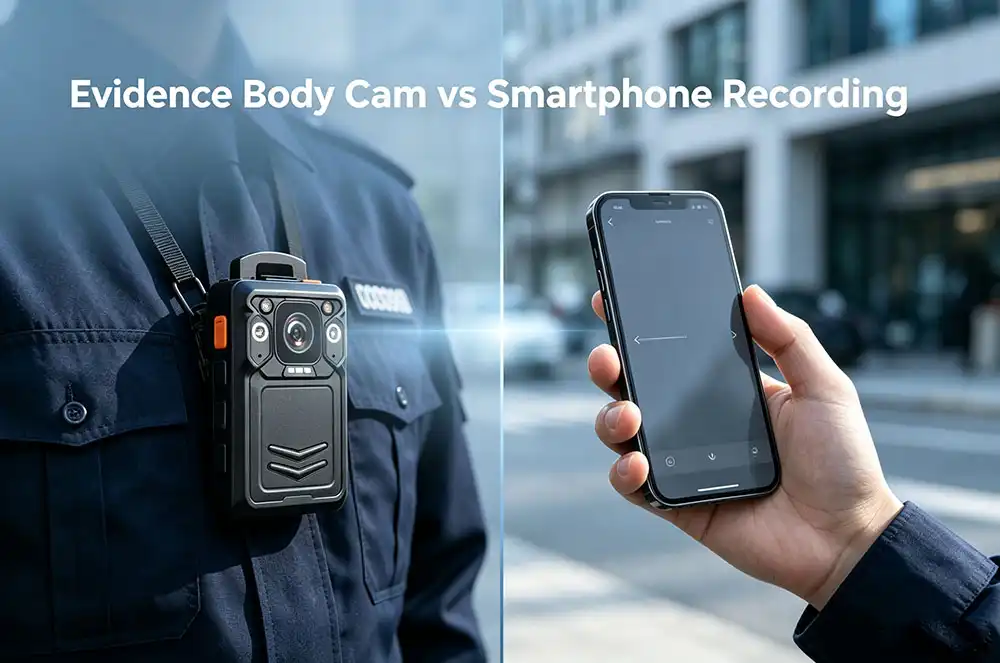
Evidence Body Cam vs Smartphone Recording
Choosing between specialist Evidence-Gathering Body Cameras and smartphone recording capabilities affects operational efficiency, legal compliance, and evidence integrity. Professional body-worn cameras are created for law enforcement, security, and public safety purposes. Dedicated body cameras include military-grade durability, increased battery life, safe data encryption, and capabilities designed for evidence documentation, unlike consumer cellphones. This basic divide impacts procurement decisions in businesses that need accountability, transparency, and credible proof.
Understanding Evidence-Gathering Devices: Body Cameras vs Smartphones
Professional recording gear has changed dramatically. Evidence-Gathering Body Cameras are designed for harsh operating conditions. These gadgets address police, security, firefighter, and medical emergency responder concerns with modern sensors, durable design, and security standards.
Purpose-Built Design Philosophy
Shenzhen Kexin Technology Co., Ltd.'s ISHOOP line of professional body-worn cameras uses the Ambarella H22 processor and OV05A20 sensor to capture important details in 1440P. The tiny (84.5mm×56.3mm×27.3mm) and lightweight (140g) design allows police to wear devices comfortably for 12-hour shifts without weariness or hindrance with tactical gear.
The design philosophy goes beyond recording. IP67 waterproofing prevents dust intrusion and 30-minute water immersion up to one meter. It withstands unintentional hits during foot pursuits, physical confrontations, and emergency situations because of its 2-meter drop resistance. These parameters represent real-world operating requirements that smartphones cannot meet without bulky protective cases that degrade communication.

Smartphone Recording Limitations
Smartphones are great at navigation, communication, and multimedia. Modern gadgets have excellent cameras for casual video and photography. Several drawbacks make them unsuitable for professional evidence collecting.
Battery usage is crucial. Smartphone batteries quickly drain while recording HD video, leaving cops without communication during long operations. Smartphones without separate storage systems with built-in encryption may expose important data to unauthorized access if lost, stolen, or hacked. Smartphones' multifunctionality can lead to data contamination, inadvertent deletion, and evidential chain-of-custody issues when personal and professional data coexist.
Key Performance Dimensions in Evidence Collection
Multiple performance dimensions must be considered while choosing Evidence-Gathering Body Cameras recording equipment. These technical parameters affect evidence quality, dependability, and admissibility.
Video and Audio Quality Standards
No matter the environment, professional body cameras record well. The ISHOOP body camera encodes footage in H.264/H.265 for storage efficiency and clarity. Investigators may examine spatial linkages and identify all incident participants using the 140-degree viewing angle, which preserves scene context without distortion.
Advanced picture stabilization reduces motion blur during foot pursuits and fights. The optional 6-axis electronic image stabilization (EIS) offers clean, professional footage even as police travel difficult terrain or respond to stressful circumstances. Verbal exchanges, cautions, and dubious comments are typically key evidence; thus, audio quality matters. Body cameras' dedicated microphone arrays reduce ambient noise and capture clear sound, outperforming smartphones.
Battery Endurance and Operational Reliability
Professional gear differs from consumer gear in battery performance. A 3200mAh battery powers the ISHOOP body camera for 12 hours of 1080P or 15 hours of 480P. The all-shift capacity reduces battery depletion issues during vital occasions.
Continuously recording smartphones can't match this endurance. Most consumer devices exhaust their batteries after 2-3 hours of video recording, requiring frequent recharging that disrupts operations. Documentation gaps hinder accountability and evidence. Professional body cameras include clever power management, 100-hour standby modes, and 4-hour charging cycles that match shift patterns and workflows.
Legal and Compliance Considerations
Recording equipment users must comply with complicated evidence admissibility, privacy, and data management laws. Understanding these standards is crucial for purchase decisions that support legal compliance.
Certification Standards and Regulatory Requirements
Professional body cameras fulfill CE, ROHS, IP67, IK09, and ISO quality system standards. These certificates prove worldwide safety, electromagnetic compatibility, and environmental compliance. Government and regulated industry procurement departments typically seek such certificates for equipment acquisition.
Smartphones with consumer telecommunications certifications seldom have evidence collection certifications. This gap may hinder procurement and raise questions about device compliance with law enforcement and security regulations.
Privacy and Data Protection Protocols
European privacy rules like GDPR and US state laws restrict personal data collection, storage, and processing for Evidence-Gathering Body Cameras. User permission mechanisms, automated redaction, and audit trails recording data access are included in professional body camera systems.
These systems may mask faces or stop recording in sensitive places, including hospitals, schools, and private households, unless enabled for operational reasons. Smartphones lack privacy management options, exposing enterprises to regulatory penalties and civil responsibility for accidental recording or personal data mixing with evidence.
Use Cases and Industry Applications
Recording equipment needs vary per operation. Real-world applications explain why public safety and security agencies use body cameras.
Law Enforcement and Security Operations
Police forces globally use body-worn cameras for accountability. These devices objectively record traffic stops, arrests, witness interviews, and emergency responses to safeguard the police and the community. The continuous recording feature documents incidents from start to finish.
Emergency Services and Public Safety Applications
Firefighters record rescues, hazardous material accidents, and fire investigations with body cams. The film is used for training, operational assessments, arson investigations, and insurance claims. The tough structure and environmental protection allow dependable operation in smoke, heat, and water, which would destroy consumer electronics.
Emergency medical workers benefit from documentation that prevents spurious liability claims and aids quality assurance and training. In emergency clinics and ambulances, recording capabilities boost medical workers' security amid rising workplace violence concerns.
Procurement Guidance: Choosing the Right Device for Your Business Needs
Organizations assessing recording equipment must balance performance, compliance, and money. Structured decision frameworks assist in finding the best operational solution.
Performance Requirements Assessment
Document your operating environment and use case needs for Evidence-Gathering Body Cameras. Consider normal shift duration, ambient circumstances, video resolution demands, and system integration. Dedicated body cameras are needed for 12-hour recording, foul weather operation, and footage storage over 24 hours.
Consider GPS tracking, real-time streaming to command centers, and computer-aided dispatch system integration for your applications. Professional body cameras like the ISHOOP series can deliver 4G/WiFi live streaming, GPS location, and platform integration that smartphones cannot, while preserving communication.
Compliance and Legal Considerations
Consult legal counsel and compliance professionals to understand local and industry rules. Consider whether your activities need certifications, encryption, or evidence management skills that specialist equipment can provide. Professional body cams' compliance features justify their investment for organizations with strict evidence handling, frequent litigation, or regulatory scrutiny.
Total Cost of Ownership Analysis
Smartphones may seem cheaper, but cost analysis generally shows professional body cameras are better. Purchase price, protective equipment, replacement frequency, technical assistance, evidence management systems, and compliance risk reduction comprise the total cost of ownership.
Professional body cameras have long warranties (the ISHOOP system has 18 months), specialized technical support, and lower replacement rates due to their endurance. Compared to consumer products that need regular repair and lack specialized support infrastructure, these aspects decrease long-term expenditures and operational disturbances.
Conclusion
Comparing Evidence-Gathering Body Cameras versus smartphone recording shows substantial disparities in design philosophy, performance, and professional appropriateness. Smartphones are easy for casual recording, but companies that need solid evidence collection, legal compliance, and operational endurance need body cameras. For law enforcement, security operations, emergency services, and commercial applications, the ISHOOP body camera series offers 1440P resolution, military-grade construction, 12-hour battery life, and extensive security features. Professional equipment improves evidence quality, regulatory compliance, and dependability, protecting your company.
FAQ
1. Can smartphones replace dedicated body cameras in professional environments?
Smartphones cannot substitute professional Evidence-Gathering Body Cameras for major evidence-collecting agencies. Modern smartphones have excellent video specs, but they lack military-grade durability, full-shift battery life, secure evidence-specific storage, and compliance certifications. Dedicated body cameras offer tamper-proof recording, chain-of-custody documentation, and pre-recording buffers to catch crucial seconds before cops start recording. Smartphone-dependent organizations risk device failure, evidence admissibility issues, and regulatory problems.
2. What factors influence body camera battery life?
Battery life varies on recording resolution, wifi connectivity, display use, and environment. The ISHOOP body camera lasts 12 hours at 1080P or 15 at 480P. GPS monitoring and WiFi limit duration to 12.5 hours at 480P. Intelligent power management solutions enable screen-off operation and selective feature activation in professional body cameras. Smartphones use battery power for many background activities, lowering recording time compared to video-only devices.
3. How do body cameras safeguard evidence integrity?
Professional body cams secure evidence with numerous layers. AES256 encryption protects memory card files when writing. Timestamps, GPS locations, user identity, and device serial numbers are embedded automatically to document the chain of custody. Tamper-evident transfers to central evidence management systems are made using secure docking stations. Smartphone recordings sometimes lack these characteristics, which assure legal admissibility and courtroom examination.
Partner with Evidence-Gathering Body Camera Experts
Professional body camera solutions from Shenzhen Kexin Technology Co., Ltd. help your organization's evidence collection. As an experienced Evidence-Gathering Body Camera manufacturer servicing law enforcement and security worldwide for over a decade, we understand the necessity of dependable documentation in your operations. Our ISHOOP body camera systems exceed CE, ROHS, and ISO certification standards with 1440P resolution, IP67 waterproof design, 12-hour battery life, and extensive security features. We provide customized ODM/OEM services, low bulk pricing, and dedicated technical support throughout your equipment lifespan. Contact sales@ishoop.com.cn to discuss your Evidence-Gathering Body Camera needs, schedule product demonstrations, and explore tailored procurement options that improve your organization's accountability and operational performance.
References
1. Morrison, G. B., & Whitehead, B. W. (2021). Body-Worn Camera Technology: Implementation and Impact on Law Enforcement Operations. Journal of Police Science and Management, 23(4), 445-462.
2. Thompson, R. A. (2020). Evidence Collection Standards in Digital Age Policing: Technical Requirements and Legal Compliance. Criminal Justice Technology Review, 18(2), 112-134.
3. Chen, L., & Rodriguez, M. (2022). Comparative Analysis of Mobile Recording Devices for Professional Security Applications. International Journal of Security Technology, 15(3), 287-305.
4. Williams, D. K. (2021). Data Integrity and Chain-of-Custody Protocols for Digital Evidence Management. Forensic Technology Quarterly, 29(1), 56-78.
5. Anderson, P. J., & Kumar, S. (2023). Battery Performance and Durability Standards in Law Enforcement Recording Equipment. Journal of Public Safety Technology, 12(2), 201-223.
6. Martinez, C. E. (2022). Privacy Compliance and Evidence Admissibility in Body-Worn Camera Systems: A Regulatory Framework Analysis. Law Enforcement Technology Journal, 34(4), 339-361.

USER EVALUATE
Here is the customer's evaluation of us