



Evidence Body Camera Benefits for Criminal Cases
Modern criminal investigations rely on Evidence-Gathering Body Cameras to record crucial video and audio that improves case integrity and court results. These modern recording devices provide law enforcement, security, and legal teams with judicially admissible evidence and accountability and openness. These specialized cameras provide documentation that traditional recording methods cannot match, making them essential investments for professional evidence collection and justice system support organizations. They have extended battery life, superior video resolution, and encrypted data storage.
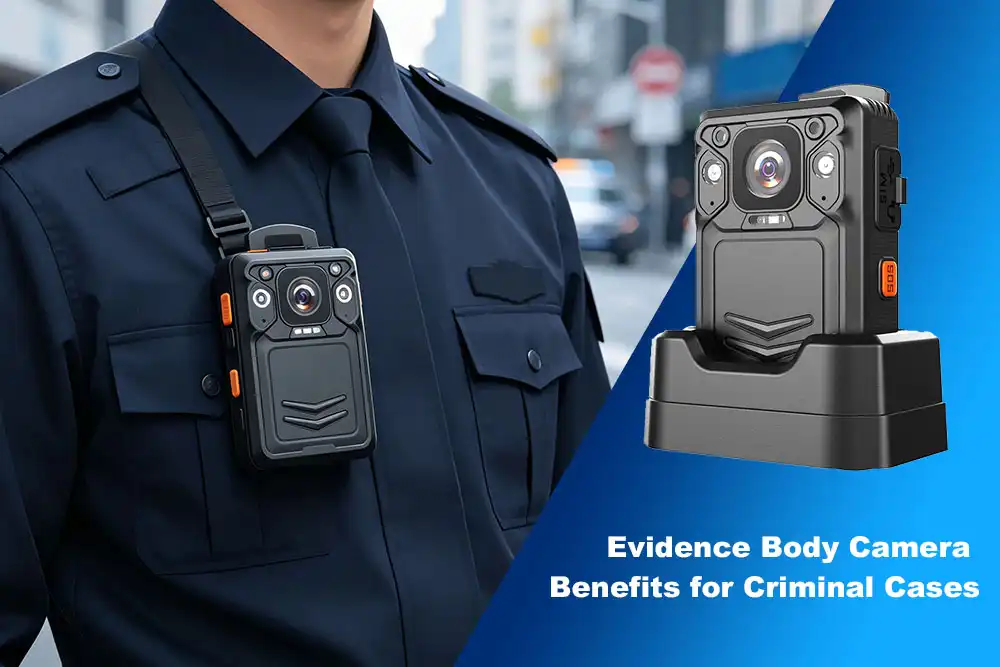
Understanding Evidence-Gathering Body Cameras and Their Benefits
Evidence-Gathering Body Cameras are a major criminal justice technology innovation. Professional-grade sensors, powerful encryption algorithms, and weather-resistant construction for harsh field circumstances distinguish these devices from simple recording equipment.
Core Technologies That Define Professional Evidence Capture
Ambarella H22 chipsets and OV05A20 sensors in modern Evidence-Gathering Body Cameras provide 1440P resolution for clear facial features, license plates, and environmental background. This combination keeps footage admissible even when magnified or boosted during forensic processing. H.264 and H.265 compress video files without compromising quality, extending recording time, and improving storage efficiency. These technical requirements give investigators clear, precise documentation that juries and judges can trust, affecting case outcomes.
Documentation Advantages in Criminal Investigations
Complete audio-visual documentation from Evidence-Gathering Body Cameras changes criminal cases. Body-worn recording devices record remarks, actions, and ambient factors that witness testimony cannot consistently express when cops respond to domestic disturbances, traffic offenses, or suspicious activities. The 140-degree viewing angle mimics the human viewpoint, properly documenting police's crucial situations. Pre- and post-recording buffers capture 30 to 60 seconds before and after manual activation to catch important moments in fast-changing scenarios. This continual documenting has helped resolve contradictory stories and establish accurate dates for fair judgment.
Comparison of Evidence-Gathering Body Cameras: Choosing the Best for Your Organization
Technical characteristics, vendor reliability, and overall ownership expenses must be considered while choosing recording equipment. To find sustainable solutions, organizations must combine fiscal limits with long-term operational needs.
Technical Specifications That Impact Evidence Quality
Although video resolution is the most noticeable parameter, frame rate stability, bitrate management, and low-light performance also affect footage usefulness. ISHOOP Evidence-Gathering Body Cameras capture 1440P at 30fps with 1080P and 720P resolution choices, allowing departments to balance recording quality and storage capacity. Officers moving quickly can see well with six-axis image stabilization during foot chases or violent confrontations. Night vision up to 10 meters using infrared LED illumination ensures document quality independent of lighting. The combined specs provide chain-of-custody and courtroom presentation-compliant recordings.
Storage Capacity and Data Management Considerations
Archival flexibility and recording duration for Evidence-Gathering Body Cameras depend on memory capacity. Systems with 32GB to 256GB of storage may handle agencies with daily uploads or multi-day retention before transfer. The whole storage lifespan of sensitive data is protected by AES256 encryption during file writing. Integrating secure docking stations allows automatic upload methods to retain audit trails, timestamp verification, and user attribution, which are essential for legal proof validity. When choosing storage, organizations should consider average shift duration, incident frequency, and retention policy.
How to Properly Use Evidence-Gathering Body Cameras: Best Practices for Procurement Clients
Beyond hardware purchasing, successful deployment includes training, data management, and maintenance to enhance device lifespan and evidence integrity.
Deployment Strategies for Maximum Operational Effectiveness
Mounting positions greatly affect film quality and efficiency. The typical 360-degree rotating crocodile mount secures to uniform shirts to record officer's viewpoint without blocking mobility. Some MOLLE mounts fit tactical vests used by specialist troops. The small (84.5mm × 56.3mm × 27.3mm) and lightweight (140g) design provides longer-lasting comfort, decreasing officer fatigue and promoting constant activation. Departments should have clear activation procedures for ordinary encounters, traffic stops, searches, and arrests to document everything while protecting privacy in sensitive contexts.
Data Management Protocols That Preserve Evidence Integrity
Effective data handling starts with safe transfer and chain-of-custody documentation. Docking stations should automatically upload film and generate verification logs with transfer timestamps and handling staff. Evidence-Gathering Body Camera management solutions must be compatible with AES256 encryption to decode stored files, requiring infrastructure compatibility assessment before procurement. Retention plans must balance storage costs against legal preservation obligations, which range from 90 days for regular recordings to indefinite for formal complaints or criminal investigations. Organizations should automate retention classification based on incident labeling to eliminate human review and ensure discovery compliance.
Legal and Operational Considerations for Evidence-Gathering Body Cameras
Comprehending jurisdiction-specific admissibility and privacy protection requirements is essential to comprehending Evidence-Gathering Body Camera evidence regulations.
Courtroom Admissibility Standards Across Jurisdictions
When properly authenticated and a chain-of-custody continuity is established, US courts accept Evidence-Gathering Body Camera footage as documentary evidence. Officer testimony verifying device functionality and film authenticity usually proves that recordings are accurate under the Federal Rules of Evidence. Technical verification for authentication is provided via integrated metadata such as User ID, Device ID, timestamps, and GPS coordinates. Comprehensive activation protocols and continuous film are essential for prosecution success since defense arguments usually center on selective recording, editing accusations, or viewpoint limits rather than admissibility.
Privacy Protection and Regulatory Compliance Requirements
Evidence-Gathering Body Camera deployment must combine transparency with constitutional and statutory privacy rights. Private house recording involves careful policy evaluation, especially when filming domestic circumstances involving uninvolved tenants or children. Redaction, format conversion, and distribution tracking are required by many countries for recorded subjects' disclosure upon request. When emergency response recordings contain medical information, law enforcement and hospital privacy officials must coordinate under HIPAA. Software for automatic redaction, selective disclosure, and audit trail production should be considered when procuring software to comply with legislation.
Procurement Guide: How to Buy the Right Evidence-Gathering Body Cameras for Your Business
Strategic procurement entails needs assessment, vendor evaluation, and lifetime cost analysis that includes training, maintenance, and system integration.
Defining Organizational Requirements and Use Cases
Different operating conditions need different Evidence-Gathering Body Camera capabilities. Investigative units may value distinct form factors above durable construction, whereas patrol personnel need long battery life for 12-hour shifts. Traffic enforcement benefits from improved low-light license plate capture during nighttime stops. Commercial security staff require a real-time central station monitoring link. Operational evaluations should determine average shift durations, environmental exposure, connection infrastructure availability, and evidence volume forecasts. These considerations directly influence specifications, limiting over-acquiring unneeded features and under-specification that reduces operational effectiveness.
Evaluating Total Cost of Ownership Beyond Purchase Price
Upfront hardware expenditures are merely half of the lifespan costs. With Evidence-Gathering Body Camera deployment numbers and retention standards, storage infrastructure may demand large server investments or cloud service subscriptions. Beyond device purchases, docking stations, software licensing, and system integration are costly. Administrative staff need evidence management, disclosure processing, and retention compliance training, while cops learn activation protocols, evidence tagging, and basic troubleshooting. Manufacturers like Shenzhen Kexin Technology provide 18-month warranties to safeguard against premature failures, but businesses should pay for post-warranty maintenance contracts for firmware upgrades and technical support.
Selecting Qualified Vendors and Ensuring Product Authenticity
The selection of vendors affects long-term satisfaction and operational performance. Emerging brands without field-tested products are less reliable than established producers. CE, ROHS, IP67, IK09, and ISO certifications prove quality and environmental endurance. Request references from agencies with comparable operating characteristics, pilot test with representative user groups, and evaluate after-sales support capabilities, including response times, replacement part availability, and technical competence. Authorized distributors provide local support infrastructure to simplify maintenance and replacement, and assure product authenticity and warranty validity.

Conclusion
Evidence-Gathering Body Cameras alter criminal investigations by providing credible documentation that supports fair adjudication, officer safety, and public accountability. Advanced sensors, secured storage, and communication produce courtroom-proof evidence with operational benefits beyond recording. Technical specifications, data management standards, legal compliance, and overall ownership expenses must be considered for successful implementation. Companies that buy excellent equipment from Shenzhen Kexin Technology satisfy changing transparency standards and assist judicial system integrity through reliable evidence gathering.
FAQ
1. How long does the battery last during active recording?
The 3200mAh battery lasts 12 hours at 1080P and 15 hours at 480P. GPS and WiFi provide 12.5 hours of 480P recording. Docking stations take 4 hours to fully charge, while standby time surpasses 100 hours.
2. Can recorded footage be securely shared with prosecutors and legal teams?
Writing files with AES256 encryption protects evidence integrity throughout storage and transport. The USB interface allows driver-free computer connections with encryption, enabling safe evidence sharing. Streaming data to command centers or approved receivers is encrypted using AES256 via network security standards.
3. What storage capacity should agencies select for typical patrol operations?
Upload frequency, shift length, and recording quality determine storage demands. The 64GB capacity stores over 24 hours of 1080P film, allowing for 12-hour shifts and prolonged operations. Companies that want multi-day retention before upload should choose 128GB or 256GB, whereas departments that dock daily may use 32GB.
Partner with Shenzhen Kexin Technology for Your Evidence Camera Needs
Shenzhen Kexin Technology Co., Ltd. specializes in Evidence-Gathering Body Camera production, providing law enforcement agencies in 30+ countries with dependable recordings. ISHOOP body cameras exceed strict evidential requirements with 1440P resolution, IP67 waterproofing, long battery life, and AES256 encryption. We provide ODM/OEM customization for particular operating needs, bulk procurement, 18-month warranty coverage, and fast technical support. Contact our procurement specialists at sales@ishoop.com.cn to discuss your evidence-gathering body camera supplier needs, request detailed specifications, or schedule product demonstrations to see how our advanced recording technology can improve your investigative capabilities and operational transparency.
References
1. Miller, L., Toliver, J., & Police Executive Research Forum. (2014). Implementing a Body-Worn Camera Program: Recommendations and Lessons Learned. Washington, DC: Office of Community-Oriented Policing Services.
2. White, M. D. (2019). Police Officer Body-Worn Cameras: Assessing the Evidence. Washington, DC: National Institute of Justice, Office of Justice Programs.
3. Goodison, S. E., Davis, R. C., & Jackson, B. A. (2015). Digital Evidence and the U.S. Criminal Justice System: Identifying Technology and Other Needs to More Effectively Acquire and Utilize Digital Evidence. Santa Monica, CA: RAND Corporation.
4. Lum, C., Koper, C. S., Wilson, D. B., Stoltz, M., Goodier, M., Eggins, E., ... & Merola, L. (2020). Body-Worn Cameras' Effects on Police Officers and Citizen Behavior: A Systematic Review. Campbell Systematic Reviews, 16(3), e1112.
5. Peterson, B. E., Yu, L., La Vigne, N., & Hickman, D. (2018). The Milwaukee Police Department's Body-Worn Camera Program: Evaluation Findings and Key Takeaways. Washington, DC: Urban Institute Justice Policy Center.
6. Fan, M. D. (2016). Justice Visualized: Courts and the Body Camera Revolution. UC Davis Law Review, 50(3), 897-959.

USER EVALUATE
Here is the customer's evaluation of us