



Wearable Body Camera vs Dash Cam: What’s the Difference?
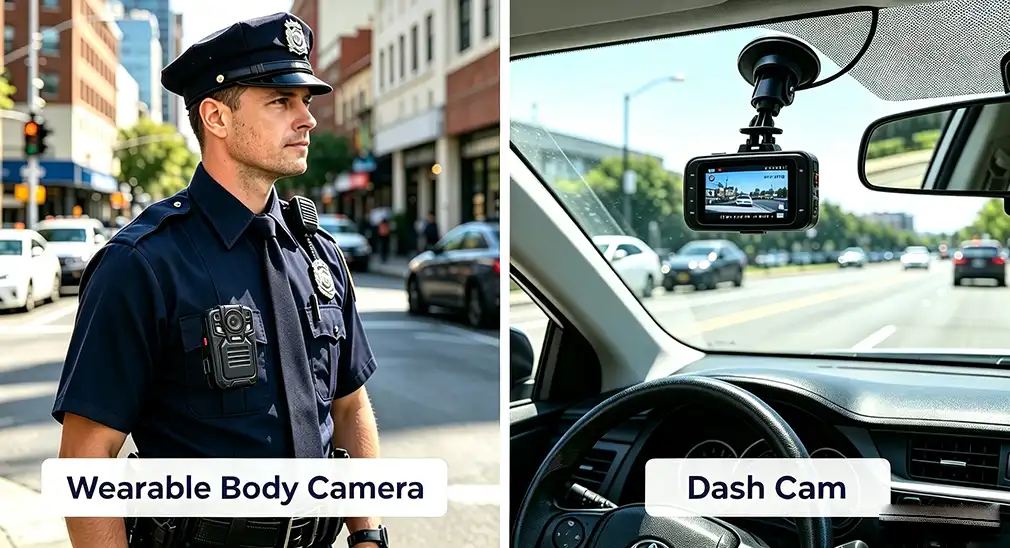
It is important to know the main difference between a personal body camera and a police cam when looking at recording technology for business use. A wearable body camera is a movable recording device that can be attached to clothes or worn on an officer's uniform. It records exchanges from the wearer's point of view during searches, investigations, or emergency reactions. A dash cam, on the other hand, is mounted inside a car and records what's going on around the car and the road conditions. Wearable cameras and dash cams are both used for recording, but dash cams stay in one place and record all traffic situations and accidents, while wearable cameras can be moved around and used without using your hands during building checks and foot searches.
Understanding the Basics: What Are Wearable Body Cameras and Dash Cams?
Defining Wearable Body Cameras
Body cams that you wear are a special kind of recording gear made for people who work outside of vehicles. Police officers, security guards, firefighters, and retail workers can record their activities with these small devices that can be attached to uniforms, vests, or helmets. Modern body-worn cameras have instant-record features, which means that you can start recording with just one button press, even if the camera is off. Multiple proof signs, such as audio alerts, visual cues, and vibrations, are built into the technology to make sure users know exactly when recording begins or ends.
Defining Dash Cams
Dash cams are recording devices that are mounted on a vehicle and continuously record road conditions, traffic accidents, and how the driver is acting. These gadgets usually stick to windscreens or dashboards and record views from the front, back, or inside of the car. Dash cams record continuously while vehicles are moving without needing to be operated manually. They start recording automatically when the vehicle starts. They are very good at getting proof from accidents, keeping an eye on how fleet drivers act, and keeping records of traffic stops from the point of view of a car.
Primary Applications Across Industries
Law enforcement organisations use both tools, but they are used in different ways. Wearable cams are used by police officers on foot checks, building searches, and one-on-one encounters where being mobile is important. Body-worn devices are used by traffic police to do inspections at the side of the road and to enforce laws about pedestrians. Dash cams, on the other hand, record pursuits, traffic stops, and accident scenes from the point of view of patrol vehicles.
Body-worn devices are most popular among security guards in business buildings, residential neighbourhoods, and transportation hubs because their job requires them to walk watch paths and respond to events in a variety of places with a Wearable Body Camera. Dash cams are popular with fleet management companies and transportation services because they record accidents and keep track of how well drivers are doing. Firefighters and emergency medical workers like portable tech that they can take into buildings and emergency scenes with them to record situations that their trucks can't reach.
Key Differences to Guide Procurement Decisions
Form Factor and Mobility Considerations
The changes in how these gadgets are built have a direct effect on how well they work. Wearable cameras are about 84x54x29mm and weigh about 165g. They are made to be worn all day on uniforms without getting tired. Because they are small, they can be attached to uniform places like chest mounts, shoulder epaulettes, or helmet fixings, which lets them record from the wearer's point of view.
Dash cams usually have bigger sizes so that the screens and fastening tools can be properly put inside the car. Because they are fixed in place, they can only be used for vehicle operations. However, since they get their power from the vehicle's electrical systems, you don't have to worry about the batteries dying during long shifts.
Video Quality and Recording Capabilities
Wearable cameras made for professionals can now record in 1296P Full HD at up to 60 frames per second, and they come with quality choices like 2560x1080p30 and 1920x1080p30. The 140-degree wide-angle lens captures a lot of the scene, including things going on in the edges that are hard to see with a narrower field of view. These devices can also take 33-megapixel still pictures, so police officers can take high-resolution pictures while the videos are still being recorded. This ability to do two things at once is very helpful when going to crime scenes or accident scenes and needing both video footage and thorough photos as proof.
Most dash cams have similar video qualities, but they don't have the high-resolution picture features that more modern body-worn cameras do. Their major focus when recording is still on continuous video capture rather than flexible multimedia documentation.
Storage Solutions and Data Management
Modern body-worn cameras can store data in a variety of ways, with capacities ranging from 32GB to 256GB. A 32GB memory card can hold about 128 hours of video footage, which is a lot of data to store between downloads. The pre-recording buffers on these devices start recording 30 seconds before the record button is pressed, and the post-recording functions keep recording for 300 seconds after the record button is depressed. This makes sure that important times aren't missed during transitional periods.
Dash cams use loop recording, which means that the latest footage is overwritten automatically when the storage space is full. This means that you don't have to handle the footage as much, but you could lose important evidence if you don't download it right away. Many modern systems have cloud connection for wifi downloads, and more and more devices in both groups are getting this function.
Power Management and Battery Performance
Battery longevity is a very important difference. Wearable cameras of good quality that come with two 1950mAh batteries can record continuously for more than eight hours on a single charge, so you can go through full work shifts without stopping. Between shifts, users can swap out recharging batteries or use docking stations that charge devices and send video to private storage systems at the same time.
Dash cams get around battery problems by linking directly to the power systems of vehicles, while a Wearable Body Camera requires independent power support. They work constantly as long as the vehicles are running, and some models can even offer parking mode tracking when the engines are off. This gets rid of the difficulties of charging but limits the usefulness to situations involving vehicles.
Night Vision and Low-Light Performance
Smart IR night vision with dual infrared illuminators is built into modern body-worn cameras. This lets you see up to 10 meters in total darkness. The smart IR-cut filter switches automatically between daylight and night vision modes, so the image quality stays the same no matter how bright it is outside. This feature makes sure that the quality of the paperwork is maintained during searches at night, when buildings aren't well-lit, or when emergency reactions happen in dark places.
Many dash cams have night vision features, but how well they work depends on how bright the street is and how bright the headlights are. This is because most of them don't have built-in infrared systems that are designed for close-range documentation.
Compliance, Privacy, and Legal Regulations Impacting Usage
Data Security and Encryption Standards
Body-worn cameras handling sensitive law enforcement footage incorporate sophisticated encryption protocols protecting data from unauthorized access. Modern devices embed watermarks displaying user IDs, dates, and timestamps directly into recordings, creating tamper-evident documentation suitable for legal proceedings. Secure docking stations facilitate encrypted data transfer to departmental servers while maintaining chain-of-custody integrity.
Organizations must verify that selected devices meet certification requirements, including CE, ROHS, IP67 waterproof ratings, and IK09 impact resistance standards. These certifications ensure equipment withstands harsh operational environments while maintaining data integrity.
Regional Legal Frameworks
United States regulations governing body-worn camera deployment vary by state and municipality, with specific mandates addressing when recording is required, notification obligations, and retention schedules. Many jurisdictions require law enforcement agencies to establish clear policies regarding camera activation during citizen interactions, balancing transparency with privacy concerns in sensitive situations.
Dash cam regulations focus primarily on windshield obstruction limits and audio recording consent requirements. Some states mandate two-party consent for audio recordings, affecting configuration choices for devices capturing in-cabin conversations.
Best Practices for Organizational Compliance
Organizations deploying recording technologies should establish comprehensive policies addressing data retention periods, access controls, and review procedures. Law enforcement agencies typically retain footage for minimum periods ranging from 60 days to several years, depending on case involvement. Security firms and corporate clients must develop protocols aligned with applicable privacy laws while meeting operational documentation needs.
Training programs should familiarize users with proper activation procedures, prohibited recording situations, and equipment care requirements. Regular audits verifying policy compliance help organizations maintain legal protection while maximizing technology benefits.
Comparative Analysis: When to Choose Wearable Body Cameras Over Dash Cams (and Vice Versa)
Optimal Use Cases for Wearable Body Cameras
Body-worn technology works best for law enforcement and security operations that need to move their staff around. When police officers search buildings, serve warrants, or go on foot pursuits, they need paperwork that can follow them through doorways, stairwells, and other places where vehicles can't go. Security guards who walk around multi-story business buildings or outdoor events rely on portable recorders that let them record incidents as they happen.
Firefighters going into buildings that are on fire or emergency medical workers handling patients in homes and public places need paperwork that they can use without their hands with a Wearable Body Camera. Visible recording devices help retail security staff stop theft and handle customer complaints. These devices often stop bad behaviour while keeping track of events that need help.
Optimal Use Cases for Dash Cams
Fleet management operations that put an emphasis on keeping an eye on driver behaviour and limiting responsibility after accidents favour dash cam technology. Transportation companies with delivery vans, ride-sharing services, or long-haul trucking teams can get detailed route information without having to talk to the drivers. Continuous highway tracking helps traffic police vehicles, in addition to the cams that officers wear while they're on watch in their cars.
Cost-Benefit Analysis for Procurement
Professional body-worn cameras with advanced features usually cost between a modest and high price, based on the quality of the video, the amount of storage space, and smart features like WiFi connection. Companies should look at the total cost of ownership, which includes batteries, docking stations, storage infrastructure, and software for managing data. Reputable manufacturers let you buy in bulk and get discounts, longer warranties, and technical support that is specifically for enterprise deployments.
Buyers should give more weight to sellers whose products consistently meet international standards and whose customer service is quick and helpful after the sale. If a manufacturer offers ODM and OEM customisation, they can add agency logos, custom software, or special fitting solutions to devices to make them fit specific practical needs.
Future Trends and Technological Advancements in Wearable Cameras and Dash Cams
AI-Powered Analytics and Automated Review
New developments in artificial intelligence make it possible for video analysis to be done automatically, flagging possible events, recognising license plates, and finding things that aren't allowed without having to be looked at by hand. By showing parts that need attention, these systems cut down on the time managers spend going over film. Face recognition can help catch criminals or find people who have gone missing, but privacy issues limit how it can be used.
Cloud-Based Evidence Management Systems
More and more modern body-worn cameras have a WiFi connection, which lets you post videos right away to safe cloud services. This feature lets supervisors watch live streams during major incidents, giving command staff a real-time picture of what's happening. Cloud storage gets rid of the need for local computer hardware while still backing up data off-site to protect against loss.
Enhanced Battery Technology and Power Efficiency
Manufacturers are still working on making batteries with higher capacities and parts that use less power, which makes them last longer. Some new designs include quick-charge features that cut down on downtime between shifts, while others look into solar-assisted charging for longer deployment situations.
Integration with Unified Security Ecosystems
Modern businesses are looking for recording tools that work with a wider range of security tools, such as radios, GPS tracking, and platforms for managing incidents. Body-worn cameras that can send biometric data and location information make situational awareness tools that improve officer safety and operational coordination.
Conclusion
Knowing the differences in how personal body cameras and dash cams work lets you make smart purchasing choices that meet the needs of your company. A Wearable Body Camera is a practical solution for situations where you need to document events without using your hands in a variety of settings, while dash cams are great for fleet operations and traffic enforcement because they record everything that happens inside a car. Modern body cameras with 1296P video quality, 33-megapixel photos, longer battery life, and smart connectivity can be used by law enforcement, security, emergency services, and retailers to collect all kinds of evidence. More and more, organisations that care about legal protection, transparency, and accountability see these technologies as necessary tools for doing their jobs, not just nice-to-have extras.
FAQ
1. Can wearable body cameras and dash cams integrate into unified security systems?
Many contemporary body-worn cameras and dash cams support integration through compatible evidence management software platforms. Organizations can consolidate footage from both device types into centralized databases, facilitating coordinated review and case management. Compatibility depends on manufacturer specifications, so procurement professionals should verify integration capabilities during vendor evaluation.
2. What battery life can organizations expect from professional body-worn cameras?
Quality devices equipped with dual 1950mAh batteries typically provide eight or more hours of continuous recording, sufficient for standard work shifts. Some high-capacity models extend this duration further, while features like pre-recording buffers and post-recording functions operate without significantly impacting overall battery performance. Organizations should consider operational duration requirements when specifying equipment.
3. How much video storage capacity do body-worn cameras provide?
Storage capacities range from 32GB to 256GB, depending on model selection. A 32GB unit stores approximately 128 hours of footage, though actual capacity varies with resolution settings and compression standards. Organizations with frequent critical incidents may prefer higher-capacity options, reducing download frequency, while those with regular evidence transfer schedules find standard capacities sufficient.
Partner with a Trusted Wearable Body Camera Manufacturer
Shenzhen Kexin Technology Co., Ltd. delivers enterprise-grade Wearable Body Camera solutions certified to international CE, ROHS, IP67, and IK09 standards. Our devices provide 1296P Full HD recording, 33-megapixel photography, Smart IR night vision, and dual 1950mAh batteries supporting eight-plus hours of continuous operation. We offer comprehensive ODM and OEM customization services tailored to your operational requirements, backed by experienced engineering teams and reliable global logistics. Contact our procurement specialists at sales@ishoop.com.cn to discuss bulk purchasing options, technical specifications, and customized solutions that enhance your organization's documentation capabilities and operational transparency.
References
1. International Association of Chiefs of Police. (2020). Body-Worn Camera Model Policy Framework. IACP Law Enforcement Policy Center Publications.
2. National Institute of Justice. (2019). Body-Worn Camera Technologies and Equipment Analysis. U.S. Department of Justice Research Report.
3. Bureau of Justice Assistance. (2021). Body-Worn Camera Toolkit: Implementation Guidelines for Law Enforcement. Office of Justice Programs.
4. Police Executive Research Forum. (2018). Cost and Benefits Analysis of Body-Worn Camera Programs in Law Enforcement. PERF Critical Issues Publication.
5. European Committee for Standardization. (2022). Audio, Video and Audiovisual Recording Equipment Standards for Professional Security Applications. CEN Technical Committee Documentation.
6. Security Industry Association. (2023). Body-Worn Camera and Mobile Video Technology Buyer's Guide for Enterprise Security Operations. SIA Annual Technology Report.

USER EVALUATE
Here is the customer's evaluation of us