



Night Vision Body Cameras: A Game-Changer for Private Security Professionals
When security activities extend into the hours after dark, typical recording technology generally falls short. A night vision body camera changes the way private security personnel document occurrences, gather evidence and stay safe during low-light operations. Such gadgets are specifically designed to incorporate infrared technology and ruggedised build, enabling security teams to capture quality footage even in full darkness. This technique solves a major problem for professionals working on night patrols, in underground facilities or in low light conditions, when traditional cameras usually show useless blank displays. The capacity to record identifying information in zero lux circumstances is a game-changer for security accountability and operational performance.
Understanding Night Vision Body Cameras: Features and Benefits
Current night vision body cameras that can see in the dark have come a long way since their early versions. These gadgets are used by security workers who can't have gaps in their records, no matter how bright it is outside.
Core Technology Behind Low-Light Recording
At the heart of every night vision body camera is advanced sensor technology that is made to pick up as much light as possible. CMOS sensors that are more sensitive to light can pick up on very little light, and infrared LEDs send out invisible light that bounces off of objects and back to the camera. This mix makes black-and-white video that is clear even when it's completely dark. Face recognition works well at 0.01 lux or less, and models made for professionals can see faces up to 15 meters away. Infrared light, usually with a wavelength of 850nm, gives off enough light to see without letting people know that they are being recorded, which is very important for covert security operations or sensitive investigations.
Critical Features for Security Operations
Security workers need certain features that regular consumer cams don't have. Here are the main benefits of recording devices with night vision:
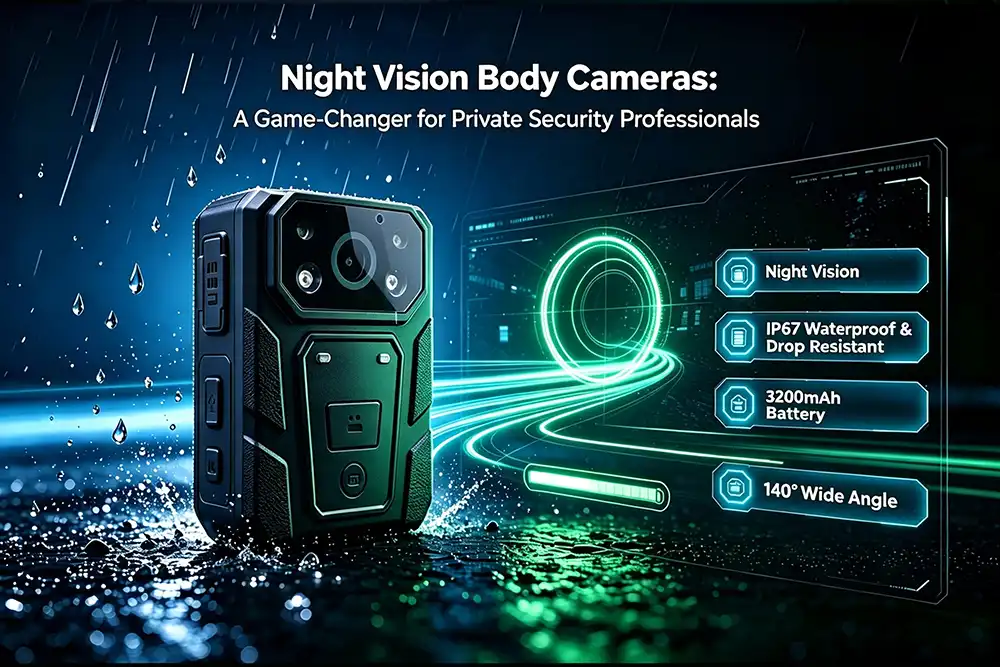
1. Weatherproof Construction: Enclosures with an IP67 rating keep the inside parts safe from dust and water exposure up to one metre. This makes sure that it will work in rain, snow, or humid situations that are typical for outdoor security jobs.
2. Extended Battery Performance: A 3200mAh battery can record video continuously for 10 hours or play audio-only for 11 hours or more. This longer runtime means that full shifts can be covered without having to be recharged in the middle of a check, which could lower the level of security.
3. Wide-Angle Coverage: The 140-degree field of view records the whole scene, eliminating the blind spots that come with narrow lenses. This coverage of the edges is helpful when more than one person enters the frame at the same time or when recording how spaces relate to each other at event scenes.
4. Instant Activation: With just one touch, security staff can start recording right away, without having to go through a series of menus. This fast rollout feature makes sure that important moments at the start of an event are recorded and not missed while the device is starting up.
These features take into account the operational facts that security workers have to deal with every night. The mix of technical ability and resistance to the environment makes a reliable tool that works even when things are tough. Storage options from 32GB to 256GB can meet different keeping needs, and H.264 MPEG4 compression keeps video quality high while making the most of available space by sizing files efficiently.
Evidence Quality and Legal Admissibility
The value of proof in a disagreement or court case is directly affected by how clear the recording is. At 60 frames per second and 1296P resolution, the video meets the standards for being shown in court in most states. High frame rates make it possible to record motion without blurring, which is very important for keeping records of events that happen quickly or identifying people. When GPS is added to recordings, they are automatically timestamped and geo-tagged, which proves their position and makes proof chain-of-custody standards stronger. Connecting to WiFi makes sending data to evidence management systems safe, which cuts down on handling that could damage file integrity.
How to Choose the Best Night Vision Body Camera for Your Security Needs
When making a procurement choice, technical details must be carefully weighed against practical needs and budgetary limits.
Operational Environment Assessment
The security teams need to plan out where and how night vision body cameras will be put in place. Patrolling the borders of an outdoor area is different from patrolling an indoor building. For underground parking garages, cameras need to be able to work in low light, and for outdoor use, they need to be able to handle weather and temperature changes. For example, commercial building security might put more emphasis on sound quality for tracking lifts, while event venue teams may need longer battery life for 12-hour shifts. By understanding these specific use cases, you can avoid buying equipment that doesn't work well in your real-world operations.
Essential Performance Metrics
The person identification distance is based on the night vision's functional range. For professional security purposes, the minimum distance needed for face recognition is usually between 10 and 15 meters. When infrared lights are used, they use about 20% more power than when recording in daytime, so the battery performance should be carefully looked at. Different standards exist for video resolution, but 1296P is currently the standard for professionals because it balances quality and file size. Ratings for durability, like IP67 waterproofing and drop-test certifications, show whether devices can be used in the field for years or need to be replaced often.
Vendor Selection and Support Services
Buying from well-known companies guarantees that the products are real, that the quality is consistent, and that the warranties will be honoured. Shenzhen Kexin Technology Co., Ltd. has been in business since 2015 and has CE, ROHS, IP67, and ISO standards. They serve law enforcement and security clients in over 30 countries. Their ODM and OEM skills allow them to meet specific regional needs or customisation requirements that standard goods can't. An 18-month guarantee is longer than the norm in the industry, which shows that the maker is confident in the product's durability. Technical problems are quickly fixed by dedicated engineering support, which cuts down on operational downtime that opens security holes.
Setting Up and Using Night Vision Body Cameras Effectively
Setting up and running things correctly will get you the best return on your investment and keep you safe.
Initial Configuration and Optimization
When security managers get new night vision body cameras, they should set the IR activation levels to match the lighting conditions in the place where they work. The coverage angle changes depending on where the camera is mounted. A chest mount records the scene from a natural angle, while a shoulder mount records what the officer sees. Changing the camera angle downward by 5 to 10 degrees usually gets the best results for capturing subjects without too much of the background. Power management settings balance the quality of the recording with the life of the battery. For example, turning down the screen light at night increases the amount of time that can be recorded without lowering the quality of the tape.
Maintenance Protocols for Longevity
Cleaning the camera lens and IR window on a regular basis keeps dirt from building up and affecting the night vision. Dust is removed by compressed air, and smudges are removed by microfibre cloths that don't scratch optical surfaces. Maintenance for battery health includes fully discharging and charging the battery once a month to keep the capacity from dropping. Firmware updates fix security holes and sometimes add new features. Checking the manufacturer's website every three months makes sure that devices are running the latest software versions. Formatting a storage card every 30 days stops file system mistakes that could mess up records during emergencies.
Legal Compliance and Privacy Considerations
Recording laws are very different depending on where you work and what you're recording. In public places, you can usually film people without their permission, but on private land, you might need to post notices or get their permission directly. Audio recording laws are different from video recording laws in many states. For example, some states need two people to agree to record audio. Before going on the offensive, security teams should talk to a lawyer who knows the area laws. Data retention policies need to balance practical needs with privacy concerns. For example, keeping video forever puts you at risk of being sued for things you don't need to be. Unauthorised people can't listen to private recordings if they are encrypted. This is especially important if the device is lost or stolen.
Procurement Guide: Buying Night Vision Body Cameras for Your Business
When you buy strategically, you weigh the short-term costs against the long-term benefits and dependability of the product.
Identifying Reputable Suppliers
Having a direct relationship with a maker cuts out middlemen and ensures that the goods you buy are genuine. Shenzhen Kexin Technology Co., Ltd. has clear price systems and discounts for buying in bulk, which make the cost per unit much lower for bigger security teams. Night vision body cameras meet international quality standards when they have certifications like CE, ROHS, and ISO. Customer reviews from similar security operations can help you understand how well the product works in real life and how quickly you can get help after the sale. Manufacturers who give both standard models and customisation services show that they can adapt to changing security needs.
Cost-Benefit Analysis and Total Ownership
The initial buying price is only one part of the total costs of owning. Long-term costs are affected by how often batteries need to be replaced, how much the warranty covers, and how easy it is to get technical help. Even though they cost more at first, higher-quality gadgets with longer guarantees usually end up being cheaper after three years of use. When you buy in bulk, you can usually get discounts of 15 to 30 percent, based on how much you buy. This makes fleet-wide rollout more affordable. The choice of storage capacity affects future scalability. For example, buying 128GB models costs more at first, but it saves money in the long run when retention needs grow.
Future Trends and Innovations in Night Vision Body Cameras for Security
As technology keeps getting better, security pros can do more and better things.
Artificial Intelligence Integration
AI-powered analytics are making human monitoring more effective. Smart algorithms find specific risks, like guns or aggressive behaviour, and send automatic alerts to command centers. Adding facial recognition makes it possible to match people in real time with watchlists, which improves response to known threats. Object tracking follows people across multiple camera feeds, so spying stays continuous while searches are going on. These night vision body camera features make it easier for security staff to think and work while also speeding up and improving the accuracy of incident detection.
Enhanced Power Management and Miniaturization
Improvements in battery technology promise longer operation times without making the device heavier. Recent developments in lithium-polymer formulations offer 30% more capacity while keeping the same size. Solar-assisted charging increases the time that a placement can last in remote areas that don't have regular access to power lines. The trend toward miniaturisation makes designs lighter and more comfortable to wear for longer periods of time. Modular designs let you change parts, like sensors or batteries, without having to replace the whole device. This makes it last longer and throws away less electronics.
Conclusion
Night vision body cameras have gone from being specialised tools for police to being necessary gear for professional security work. When you put together infrared imaging, high-resolution recording, and a ruggedised design, you get around the main problem of documenting in low light. When you do strategic procurement, you have to compare technical specs to practical needs, buy from reputable makers, and follow the right training procedures. The technology keeps getting better, with AI being added and battery life getting better. This means that security workers who are committed to accountability and evidence-based tactics will be able to do even more.
FAQ
1.How long does the battery last with night vision activated?
Professional units with 3200mAh batteries can usually record continuously for 10 hours, even when the IR LEDs are on full brightness. The actual performance depends on the temperature and the video quality settings you choose. Turning on power-saving features like screen lowering makes the process last longer. Teams that work 12-hour shifts should think about getting extra batteries or setting up ways to charge in between shifts to make sure they can keep providing coverage during long deployments with their night vision body camera.
2.What storage capacity do security teams typically require?
How much space is needed depends on how long records are kept and how good they are. A 64GB card can hold about 8 to 10 hours of 1296P video compressed with H.264. Teams that are recording full shifts should choose at least 128GB to allow for busy times. When cards reach full capacity, automatic overwriting cycles take care of the space, so the system keeps running without any help from a person. Cloud backup systems give you extra protection against losing data because your device gets stolen or broken.
3.Can these cameras record in complete darkness?
Infrared types can record clear black-and-white video in dark environments by giving off faint infrared light. The optimal range for identifying a person is usually between 10 and 15 meters. For legal purposes, the quality of an image taken in complete darkness is just as clear as an image taken during the day. Some more high-tech types have thermal imaging that looks for heat signals instead of reflected light. This lets you see things clearly even when there is light fog or smoke.
Partner with a Trusted Night Vision Body Camera Manufacturer
Shenzhen Kexin Technology Co., Ltd. makes professional-grade recording systems that are designed to work with sensitive security apps. Our IP67 weatherproofing, tried-and-true infrared technology, and 18-month warranties for our night vision body cameras show that we care about the reliability of our products. We've been helping police and security workers in more than 30 countries for more than 10 years, so we know the problems you face every night. Our ODM/OEM services let us tailor solutions to your exact needs, whether you need custom mounting systems, changes to meet local regulations, or the inclusion of fleet management software. Competitive bulk price makes it possible for an entire company to use the same product without sacrificing quality. Connect with our procurement specialists at sales@ishoop.com.cn to discuss your requirements, request technical specifications, or arrange product demonstrations that showcase real-world performance.
References
1. International Association of Chiefs of Police, "Body-Worn Camera Policy and Implementation Program," Law Enforcement Technology Standards, 2023.
2. Security Industry Association, "Video Surveillance Equipment Standards for Private Security Operations," Technical Guidelines Series, 2024.
3. National Institute of Justice, "Body-Worn Camera Performance in Varying Light Conditions: A Comparative Study," Research Report NIJ-2023-15.
4. American Society for Industrial Security, "Best Practices in Evidence Collection for Private Security Professionals," Professional Standards Manual, 2023.
5. Electronic Security Association, "Infrared Imaging Technology in Security Applications: Technical Overview," Industry White Paper, 2024.
6. Bureau of Justice Assistance, "Implementing Body-Worn Camera Programs: Procurement and Policy Considerations," Policy and Practice Guide, 2023.

USER EVALUATE
Here is the customer's evaluation of us