



Night Vision Body Camera Functions Demystified
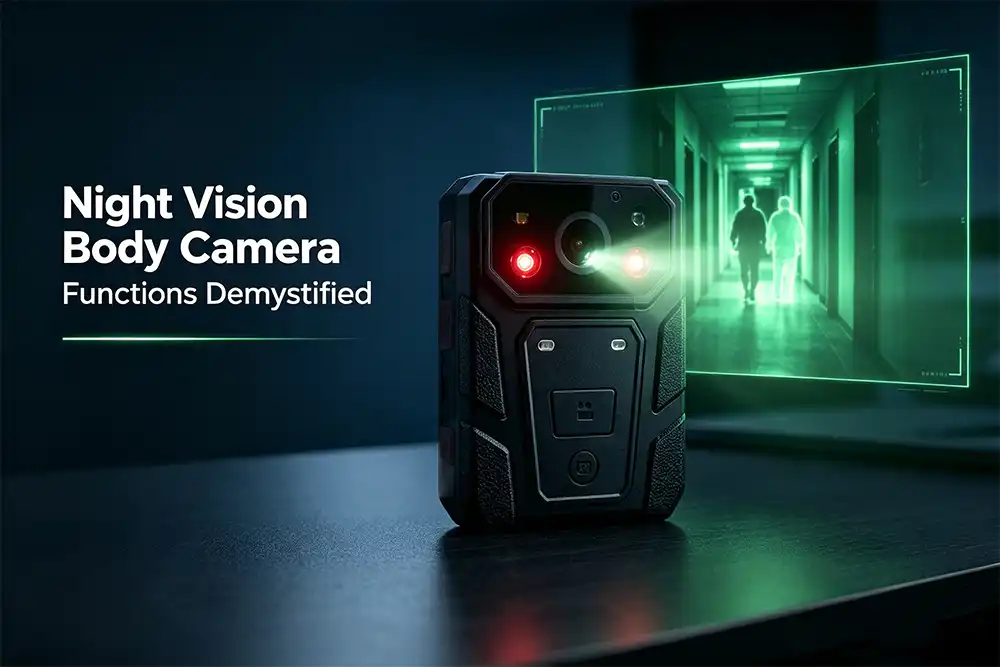
A night vision body camera represents a breakthrough in evidence capture technology, utilizing infrared illumination and sensitive CMOS sensors to document incidents in complete darkness. These wearable devices transform low-light or zero-lux conditions into clear video records through IR LED arrays that illuminate scenes invisible to the naked eye, converting them into detailed monochrome footage. The technology ensures law enforcement officers, security personnel, traffic police, firefighters, medical responders, and retail staff maintain continuous documentation regardless of lighting challenges, addressing the critical gap where standard cameras fail after sunset or in poorly lit environments.
Understanding How Night Vision Body Cameras Work
Core Technologies Behind Low-Light Recording
Infrared technology is what makes it possible to record in low light. The device uses infrared LEDs that give off light with wavelengths around 850nm. This makes the light invisible to most subjects but perfectly visible to the specialized CMOS sensor. This sensor is very sensitive to light; it can gather photons even when it's almost completely dark to make images that can be recognized. When there isn't enough light in the room, the camera instantly turns on its infrared array and records in black and white. This keeps facial features and incident details that would be lost in color video.
The CMOS sensor's architecture has bigger photodiodes than those in consumer cameras, which makes it more efficient at collecting photons. This design choice directly influences the quality of the video during night operations. This lets police identify suspects up to 15 meters away in total darkness. Because the 1296P quality keeps the image sharp across the whole frame, the evidence value stays the same whether the video is from daylight or night patrols.
Essential Features for Field Operations
The ability to work during long shifts depends on how well the batteries work. The 3200mAh power cell can record continuously for about 10 hours with the IR lighting on, which is enough time for full shifts without having to stop and charge in the middle of the shift. This feature solves the main problem that patrol officers and security guards have: they can't have equipment break down during important events. Power management algorithms lower power use by dimming the screen while recording and changing the IR intensity based on how reflective the scene is.
Adding GPS to a recording gives it more time and space context. Automatic timestamping and geotagging make proof chains that can't be argued with. They record not only what happened but also exactly when and where it happened. When investigating accidents, this feature helps traffic cops a lot because location data backs up written records and stops arguments about where the accident happened. Connectivity to WiFi makes it easier to move evidence to central storage systems, which makes managerial work easier and speeds up the case handling timeline.
Durability standards make sure that products work reliably in harsh conditions. The IP67 grade for waterproofing keeps the electronics inside safe from heavy rain, accidental submersion, and dusty environments that are common on building sites, at outdoor events, and in emergency situations. The tough housing can handle drops from normal holding heights and doesn't get damaged by contact during fights. These details are very important for firefighters going into dangerous rescue zones and security guards dealing with crowds that can get violent, where equipment is always at risk of being physically damaged.
Legal and Operational Advantages
When employees know that thorough recording is being done, they are much more aware of their surroundings. When both sides know that permanent recording is happening, officers act more professionally during encounters, citizens behave more cooperatively, and false charges drop by a large amount. Night vision body cameras make these benefits available 24 hours a day, 7 days a week. This gets rid of the "dark hours" problem, when disagreements didn't have any proof that could be checked.
Compliance frameworks are requiring more and more video documentation of enforcement activities that are open to the public. In many places, recording must now go on all the time during traffic stops, building checks and medical emergencies. These requirements can be met by cameras that can detect infrared light no matter when the incident happens. This protects businesses from liability and employees from making false complaints. Well-known companies like Shenzhen Kexin Technology Co., Ltd. offer 18-month warranties on their products to show that they are sure they will work well in business settings for a long time.
Comparing Night Vision Body Cameras to Standard Cameras
Performance Differences in Various Lighting Conditions
Standard night vision body cameras depend on light from the environment and stop working when the light level drops below about 5 lux. During evening shifts, video quality quickly drops, leaving behind grainy, useless footage that can't be used as evidence in court. Infrared models keep their clarity even when there is no light, so they can see facial features, license plates, and information about accidents even when it is completely dark. This performance gap is very important for overnight security patrols in businesses, traffic control on country roads that aren't lit up, and emergency medical responses in neighborhoods that don't have street lighting.
The quality of the audio recording is the same on both types of cameras, so you can get conversations and other sounds that are important for setting the scene. The main difference is that night vision models record both audio and video at the same time, while regular cameras only record audio when it's dark, making the video useless. Premium models come with GPS functionality even if they don't have night vision, but it's even more useful when combined with reliable visual documentation in all lighting conditions.
Feature Comparison for Procurement Decisions
Total cost of purchase is affected by how much space is available. The H.264 MPEG4 compression method does a good job of balancing file size with quality keeping, which lets you record for longer periods of time on the same amount of storage. Based on shift length and keeping rules, organizations can choose from 32GB, 64GB, 128GB, or 256GB options. Larger capacities allow for longer periods of time between data offloads. Intelligent overwrite feature stops delays when storage is full by automatically playing the older footage when memory is getting close to full.
Motion recognition modes and ongoing recording modes are used for different reasons. Continuous recording makes sure there are no gaps in the evidence, but it uses up all of your storage space and battery power. Motion-activated recording saves time and money, but it could miss events during moments of static observation. Law enforcement agencies usually require continuous recording during active duty hours. Private security companies, on the other hand, may use motion detection while watching over static areas like warehouse perimeters or parking lots overnight.
The small 2.0-inch LCD screen lets you look over an incident right away without having to go back to base stations. Before leaving a scene, officers make sure that important facts were recorded correctly and that the camera quality is good. This real-time proof feature keeps expensive return visits from happening if the quality of the footage turns out to be bad when it is looked at later. The 140-degree wide-angle lens catches a wide range of scenes, including things going on in the edges that narrow-field-of-view lenses might miss.
Buyer's Guide: How to Choose the Right Night Vision Body Camera
Defining Organizational Requirements
Law enforcement agencies put a high value on the integrity of evidence, so they require devices to meet chain-of-custody standards and produce videos that can be used in criminal processes. The safe USB data transfer method stops worries about wireless interception while keeping the evidence's authenticity. Industrial safety offices look for standards that show how long something lasts, like IP67 grades and impact protection, so that it can work in harsh industrial settings. Private security companies weigh the costs and benefits of different feature sets, finding the bare minimum that meets client needs without adding extra features that aren't necessary.
Environmental conditions determine the order of technical requirements. When traffic cops work in open highway areas, they need grades that protect them from extreme temperatures, rain, and road debris. Firefighters need cams that can handle being exposed to high temperatures and being hit while they are navigating structures. Medical staff benefit from small designs that allow for quick reactions to emergencies without getting in the way of caring for patients. Retail security teams like mounting options that aren't too obvious so they can keep a professional look when they're talking to customers.
Critical Evaluation Metrics
Video quality standards should include the lowest possible image (1296P), frame rate (30fps at the very least for smooth motion), and sensitivity to low light. For recording conversations, clear sound is just as important, so omnidirectional microphones with wind noise reduction are needed for outdoor use. The battery specs must take into account how much IR power is used, and they must be able to work for at least 10 hours to meet industry standards for full-shift coverage without stopping to charge.
Warranty terms show that the company that made the product trusts it to work well. Because it was built to professional standards, the 18-month warranty period is longer than most consumer electronics warranties. Post-sale support is very important during the implementation phase, as responsive expert help fixes configuration problems and makes sure that the system works well with current evidence management infrastructure. Organizations should make sure that the help methods they offer include email, phone, and a lot of documentation.
Verification of certification keeps low-quality goods from getting into professional use. CE and ROHS certifications show that the product is safe for electrical equipment and the environment, while ISO certification shows that the product is managed with quality throughout the whole manufacturing process. Instead of depending only on marketing claims, procurement teams should ask for approval documents from vendors during the evaluation phase to make sure that goods meet international standards. Night vision body camera verification is essential for organizational compliance.
Practical Tips for Effective Use of Night Vision Body Cameras
Optimal Positioning and Activation Protocols
Where the night vision body camera is placed has a big effect on how useful the footage is. Mounting in the middle of the chest gives stable views and reduces motion blur during foot chases. Mounting on the shoulder, on the other hand, improves sight-line alignment and shows the operator's real field of view. Don't put your device in a pocket or on a belt that could get in the way of your arms, tools, or changing body positions. Secure positioning stops the camera from turning while people are moving around, so the frame stays the same during incidents.
The one-touch activation feature lets you start recording right away without turning the device on all the way, which lets you catch the start of an incident that would normally be missed during a multi-step startup sequence. Activation should be practiced during training drills so that the move becomes automatic muscle memory. This will make sure that deployment happens naturally in high-stress situations. Regular testing makes sure that buttons work and that recording indicators work right, so that equipment doesn't break down at crucial times.
Power and Storage Management Strategies
Screen lighting uses a lot of power, so lowering the display while recording will extend the battery life. Turn off WiFi when you don't need to join in real time and only turn it on for planned data transfers. At the start of each shift, check the battery status and replace or charge any units that are below 80% capacity to make sure they work for the full time. Companies should keep extra batteries on hand for long operations so that they can be swapped out quickly and without stopping recording during long events.
When planning storage capacity, retention policies and offload frequency should be taken into account. If you have the right administrative infrastructure, daily transfers work well for normal patrol operations. Multi-day abilities, on the other hand, are better for distant deployments or agencies that have centralized weekly processing plans. Regularly checking the storage's capacity keeps it from running out of space without warning, and automatic overwriting acts as a safety net rather than the main way to handle storage.
Compliance and Maintenance Requirements
Data privacy laws change a lot from one place to another, governing who can record, how long they have to keep data, and who has to share it. Agencies need to make clear rules about when recording is required, allowed, or not allowed, and they need to train their staff on the rules in their area and the organization's rules. Using secure transfer methods and access-controlled storage systems to keep the chain of custody intact stops claims of tampering with evidence.
Routine repair makes sure that equipment works well and lasts longer. Once a week, the lenses should be checked to make sure they are clean, the fixing is secure, and there is no physical harm. Firmware updates fix security holes and make features better, but they need to be connected to maker update sites on a regular basis. Cleaning the lens to improve image quality, replacing the battery to extend runtime, and reformatting the storage to fix file system corruption are all common ways to fix problems. Setting up preventive maintenance schedules cuts down on unexpected breakdowns and gets the most out of your equipment investment.
Procurement and Post-Purchase: Ensuring Smooth Acquisition and Support
Strategic Sourcing Approaches
For deployments with more than one unit, bulk buying deals can save you a lot of money. When police departments outfit whole patrol divisions, security companies outfit guard teams, or store chains standardize loss prevention equipment, they can get bulk discounts that lower the cost of buying each item. Authorized dealers sell real goods with valid warranties, so you don't have to worry about the fake goods that come from unauthorized sellers with strangely low prices.
There are times when you can get good deals on professional-grade night vision body cameras, like during budget cycles or trade shows in your business. Manufacturers sometimes offer limited-time deals like longer guarantees, packages of accessories, or better payment terms to get people to buy more. When you time your purchases to take advantage of these chances, you get the most out of your budget without lowering the quality of the tools or making it harder to get help.
Post-Purchase Support Ecosystem
Manufacturer defects, component failures, and performance loss from normal professional use should all be covered by the warranty. Make it clear which warranty exclusions apply to damage done on purpose, changes made without permission, or extreme use that goes beyond what the manufacturer intended. Repair services should be able to turn things around quickly so that operations don't have to be interrupted too much. Pre-emptive replacement programs should keep the force strong during equipment service times.
The accessory community makes devices more useful and lets tools fit specific needs. Different types of mounting choices are available, such as chest harnesses, epaulette clips, and helmet mounts. Longer battery packs allow for unusually long shifts or nonstop operations for several days during big events. Software updates add new, better features after the product has been bought. As technology changes, these updates could include better compression algorithms, more advanced video analytics, or more system integrations.
Shenzhen Kexin Technology Co., Ltd. works with law enforcement and security workers in more than 30 countries, showing that they have global application experience in a range of working settings and legal frameworks. This global presence shows that the product has been tested in a variety of settings and meets the standards of many different countries. This lowers the risk of adoption for businesses that need reliable solutions for collecting proof.
Conclusion
Night vision body cameras fill in the important documentation gap that makes it hard to keep people safe and secure at night. Infrared technology, along with professional-grade features like long-lasting batteries, waterproof construction, and smart storage management, makes it possible to record evidence 24 hours a day. When organizations choose the right devices that fit their operating needs, the environment, and their budget, they gain legal protection, openness, and responsibility during all job hours. The worth of equipment is maximized over its multi-year service lifecycles when it is deployed correctly, maintained according to protocol, and sourced strategically. This supports mission goals and protects people and organizations from liability risk.
FAQ
1.How long does the battery last during continuous night recording?
With the infrared light on, the 3200mAh battery can power the night vision body camera for about 10 hours straight of video recording. The actual length of time depends on how strong the infrared light is set, the temperature of the area, and the use of extra features like GPS or WiFi. With audio-only recording, the process lasts longer than 11 hours. Organizations should plan for full-shift coverage during standard business hours, and they should keep extra batteries on hand in case of long-term problems or work.
2.Can night vision footage be used as legal evidence?
Infrared records are fully legal as long as they are made with certified technology that is kept in good shape and handled safely throughout the chain of custody. The 1296P resolution gives enough information to identify faces and reconstruct what happened. Courts will accept black-and-white night footage just as much as color daytime footage, as long as timestamps, GPS data, and file integrity can still be checked. No matter what recording technology is used, agencies must follow the rules for treating proof in their area.
3.What storage capacity is needed for typical operations?
A 64GB storage setup can hold about 8–10 hours of 1296P H.264 compressed video, which is enough for normal shifts with daily offloads. 128GB or 256GB capacities are better for agencies that need to transfer data once a week or keep it for a long time. Planning for storage should take into account policies on how long to keep footage, how often incidents happen, and when to do administrative work so that footage that hasn't been looked at yet doesn't get erased too soon.
Partner with a Trusted Night Vision Body Camera Manufacturer
Organizations seeking reliable evidence capture solutions gain significant advantages when working with experienced manufacturers. Shenzhen Kexin Technology Co., Ltd. is a trusted night vision body camera supplier specializing in body-worn camera systems for law enforcement, security, and emergency response sectors worldwide. Our infrared-equipped models meet CE, ROHS, IP67, IK09, and ISO certifications, ensuring equipment performs reliably under demanding field conditions. We provide ODM/OEM customization to adapt devices to specific operational requirements and jurisdictional compliance needs.
Contact our procurement specialists at sales@ishoop.com.cn to discuss bulk orders, technical specifications, and integration support. We offer personalized consultations evaluating your operational environment, budget parameters, and feature priorities to recommend optimal configurations. Our 18-month warranty and dedicated engineering support ensure your investment delivers long-term value. Whether equipping patrol divisions, security teams, or emergency responders, we provide scalable solutions backed by a decade of manufacturing expertise and deployment experience across 30+ countries.
References
1. International Association of Chiefs of Police. (2021). Body-Worn Camera Model Policy. Alexandria: IACP Publications.
2. Bureau of Justice Assistance. (2020). Body-Worn Camera Toolkit: Implementation Guide for Law Enforcement Agencies. Washington: U.S. Department of Justice.
3. Security Industry Association. (2023). Video Surveillance Standards and Best Practices for Professional Security Applications. Silver Spring: SIA Technical Committee.
4. National Institute of Standards and Technology. (2022). Performance Metrics for Body-Worn Camera Systems in Low-Light Environments. Gaithersburg: NIST Special Publication Series.
5. Journal of Forensic Sciences. (2023). Evidentiary Value Assessment of Infrared Body Camera Footage in Criminal Proceedings. Volume 68, Issue 3, pp. 892-907.
6. Fire Engineering Magazine. (2022). Documentation Technologies for Emergency Response Operations: Implementation and Training Protocols. Saddle Brook: Fire Engineering Editorial Board.

USER EVALUATE
Here is the customer's evaluation of us