



Key Benefits of Body Cameras for Patrol Officers
The US law enforcement landscape has been transformed by Body Camera for Patrol Officers technology. Patrol officers develop trust between law enforcement and local communities by activating their body-worn gadgets during regular contacts. Accountability, transparency, and operational efficiency increasingly depend on recording solution choice. Distributors and procurement managers make crucial decisions that affect finances, legal compliance, and officer safety. This guide helps B2B decision-makers evaluate patrol body camera systems based on technical specifications, vendor capabilities, and regulatory requirements.
Understanding How Body Cameras Work for Patrol Officers
Modern Body Cameras for Patrol Officers have advanced components that operate together during patrols. These systems' law enforcement effectiveness depends on their technology.
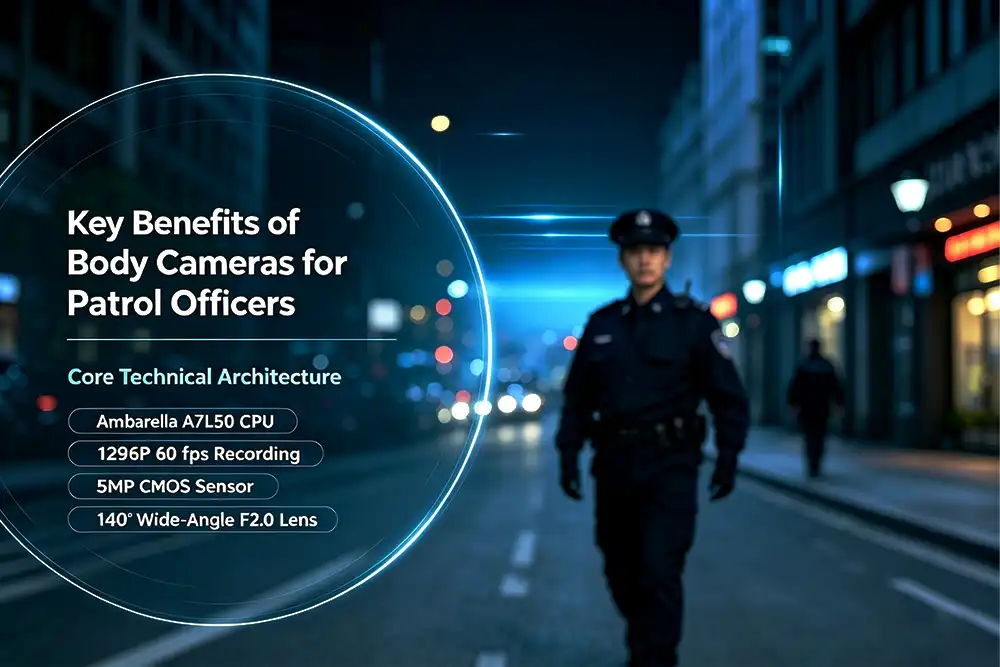
Core Technical Architecture
The ISHOOP Police Action Camera shows how chipset technology improves performance. The Ambarella A7L50 CPU encodes video for seamless 1296P 60 fps recording. Even in poor lighting, the 5MP CMOS sensor creates detailed images, and the 140-degree wide-angle F2.0 lens covers the scene. Officers may document encounters without losing frame-edge information with this technological basis.
H.264 MPEG4 compression balances video quality and storage efficiency when recording. A 32GB memory card holds eight hours of 1080P recording, but 128GB cards hold even more. Officer ID, timestamp, and date are watermarked onto video files to protect chain-of-custody integrity for trial presentation.
Data Management and Security Protocols
Unauthorized access to critical footage is prevented via secure storage. Officers can watch videos but not delete them without PC management software administrator privileges. Agencies handling sensitive processes can implement AES256 encryption. The unique device ID and six-digit officer ID system link every recording to persons and equipment, ensuring accountability.
USB 2.0 transmission protects Body Camera for Patrol Officers' evidentiary data from wireless vulnerabilities that might jeopardize admissibility. Officers may immediately check recording quality on the 2-inch TFT-LCD screen before departing from incident sites.
Key Benefits of Body Cameras for Patrol Officers
Body Camera for Patrol Officers programs assist law enforcement operations in various ways. These benefits are valuable to procurement decision-makers considering technology expenditures.
Enhanced Accountability and Transparent Documentation
Cambridge University research found that full-body camera programs reduce police-public complaints by 87%. Conflict lessens when citizens know interactions are documented. Knowing their acts are recorded makes officers more professional. Collective responsibility boosts community trust in law enforcement.
ISHOOP's timestamp watermarking gives every frame verifiable metadata. This paperwork provides factual baselines for internal investigations and civilian complaint assessments, protecting police and community members from false charges. Transparency is generating verifiable, tamper-proof, legal-grade paperwork.
Improved Evidence Collection and Case Resolution
High-resolution footage boosts prosecutions. 1296P recordings capture license plates, face traits, and ambient elements that witnesses overlook. Audio recording retains Miranda warnings, consent searches, and suspect statements—essential judicial admissible factors.
Courts frequently use video evidence to decide cases. Clear body camera footage minimizes trial times and typically leads to early guilty pleas, saving judicial resources. H.264 MPEG4 compression preserves evidence quality while enabling safe digital storage and sharing with prosecutors, defense counsel, and judges.
Comparing Leading Body Camera Solutions for Patrol Officers in 2026
Understanding how different manufacturers develop Body Cameras for Patrol Officers helps procurement decision-makers. Comparing important criteria helps organizations find operational and budget-friendly alternatives.
Evaluating Video Quality and Recording Capabilities
Video resolution affects evidence usefulness. Some manufacturers provide 4K recording, but large files make storage and sharing difficult. ISHOOP 1296P captures enough information for facial recognition and license plate scanning while retaining moderate file sizes. Smooth motion rendering during fast-action situations like car pursuits and foot chases is achieved at 60 fps.
Lens angle counts. Ultra-wide-angle lenses distort distances and facial characteristics, while narrow-angle lenses overlook peripheral activity during conflicts. The 140-degree wide-angle F2.0 field of view covers the scene like human peripheral vision, making courtroom presentations easier to understand for judges and jurors.
Battery Performance and Charging Infrastructure
Extra battery life decreases the Body Camera for Patrol Officers. Mid-shift charging devices cause coverage gaps and equipment management issues. The 3200mAh capacity for 10-hour recording solves these issues for regular patrol shifts. Officers don't record continually but activate devices during public contacts, agencies should compute recording length based on realistic usage patterns.
Total ownership includes charging infrastructure expenses. Optional docking stations simplify multi-device administration for bigger departments, while single-unit USB charging reduces facility modifications. Procurement teams should acquire power usage details to estimate operational expenses.
Legal and Compliance Considerations When Using Body Cameras
Implementing Body Camera for Patrol Officers programs entails navigating complicated, jurisdiction-specific laws. Failure to comply exposes agencies to civil responsibility and evidence admissibility issues.
Privacy Laws and Recording Consent Requirements
Recording regulations vary greatly by state. Patrol officers recording private dwelling conversations have challenges in eleven states that require two-party authorization for audio recordings. Some jurisdictions require conspicuous recording notices, while others ban recordings in critical settings like hospitals and schools without guidelines.
Compliance elements like one-touch audio muting for private chats or automatic deactivation in geo-fenced restricted areas should be included in procurement specifications. ISHOOP password security and administrator-controlled deletion enable agencies to protect evidence and privacy.
Data Retention Policies and Evidence Management
State laws and agency standards require film retention for 30 days to many years, depending on event categorization. Systems must handle different timeframes without increasing storage costs. The H.264 MPEG4 compression efficiency helps agencies balance quality and storage costs.
Agencies lacking efficient retrieval mechanisms face administrative difficulties from FOIA requests. ISHOOP simplifies public records requests by sorting by date, time, officer ID, and GPS position. Redaction protects bystander privacy and meets transparency requirements.
Best Practices for Purchasing and Implementing Body Cameras for Patrol Officers
Thinking beyond specification sheets is essential for successful Body Camera for Patrol Officers acquisition. Technology investments' advantages depend on implementation plans.
Defining Operational Requirements and Use Cases
Before choosing gear, agencies should evaluate patrol settings. Urban departments require good low-light performance for night patrol in dark regions, while rural agencies need long battery life for remote response times. GPS tracking and wide-angle optics let traffic enforcers capture multi-vehicle accidents.
Budget limits require priority. Never sacrifice core functionality like dependable recording, enough battery life, and sturdy build for GPS tracking. Scalable storage lets you start small and grow as finances allow.
Supplier Evaluation and Partnership Criteria
When buying mission-critical equipment, reputation and durability are key. Shenzhen Kexin Technology Co., Ltd., a law enforcement camera specialist for more than a decade, shows longevity and skill. The CE, ROHS, ISO, IP67, and IK09 certifications verify worldwide quality requirements.
ODM/OEM allows agencies to integrate radio systems or alter mounting gear for standard designs. Flexible solutions outperform one-size-fits-all items in the long run.
Implementation Strategies and Training Programs
Rolling deployments help agencies find issues before fleet changeover. Operations input from small patrol unit pilot projects informs policy refinement and training needs. Officer buy-in rises when line staff engages in selection and assessment.
Complete instruction includes device operation, legal requirements, privacy regulations, and evidence management. The ISHOOP one-button design reduces training time, but policy compliance requires regular refresher classes and scenario-based exercises.

Conclusion
Modern law enforcement accountability and efficiency depend on Body Camera for Patrol Officers technologies. When agencies choose the right solutions, lower complaints, increased evidence gathering, police safety, and community trust justify procurement spending. Tech specs key, but effective programs combine video quality, battery life, durability, and usability with budget and operational needs. Vendor selection and implementation must consider legal compliance, evidentiary integrity, and privacy. Experienced manufacturers offer customization, quality, and quick support that turn equipment purchases into long-term operating assets for agencies.
FAQ
1. How long does a body camera battery last during typical patrol shifts?
Recording resolution and screen use determine battery life. With the LCD screen off, the ISHOOP Body Camera for Patrol Officers can record at 720P for 10 hours, enough for eight-hour patrol shifts with overtime. Expect eight hours at 1296P. External power banks allow officers to patrol vehicles longer, reducing limits. Officers seldom record constantly but activate devices during public contacts, thus agencies should calculate predicted recording duration based on actual usage.
2. What video resolution do patrol officers actually need for evidence purposes?
4K sounds spectacular, but 1296P provides enough quality for license plate scanning, facial recognition, and courtroom presentation without causing file management issues. Higher resolutions greatly raise storage costs and hinder file exchange with prosecutors and courts. The 1296P standard captures enough detail while keeping sensible file sizes for evidence processes.
3. Can body camera footage be deleted or edited by officers?
Well-designed systems avoid tampering. Only administrators with PC management software access can delete ISHOOP passwords. Officers can review recordings but not delete them, ensuring evidentiary integrity and chain-of-custody. This security architecture prevents unintentional and purposeful evidence erasure.
Partner With a Trusted Body Camera for Patrol Officers Manufacturer
Shenzhen Kexin Technology Co., Ltd. offers tailored consulting for agencies implementing or upgrading body-worn camera programs. Our law enforcement camera engineers have almost a decade of experience developing CE, ROHS, ISO, IP67, and IK09-compliant products. We provide flexible ODM/OEM customization for agencies with particular operating needs, 18-month warranty coverage, and timely technical support. Our sales staff at sales@ishoop.com.cn can help procurement managers find a dependable Body Camera for Patrol Officers supplier with full requirements, bulk pricing, and deployment planning.
References
1. White, Michael D. "Police Officer Body-Worn Cameras: Assessing the Evidence." Washington, DC: Office of Community-Oriented Policing Services, 2014.
2. Ariel, Barak, et al. "The Effect of Police Body-Worn Cameras on Use of Force and Citizens' Complaints Against the Police: A Randomized Controlled Trial." Journal of Quantitative Criminology 31, no. 3 (2015): 509-535.
3. Lum, Cynthia, et al. "Research on Body-Worn Cameras: What We Know, What We Need to Know." Criminology & Public Policy 18, no. 1 (2019): 93-118.
4. Jennings, Wesley G., et al. "Evaluating the Impact of Police Officer Body-Worn Cameras on Response-to-Resistance and Serious External Complaints." Journal of Criminal Justice 58 (2018): 83-92.
5. Mateescu, Alexandra, et al. "Body-Worn Cameras: A Policy Scorecard." New York: AI Now Institute, New York University, 2017.
6. Peterson, Bryce E., et al. "Police Body-Worn Camera Research: Implementation and Outcomes." Washington, DC: National Institute of Justice, 2018.

USER EVALUATE
Here is the customer's evaluation of us