



What is AES256 encryption for body worn cameras?
When you're working in law enforcement, security, or emergency response, the footage captured on your body-worn camera isn't just a recording—it's evidence that could make or break a case. That's where AES256 encrypted body worn camera technology becomes essential. AES256 encryption is a military-grade security protocol that protects video and audio files from the moment they're recorded, ensuring that sensitive information remains inaccessible to unauthorized individuals even if your device is lost or stolen. This 256-bit symmetric key encryption scrambles data so thoroughly that current technology would take billions of years to crack it through brute force attacks, making it the gold standard for protecting chain-of-custody integrity and ensuring your evidence holds up in court.
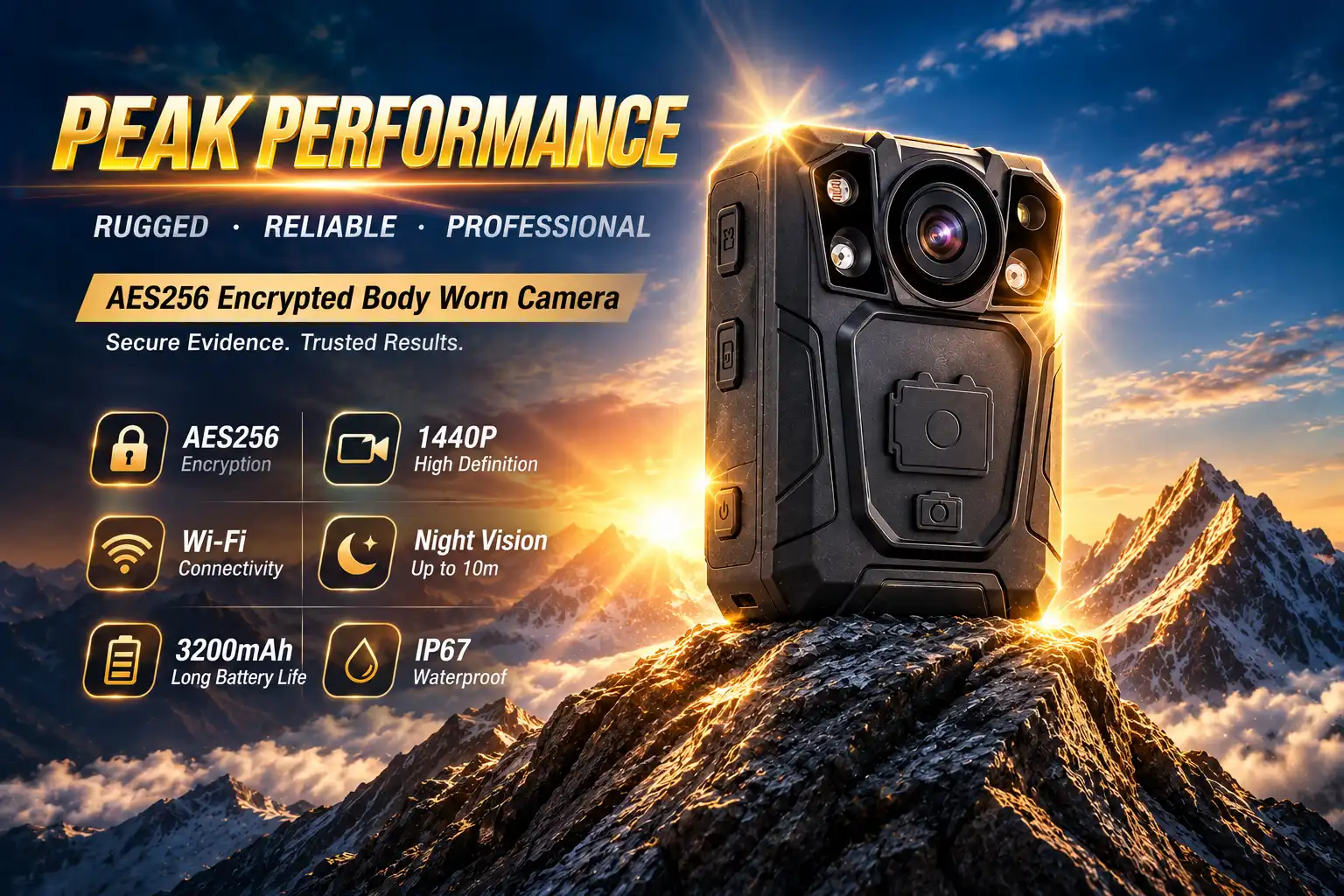
Understanding AES256 Encryption in Body Worn Cameras
What Makes AES256 the Gold Standard
In law enforcement, security, and emergency response, body-worn camera video may make or break a case. Body worn cameras using AES256 encryption are required. Military-grade AES256 encryption safeguards video and audio files from the time they're captured, keeping critical data safe even if your device is lost or stolen. This 256-bit symmetric key encryption scrambles data so effectively that brute force assaults would take billions of years to break it, making it the gold standard for chain-of-custody integrity and court trial evidence.
How Encryption Works in Real-Time Recording
Behind the scenes, AES256 encrypted devices do wonderful things when you push record. The camera's hardware encryption mechanism scrambles video and audio immediately. Professional chipsets commonly include the Ambarella H22 module. When writing to memory cards, SHOOP body-worn surveillance cameras employ this encryption. This ensures that your film is never stored insecurely.
This real-time encryption doesn't affect recording quality or frame rate. The encryption processor runs in the background when recording 1440P or 1080P at 25 or 50 fps. H.265 compression keeps files small even with encryption. Whether you utilize 64GB, 128GB, or 256GB memory cards, your storage capacity remains optimal.
Compliance and Legal Requirements
In the US, laws like CJIS (Criminal Justice Information Services) require law enforcement agents to take strict steps to protect data. In Europe, GDPR has similar rules for protecting privacy. An AES256 encrypted body worn camera meets these strict requirements because it keeps data private from the time it is captured until it is sent or stored. Your recorded proof stays true throughout the whole chain of custody, which is very important when the footage needs to be used in court. Without the right encryption, defense lawyers can question the authenticity of evidence. However, military-grade encryption gets rid of these problems.
Key Security Features and Benefits of AES256 Encrypted Body Worn Cameras
Protection Against Unauthorized Access and Tampering
If someone who shouldn't be able to see your video gets their hands on your device, they can't play, copy, or change the files. This is the main benefit of encryption. If you don't have the right decoding keys, the protected files just show up as useless binary data. This protection goes beyond keeping things from being stolen. When you send files via USB 2.0 or stream video over Wi-Fi networks, encrypted transmission keeps unauthorized people from intercepting your traffic.
Body-worn video cameras from SHOOP provide multiple levels of security. Our gadgets work with HTTPS server protocols to keep your network safe and with dynamic PIN code authentication for Wi-Fi connections. Not only are saved files encrypted, but so is RTSP data that streams video, audio, and text during live broadcast. With this all-around method, your private video is safe whether it's on the device itself, being sent to a computer, or being live-streamed to your command center.
Comparative Advantage Over Standard Encryption
You might be wondering why AES256 is important when AES128 is also a good encryption method for an AES256 encrypted body worn camera. The difference is between planning for the future and meeting legal requirements. As computers get faster, encryption that seems impossible to break today might be easy to crack tomorrow. The huge key space in AES256 makes sure that your past proof will stay safe even if technology changes in the future. 256-bit encryption is now required by many government contracts and insurance plans, so it's not just a matter of taste; it's a requirement for doing business.
Real-World Impact on Evidence Integrity
Consider a police officer summoned to a private home party. The body camera collects witness statements, scene details, and police conduct. At trial months later, the defence wonders whether the footage was modified. Due to digital signatures, AES256 encrypted body worn cameras' videos haven't altered since recording. Watermarking elements like User ID, Device ID, date, time, and geo-tags combined with encryption provide a trail that courts can verify.
The problems that business security teams face are similar. When a store security guard records a shoplifting event or a hospital security officer records a fight between patients, the footage is protected to protect both the organization and the people involved. Having documents that can be checked and can't be changed lowers your risk of being sued and settles disagreements with facts instead of conflicting testimony.
How to Verify AES256 Encryption on Body Worn Cameras
Checking Device Specifications and Certifications
When looking at purchasing body worn cameras, you need clear ways to make sure they are what they say they are. First, look over the technical specifications sheet. Look for clear references to "AES256 encryption" in the section on security features. At SHOOP, we make it clear that our devices offer "AES256 encryption during writing files to memory card" as an extra security measure. This lets procurement teams know exactly what kind of data protection is available.
Certifications are very important. International standards like CE, ROHS, IP67, and IK09 are met by devices that show the maker cares about quality and compliance. These licenses don't prove the strength of the encryption, but they do show that the maker follows strict testing procedures. By asking for FIPS 140-2 compliance documentation, you can be sure that the cryptographic module meets the security standards set by the federal government.
Third-Party Security Audits and Vendor Documentation
Manufacturers with a good reputation give detailed security white papers that explain how they use encryption. These papers should say whether the encryption is software- or hardware-based. Hardware-based encryption is safer because it works at the chip level and can't be broken by software bugs or malware. Ask your vendor for penetration testing reports from outside security companies that show the encryption can't be broken through known attack methods.
Key management methods should be included in vendor compliance documents. What is the process for making, storing, and sending encryption keys? Secure systems use Key Management Systems (KMS), which add keys while the device is docking and never store them in plain text. SHOOP's camera manager software lets administrators manage all camera settings, including security settings, through PC management software that requires a password and enforces the right way to handle keys.
Practical Validation Procedures
Your IT security team can do certification tests on the gadgets once they arrive. Try to use a regular card reader to get to the memory card directly, without using the authorized docking station or management software. If the files show up as data that can't be read instead of video files that can be played, the encryption is working right. Check the USB connection in mass storage mode. If the device is properly encrypted, it should ask for authentication before decrypted files can be accessed, even when the device is connected to a computer.
To make sure the protection is real, you can also check to see if it slows down the device. With good hardware-based solutions, encryption should not add much extra work. Test recording time—our 3200mAh battery lets us record continuously in 1080P for over 10 hours with encryption on, showing that the encryption processor works well without draining the battery too quickly. If a device's performance drops a lot when encryption is turned on, it could mean that the design isn't very good, which could lead to practical problems in the field.
Comparing AES256 Encrypted Body Worn Cameras: What Procurement Managers Need to Know
Market Overview of Leading Manufacturers
There are a number of well-known companies that make body-worn cameras, and each one has its own method to encryption and the general capabilities of the device. It is mostly companies like Axon that make combined evidence management systems that rule the North American law enforcement market. Motorola Solutions sells ruggedized phones that have good cellular connection. Panasonic makes cameras with longer battery lives that are good for working long hours. Reveal works on the UK and European markets with products that are GDPR-compliant.
In this market, SHOOP competes by providing adaptable, customizable solutions with strong technical specs at reasonable prices. The performance of our Ambarella H22 chipset is as stable as that of high-end names, and our OBV4689 sensor can take clear pictures at night up to 10 meters away, even when lighting is poor. The 140-degree wide-angle lens makes sure that the whole scene is captured, with no blind spots that could make it easy to miss important details.
Critical Product Attributes for Comparison
When procurement managers compare devices, they should look at more than just encryption. The performance of the battery directly affects how well the operation works. Our devices can record continuously in 1080P for 12 hours or up to 15 hours at lower resolutions, so there's no need to worry about charging in the middle of a shift. If you record and stream at the same time, this time drops to 7-8 hours, which is still enough to cover most standard shifts.
Connectivity options affect how well work gets done on an AES256 encrypted body worn camera. Dual-band Wi-Fi (2.4G and 5G) with channels that can be set up through the camera manager software makes network interaction adjustable. Built-in GPS that lets you play back routes gives video useful location information. The SOS function lets officers send emergency messages to command centers when they are in dangerous situations. All of these parts work together to make a full system for collecting evidence and keeping officers safe.
In tough working situations, toughness is important. IP67 protection keeps the device safe from rain and accidental submersion, and drop resistance from up to 200 cm makes sure it can handle the everyday drops and hits that come with the job. The strong metal clip that can rotate 360 degrees makes the connection safe and stays in place while you work out, but it's also easy to move when you need to.
Security Trade-offs and Long-Term Cost Considerations
At first glance, devices that don't protect data may seem cheaper, but this apparent savings comes with big risks in the long run. One data breach involving unprotected footage can lead to lawsuits for invasion of privacy, fines from the government, and damage to the company's reputation that is much worse than any savings on equipment costs. When businesses don't take the right steps to protect their data, their insurance rates may go up.
Devices that are encrypted do need the right framework for managing proof. You'll need docking stations that work with your devices and software that can safely handle decryption keys. This means looking at not only how much the camera costs, but also how much the whole system costs, including the equipment for the back end. But this investment saves the most important things about your organization: the trust of the people you serve and the accuracy of your operational documentation.
Procuring AES256 Encrypted Body Worn Cameras: A B2B Buying Guide
Trusted Sourcing Channels for Bulk Purchasing
Direct maker ties often offer the best value and help when buying a lot of body worn cameras. When you buy from well-known companies like SHOOP, you can be sure that the products you buy are real and come with full warranty coverage and technical support. As a specialized AES256 encrypted body worn camera manufacturer based in Shenzhen, we offer ODM/OEM customization services that make devices fit the needs of each organization. This could include custom firmware, special mounting hardware, or connecting the devices to existing evidence management systems.
Wholesale wholesalers work with businesses that would rather work with local partners who can help them in their own language and ship their goods more quickly. You can use these relationships to save money when buying in smaller amounts or when you need more than just cameras. Direct connections with manufacturers, on the other hand, are better as order numbers rise because they offer better pricing and direct access to engineering help for technical questions.
Evaluating Pricing, Warranty, and After-Sales Support
When negotiating prices, the total cost of ownership should be taken into account, not just the cost per unit. How much storage space does the base price include? What kinds of software licenses do I need? Is there training for cops and IT staff from the vendor? Buying a full package with training, management software, and docking stations is often a better long-term investment than buying just the tools you need and then spending a lot of money on extras later on.
The terms of each manufacturer's warranty are very different. Standard one-year guarantees might be enough for smaller deployments, but companies that have a lot of officers should talk about getting longer warranties and early replacement plans. If an officer's camera breaks down during their shift, getting a new one quickly is more important than how long it takes to fix. Ask vendors about their advance RMA processes and whether they keep replacement units in stock in the United States or if they need to be shipped from another country.
Support after the sale is what sets professional sellers apart from commodity providers. At SHOOP, we have expert teams with a lot of experience who know both how the hardware works and how the cameras are used in real life. We help customers improve their evidence management workflows and training programs in addition to fixing problems with devices. This partnership approach makes sure that your investment gives you the most value in the long run.
Aligning Features with Organizational Requirements
Before you buy something, make sure that the device's features match your unique operating needs. Do your officers work 12-hour shifts that need batteries that last longer? Our 3200mAh battery can easily handle these needs. Need pre-recording to catch what happened before an officer turned on the camera? Our pre-recording can last anywhere from 5 seconds to 2 minutes, so you can make sure you get important background information even if activation happens after an event has started.
Think about your system for managing info. If you want to use centralized evidence review, make sure the cameras can connect to your chosen way. Our devices give you a lot of choices, like USB 2.0 transfer, Wi-Fi with endpoints that you can set, and live streaming at different resolutions and bit rates to match your network's capacity. The camera manager program offers centralized setup management, which means that IT managers can set the same settings for all of your devices from afar instead of having to set them up one by one.
The amount of storage space you choose should be based on standard shift lengths and recording trends. When you record continuously at a high resolution, you need more storage space than when you record when something happens. Loop recording can increase storage space by automatically overwriting old footage, but this function should be used with care when gathering proof. We have memory sizes ranging from 32GB to 256GB, so companies can choose the right amount of space for their evidence-keeping policies without having to pay for space they don't need.
Conclusion
To keep private video footage from police operations, security checks, and emergency situations safe, you need more than just reliable recording. You need military-grade data security. With AES256 encrypted body worn camera technology, body worn cameras go from being simple recorders to tools for gathering evidence that keep the chain of custody intact and can stand up to court review. The technology protects your files without affecting the quality of the video, the battery life, or the ease of use. It works in the background without being noticeable. As more purchase requirements call for strong data protection measures, picking devices with the right security setup becomes a must, not a choice. Companies that put proof security first now can avoid the legal problems, compliance violations, and damage to their image that can come from having footage that isn't safe tomorrow.
FAQ
1. Can brute force attacks be used to break encryption?
To use brute force to break AES256 encryption, you would have to try all 2^256 possible key combinations. This is mathematically impossible to do with today's supercomputers because it would take billions of years to complete. When used correctly, the encryption stays safe against all known attack methods.
2. Does encryption impact recording quality or battery performance?
Hardware-based encryption is used in high-quality devices like those with the Ambarella H22 chipset to quickly process data without affecting frame rates or video quality. The effect on the battery is very low—our devices can still record in 1080P for 12 hours or more with encryption turned on, which is enough for full duty shifts.
3. How do encrypted files get accessed by authorized users?
Secure docking stations and evidence management software with the right decoding keys allow only authorized users to view the data. These keys are put in during docking and are controlled by your Key Management System. This makes sure that only people who are allowed to and have the right credentials can decrypt and watch video.
Partner with SHOOP for Secure Evidence Collection Solutions
Picking the right technology partner is the first step to keeping the security of your recorded proof safe. Professional body worn cameras with possible AES256 encrypted body worn camera options are what SHOOP does best. These cameras meet the strict security needs of law enforcement, security operations, and emergency services. Since we started in 2015, our only goal has been to come up with new camera solutions that protect data at a military-grade level and are reliable in use.
Our devices have the technical specs you need, with an Ambarella H22 chipset, 1440P video resolution, a battery life of 12 hours or more, IP67 waterproofing, and full connectivity options like Wi-Fi, GPS, and live streaming. Even more importantly, we give large businesses the customization options and help they need. We are an experienced AES256 encrypted body worn camera seller, and we offer ODM/OEM services that let you change our tried-and-true platform to fit your specific operating needs and safety standards.
You can talk to our technical team about your needs whether you're buying equipment for a police department, a security company, or an emergency response group. Send us an email at sales@ishoop.com.cn to get full specifications, proof of compliance, and prices for large-scale deployments. Please check out our website at policebodycameras.com to see all of our products and learn why professional security companies around the world trust SHOOP to collect proof.
References
1. National Institute of Standards and Technology. (2001). "Advanced Encryption Standard (AES)" Federal Information Processing Standards Publication 197.
2. Police Executive Research Forum. (2019). "Cost and Benefits of Body-Worn Camera Deployment: Critical Issues for Law Enforcement Administrators."
3. International Association of Chiefs of Police. (2020). "Body-Worn Camera Model Policy Framework: Data Storage and Security Requirements."
4. Bureau of Justice Assistance. (2015). "Body-Worn Camera Toolkit: Implementation Guide for Law Enforcement Agencies."
5. European Data Protection Board. (2021). "Guidelines on Processing Personal Data Through Video Devices in Law Enforcement Context."
6. FIPS Security Requirements Coordinating Committee. (2019). "Security Requirements for Cryptographic Modules: FIPS 140-2 Compliance Standards."

USER EVALUATE
Here is the customer's evaluation of us