



Multifunctional In Use: Live Streaming With The Body Cam
Live streaming with body-worn cameras represents a fundamental shift in how organizations capture and utilize real-time visual intelligence. Unlike conventional body cameras that store footage locally for later review, body camera live streaming enables immediate video and audio transmission to command centers or remote supervisors through 4G, 5G, or Wi-Fi networks. This capability addresses the critical "information lag" problem that has historically plagued field operations—where decision-makers remained blind to unfolding situations until personnel returned with recorded evidence. Real-time streaming transforms body cameras from passive recording tools into active communication devices, enabling supervisors to provide immediate guidance during complex scenarios, verify compliance in real-time, and maintain continuous situational awareness across dispersed teams.
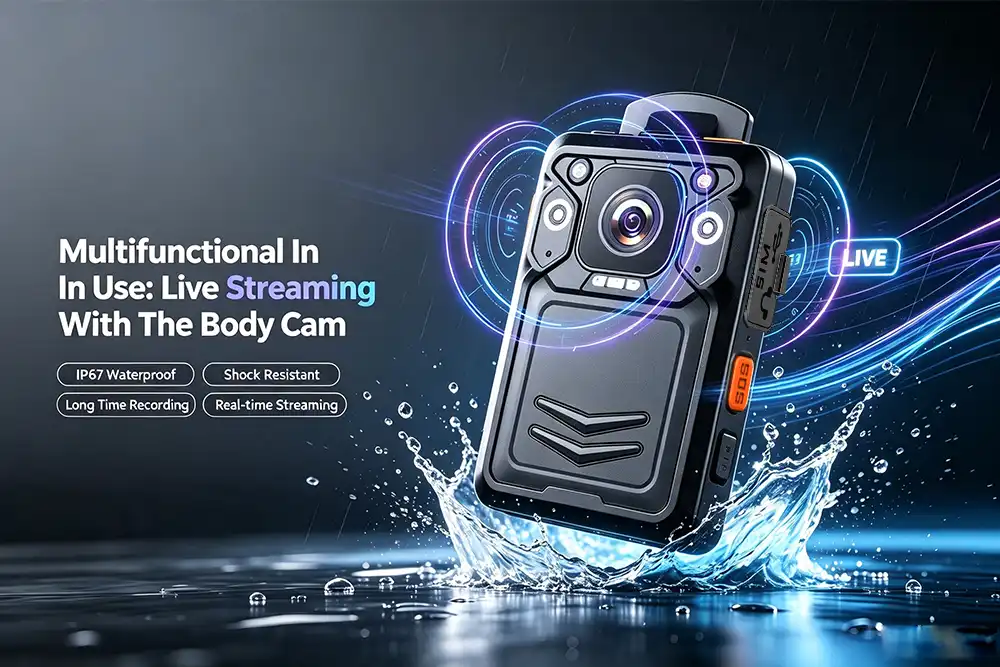
Understanding Body Camera Live Streaming Technology
Modern body camera live streaming devices are made up of a lot of complex parts that all work together to make the camera. At the hardware level, devices have powerful processing chipsets that can encode video in real time using efficient compression standards like H.264 and H.265. They also have high-resolution image sensors, like the OV05A20 sensor, which delivers 1440P video quality. Because these encoding formats use less bandwidth without lowering the quality of the video, they allow for continuous streaming even over cellular networks.
Connectivity is the most important part of streaming. Devices that can transmit in two different modes can easily switch between Wi-Fi networks inside buildings and 4G/LTE links outside. This backup makes sure that video feeds stay stable even when police officers or security guards move from one place to another. Advanced models use adaptive bitrate streaming, which changes the video quality automatically depending on the network speed that is available to avoid delays.
Privacy and Security Protocols
Sending secret operational videos in real time naturally makes people worry about data security. Professional body camera live streaming systems solve these problems by adding multiple layers of security. AES256 encryption keeps video streams from being hacked while they're being sent, and secure VPN tunnelling makes encrypted connections between devices in the field and command centers. Geographic tagging adds location information to streams, which gives important background and lets you track people in real time. Compliance with frameworks like GDPR in Europe and CJIS standards in the US makes sure that streaming systems handle private information in a way that meets legal requirements.
Power Management and Durability
For continuous streaming, a lot of power is needed, so battery capacity is an important feature. Devices with 3200mAh batteries can stream continuously for 6 to 10 hours, which is enough to cover full shifts without needing to be charged again. Thermal management systems keep devices from getting too hot after extended use, and IP67 waterproof ratings and 2-meter drop protection make sure they work well in difficult conditions. These long-lasting features are very important for traffic cops who have to work in bad weather or for firemen who have to do rescue work in tough circumstances.
Benefits of Live Streaming with Body Cameras for B2B Clients
Companies that use body camera live streaming systems say they see real gains in many areas of their operations. These benefits go beyond just keeping records; they fundamentally improve how teams talk to each other, react, and learn from events in the field.
Real-time visual access changes what supervisors can do. People working in the command center can watch multiple live feeds at the same time. This lets them spot developing safety issues, quickly assign resources, and give expert advice without being there in person. A regional boss can watch what's happening from afar during a retail security event and tell staff on-site how to calm things down. As officers do checks at accident scenes, traffic police supervisors can look over the paperwork to make sure that the right steps are taken and that important evidence is recorded properly.
Accelerated Incident Response
With live capabilities, there is no longer any time between an event happening and management becoming aware of it. When hospital security is threatened, emergency medical teams can let coming backup units know what's going on, which helps them get ready. At transport hubs, security guards can report any strange activity straight to police. This lets everyone work together to solve the problem before it gets worse. According to operational studies done in major metropolitan security deployments, this immediate communication cuts response times by about 30 to 40 percent compared to radio-only systems.
Financial and Operational Efficiency
Body camera live streaming systems cost more up front than basic recording models, but they give you a great return on your investment because they can do so many things. When employees carry all-in-one wearable systems, they don't need to carry around separate GPS trackers, cameras, and communication devices. With storage sizes ranging from 32GB to 256GB, you can store more than 24 hours of locally buffered 1080p video, in case your network connection goes down for a short time. Post-incident investigation costs go down a lot when bosses can look over situations as they happen instead of having to piece together events from different sources days later.
When used for training, the gadgets are especially useful. Firefighters can record rescue operations to watch later. This lets teams look at how they made decisions under pressure and improve their methods. During their first few weeks on the job, retail security guards benefit from real-time teaching, which speeds up skill development and cuts down on costly mistakes.
How to Choose the Best Body Camera Live Streaming Solution
When buying body camera live streaming systems, you need to carefully consider the technical specs, the vendor's abilities, and the long-term support structures. To start, businesses should be very clear about what their operational needs are based on specific use cases.
Technical Specifications and Performance Criteria
Resolution decides the value of evidence and the understanding of the situation. 1440P devices have a lot of detail that makes them great for identifying faces, reading license plates, and taking evidence that can stand up in court. Streaming resolution may be different from recording resolution, though, so buying teams should make sure that devices keep up the quality while live streaming over cellular networks. In comparison to H.264, H.265 encoding is better at compressing data, using about half as much data while keeping the same level of quality.
The operating usefulness is directly affected by how well the battery works. Make sure that the manufacturer's specs describe real-life streaming situations, not just standby or recording-only ones. Devices should be able to keep streaming for normal shift lengths, with scores of 6 hours or more for constant use. Display screens are useful for checking and playing back content, but they use a lot of power. Look for models that have automatic display timeout features to save battery life.
It's important to remember that the environment is resilient. IP67 ratings make sure that you are protected from weather and short-term submersion, which is very important for jobs like traffic control and outdoor security. Drop resistance standards should be at least 2 meters, which should match the real risks that come up in fights or emergencies.
Vendor Evaluation and Support Structures
In the market for body cameras, there are well-known brands that offer different levels of customisation, customer service, and prices. Beyond technology specs, organisations should look at a number of other factors when evaluating providers. Customisation is important, especially for big deployments. For example, can the seller change the firmware to work with current security systems or add custom features? What kind of technical support comes with the product, and does it last as long as the device does?
Warranty coverage shows how confident the maker is in the product and how much it will cost in the long run. Most professional-grade devices come with a warranty that lasts 18 months. This warranty covers defects and normal wear and tear from use. Make it clear if the guarantee covers replacing the battery, since lithium-ion cells lose power over time. Knowing where to find spare parts and repair services keeps operations running smoothly when devices need to be serviced.
Certifications of compliance show that companies meet quality standards. Check to see if it has CE, ROHS, ISO, and IK09 impact ratings. These validations by a third party show that the gadgets meet world standards for performance, safety, and the environment.
Setting Up and Implementing Body Camera Live Streaming Systems
Buying devices is only one part of a successful rollout. Setting up the network, teaching users, and making policies are also important. To get the most out of execution and user usage, organisations should follow a set of steps.
An evaluation of the network infrastructure is the basis for reliable streaming. Coverage testing should be done across all operational areas to find places where connectivity is lacking. Even though 4G LTE networks cover a lot of ground, signal strength may drop in buildings and rural areas. Businesses that work in these kinds of places may need to set up Wi-Fi access points or signal boosts. Finding out how much bandwidth is usually available can help you set the right streaming quality settings. Aim for 1.5 to 2 Mbps for standard definition streams and 3 to 5 Mbps for HD transfer.
Configuration and User Training
When setting up a body camera live streaming device, functionality and usability should be balanced. Standardise the settings across the company to make sure that everything works the same and to make fixing easier. Set up automatic recording triggers based on certain events, like when a police officer's car starts up or a security guard opens a door. This way, you won't have to manually start the recording when things are stressful. Setting up GPS tracking, privacy modes, and retention policies that are in line with company policy and the law all need careful thought.
Adoption success depends on how well users are trained. The staff needs to know not only how to do basic tasks but also how strategic value streaming works. Physical mounting methods for best camera views, battery management for long shifts, and fixing common connection problems should all be covered in training courses. Stress the safety benefits for staff—documented proof protects against false claims and makes things clear during tense interactions.
Data Management and Compliance
Strict rules must be followed to receive, store, and manage transmitted footage. Cloud-based management systems provide centralised storage with built-in rules for automatic retention, access controls, and audit trails that show who saw what video. On-premises server solutions give businesses more control over private data, but they need a bigger IT infrastructure. Hybrid methods take both of these things into account by keeping regular video in the cloud and sending sensitive streams to computers on-site.
Following the area private rules needs constant attention. GDPR requires businesses in Europe to keep only as much data as they need and not keep it for too long. In the United States, the rules are different in each state. For example, some states require police footage to be kept for a certain amount of time, while others limit facial recognition technology. Clear rules must be set by organisations about when streaming can happen, who can watch live feeds, and how long footage is kept.
Future Trends and Innovations in Body Camera Live Streaming
The features and uses of body camera live streaming are always growing as technology improves. Companies that want to make long-term investments should know about the new trends that are changing the industry.
Artificial Intelligence Integration
The most important development is the merging of artificial intelligence. Real-time video analytics can find specific objects, behaviours, or safety risks in live streams, and they can automatically notify supervisors of situations that need their attention. It is possible to immediately identify people of interest with facial recognition technology, but its use is still controversial and limited by laws in many places. During regular stops, license plate recognition helps police by automatically flagging stolen cars or cars with open traffic tickets.
5G Networks and Enhanced Connectivity
The world spread of 5G networks makes streaming much more reliable and possible. Higher speed lets more high-definition streams run at the same time, so command centers can keep an eye on bigger teams without quality dropping. Less latency (the time between capture and transfer) gets closer to real-time, which makes two-way conversation more natural and responsive. Edge computing architectures do video analytics locally on devices or network nodes that are close by. This cuts down on the amount of data that needs to be sent to central servers and speeds up automated responses.
Integration with broader IoT ecosystems
Situational awareness tools become more complete when they are connected to larger IoT ecosystems. Body cameras can talk to security systems in buildings, cars, and fixed surveillance infrastructure. This lets command centers see incidents from different points of view. Coordinating devices automatically makes things run more smoothly. For example, when a police officer sounds the emergency signal, nearby cams could start recording and streaming right away, gathering a lot of information without any help from a person.
Modular designs and software upgrades should be built into procurement strategies to account for these changes. Over-the-air (OTA) updates let devices get new features and security fixes without having to be sent back. This makes them last longer. Scalable license models let businesses add advanced analytics features as their budgets allow, instead of having to update the whole system.
Conclusion
In conclusion, body camera live streaming has changed from being specialised tools for police to useful tools for many other industries that face the same operational problem: they need to see what's happening in the field in real time. The technology fills in basic communication gaps that make things less safe, less efficient, and less accountable. When companies use these tools, they can see what's going on right away, make decisions faster, and keep detailed records that protect employees and improve service quality. Technical factors like resolution, connection, battery life, and longevity need to match the needs of the operation. When choosing a provider, it's important to focus on their ability to customise, their commitment to quality support, and their compliance licenses. As artificial intelligence and 5G networks improve functionality, organisations with forward-thinking procurement strategies will be able to take advantage of new features that make these devices even more valuable.
FAQ
1.What distinguishes live streaming from traditional body camera recording?
Traditional body cameras store video on internal memory cards, which means that footage has to be physically retrieved and downloaded before it can be looked at. Body camera live streaming sends video over wireless networks in real time to command centers or the cloud, where it can be watched right away. Many current devices can do both at the same time, streaming for real-time knowledge and recording locally for backup. This redundancy makes sure that proof is kept safe even if the network goes down for a short time.
2.How secure are streamed video transmissions?
Professional body camera live streaming systems use AES256 encryption, which is military-grade, to keep data sent from being hacked. Safe VPN tunnelling makes encrypted connections between devices and receiving servers, which stops people who aren't supposed to be there from getting in. Systems are sure to follow strict data protection rules when they meet CJIS standards in the US and GDPR requirements in Europe. Companies should make sure that the companies they work with regularly release security updates that fix new issues.
3.Can streaming body cameras integrate with existing security infrastructure?
Interoperability is a big part of how modern gadgets are made. Most systems let you connect to them through an API, which lets you connect to video management systems, computer-aided dispatch platforms, and databases for proof management. During the procurement evaluation process, organisations should talk to vendors about their specific integration needs, since different manufacturers offer different customisation options.
Partner With a Trusted Body Camera Live Streaming Manufacturer
Shenzhen Kexin Technology Co., Ltd. makes body camera live streaming systems for businesses that are designed to work in tough professional settings. Our ISHOOP brand products have a 1440P resolution, dual 4G/Wi-Fi connection, and an 18-month warranty. They are made using ISO-certified methods and are sold in over 30 countries. We know that choices about what to buy involve more than just the specs. They also have to do with customisation needs, help with integration, and the value of a long-term relationship. Our engineering team offers ODM and OEM services that are tailored to your specific operational needs. This is true whether you need firmware modifications for specific uses or custom housing designs for specific mounting situations. The gadgets are compliant with foreign rules like CE, ROHS, IP67, and IK09. This means they can be sold in many different places. Our ten years of experience in digital imaging and dedication to quick technical help throughout the product lifecycle make us a reliable choice for organisations looking for a body camera live streaming provider. For more information on how our body camera live streaming solutions can improve operational transparency, speed up incident response, and give your organization a measurable return on investment, please contact our team at sales@ishoop.com.cn.
References
1. International Association of Chiefs of Police. (2020). Body-Worn Camera Model Policy and Implementation Guidelines. IACP Law Enforcement Policy Center.
2. Smith, J. & Anderson, R. (2021). Real-Time Video Streaming in Public Safety: Technical Architectures and Deployment Strategies. Journal of Emergency Management Technology, 15(3), 112-128.
3. European Union Agency for Cybersecurity. (2022). Data Protection and Privacy Considerations for Body-Worn Camera Systems in Law Enforcement. ENISA Technical Report Series.
4. Martinez, L. (2019). Evaluating Return on Investment for Advanced Security Technology: A Procurement Manager's Guide. Security Management Review, 42(6), 78-94.
5. National Institute of Standards and Technology. (2021). Encryption Standards for Mobile Video Transmission in Justice and Public Safety Applications. NIST Special Publication 800-Series.
6. Chen, W. & Thompson, K. (2023). Artificial Intelligence Integration in Wearable Camera Systems: Current Capabilities and Future Directions. International Conference on Security Technology Proceedings, 445-462.

USER EVALUATE
Here is the customer's evaluation of us