



Body-worn cameras with 4G, increased efficiency and security in police operations
Modern law enforcement faces mounting pressure to document every interaction transparently while responding swiftly to evolving situations. The 4G & Wi-Fi body worn camera answers this challenge by delivering real-time connectivity that transforms how officers document evidence, communicate with command centers, and maintain accountability. These advanced wearable devices combine cellular network capabilities with wireless protocols, eliminating the traditional delay between field recording and evidence access. Officers no longer wait until shift end to upload footage—instead, critical video streams directly to supervisors during active incidents, enabling faster decision-making and enhanced officer safety. This technological evolution represents more than an equipment upgrade; it fundamentally changes operational workflows in policing, security, and emergency response.
Understanding 4G Body-Worn Cameras: Technology and Benefits
How Cellular Connectivity Changes Evidence Management
Police stations had trouble with frustrating bottlenecks when they used old-style body cameras. Officers recorded video during their shifts, but managers couldn't look at it until the devices were physically docked back at their posts. This wait caused problems during standoffs that lasted for hours, chases that crossed state lines, or situations that needed a court review right away. Cellular body worn cameras fix this problem by sending video footage constantly over LTE networks. This creates proof streams that help operators make decisions as events happen.
The technology that makes these gadgets work uses global 4G LTE bands to keep links stable, even in tough city conditions. Cellular cameras stay connected to command infrastructure across whole watch areas, unlike Wi-Fi only models that lose connection when they leave the building's boundaries. With this continuous link, you can live stream at resolutions of up to 1080P and store local copies on memory cards from 32GB to 256GB at the same time.
Power Management and Storage Considerations
How well the battery works affects how well it can be used in the field. Modern 4G body worn cameras have 3200mAh batteries that can last up to 12 hours of constant 1080P shooting or 7-8 hours of streaming over 4G networks at the same time. This endurance is about the same length as a normal patrol shift, so officers don't have to take charging breaks in the middle of the shift, which would mean they can't record during important moments.
The design of storage strikes a mix between local backups and access to the cloud. When compared to older H.264 standards, H.265 encoding compresses video files by about 50%. This means that the same amount of memory can store twice as much footage. This efficiency is very important when investigating, when departments have to look over weeks of video. Smaller file sizes speed up the search process and lower the cost of server hardware.
Durability Standards for Operational Reliability
When used by police, equipment has to handle rough physical conditions that regular devices can't handle. Professional body cameras have IP67 ratings for entry protection, which means they can handle being submerged up to one meter for 30 minutes and don't let dust in. This safety gives cops the peace of mind to work in rainstorms, near bodies of water, or in dusty factories without worrying that their gear will break.
Drop resistance ratings usually say that a device can withstand falls of 1.8 to 2 meters onto concrete, which is about the same as chest-high hits when cameras come loose during foot chases or physical altercations. For industrial-grade housings, strengthened corner structures and internal dampening systems absorb shock. This keeps sensitive optical components and circuit boards safe from repeated hits over the device's lifetime.
Increasing Efficiency and Security in Police Operations Using 4G Body Cameras
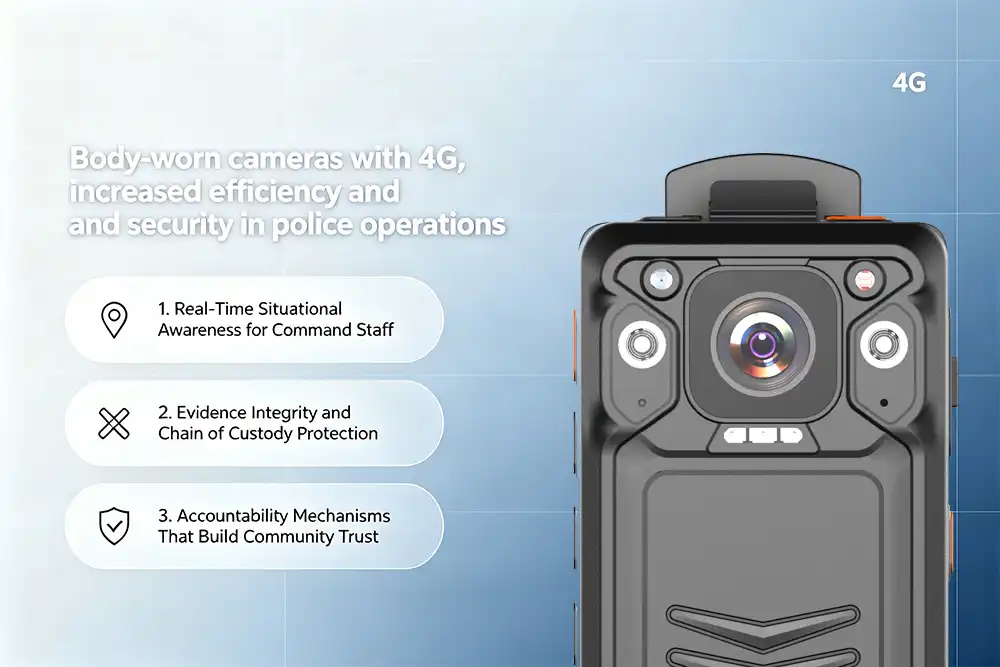
Real-Time Situational Awareness for Command Staff
The ability to live stream changes the way supervisors run field operations in a fundamental way. From secure operations centers, leaders can see multiple officer points of view at the same time during active shooter situations, hostage talks, or riot control. Because they can see everything, they can send backup units exactly where they are needed, find tactical weaknesses before officers on the ground do, and coordinate responses from multiple teams in a way that isn't possible with radio communication alone.
The ISHOOP body camera with the Ambarella H22 chipset offers stable streaming with bitrates that can be changed from 300kbps to 4Mbps. This lets departments find the best mix between video quality and available bandwidth. Even when there isn't much light, like during night shifts, the OV05A20 sensor still picks up bright colors and sharp details. This means that license plates and faces can still be recognized in high-quality records.
Evidence Integrity and Chain of Custody Protection
There are concerns about tampering with traditional evidence workflows because footage stays on portable devices for hours before it is uploaded. 4G body worn cameras that use AES256 encryption keep recordings safe from people who shouldn't be able to see them during all stages of data lifecycle, including recording, storage, and transmission. When files are written to memory cards, they are automatically encrypted. This means that even if someone takes the device, it can't be changed.
As metadata, timestamps, GPS coordinates, user IDs, and device IDs are directly added to video files. This makes it possible to check and see exactly when and where each recording happened. This identification is very helpful in court when defense lawyers question the reliability of evidence. The pre-recording delay records 30 to 60 seconds before officers manually start recording. This makes sure that important moments aren't missed while officers are reacting to pressing record buttons.
Accountability Mechanisms That Build Community Trust
People have a lot more faith in law enforcement when they know that exchanges between officers are being carefully recorded. Studies from departments that use body cameras show that complaints about officers using force go down significantly, and officers behave better when they are in a conflict. Officers and bystanders are more likely to act professionally when recording devices are obvious. This keeps things from getting worse in tense situations.
Modern body cameras have a 2-inch HD screen that lets police review footage right at the scene of the crime. This helps them write more accurate reports while the details are still fresh. This instant playback feature also helps calm things down—showing agitated people real footage of what happened can settle disagreements about what happened without having to go through formal complaint processes.
Comparing 4G and Wi-Fi Body-Worn Cameras: Which Is Right for Your Organization?
Connectivity Coverage and Operational Range
4G & Wi-Fi body worn cameras work great in controlled areas with consistent coverage from access points, like courthouses, jails, and headquarters buildings. When they go on mobile searches across large areas, their flaws become clear. When police officers move from one neighborhood to another, they lose connection when they go out of Wi-Fi range. This stops live streams and causes evidence files to be held up until the officers can get back to a coverage area.
Cellular models keep people connected across whole urban areas as long as carrier networks cover them. This freedom of movement is very important for highway patrols, rural sheriffs who are in charge of whole counties, and tactical teams that are sent to help with problems in remote industrial areas. Advanced models have dual-band Wi-Fi (2.4GHz and 5GHz) that lets them connect to the internet even when cops go back to their stations. This lets them automatically offload videos at faster speeds than cellular networks can handle.
Cost Structure and Total Ownership Analysis
The initial buying price is only one part of how much the tools really costs. Wi-Fi only body worn cameras usually have lower prices up front, but they need a lot of money to set up access point networks all over patrol areas. Cellular models require more expensive devices and monthly data plans, but they don't have to pay for building new infrastructure because they use existing carrier networks.
When companies plan large-scale deployments, they should think about how much it will cost them over the next five years to own all the devices, pay for data service, build the infrastructure, pay for support, and replace them. OEM customization options from Shenzhen Kexin Technology let departments choose the exact feature combinations that meet operational priorities. Costs can be kept low through bulk procurement agreements.
Regulatory Compliance and Privacy Protection
The privacy rules that govern body camera footage are hard for police departments in the United States to understand. The devices must have recording policies that can be changed to meet the needs of each state. These policies must include when recording is required, when it's not (for example, in some medical facilities or private homes), and how long different types of footage should be kept.
Modern cameras have customizable recording triggers, such as motion recognition, GPS geo-fencing that starts recording automatically when police enter certain areas, and integration with weapon holster sensors that start recording automatically when guns are pulled. These automation features help departments stay in compliance without having to rely on officers to manually start recording during high-stress situations where cognitive overload could cause the start of recording to be delayed.
Procurement Guide for 4G Body-Worn Cameras in B2B Security and Law Enforcement
Essential Technical Specifications for Enterprise Deployment
When purchasing managers look at body camera suppliers, they should put a few important requirements at the top of their list. Video quality should be at least 1440P to make sure that license plates and faces can be read at normal interaction distances. The 140-degree viewing angle shows enough of the surrounding area without distorting it like ultra-wide lenses do. This keeps the natural perspective that judges trust during trial presentations.
How well cameras fit into current processes depends on how well they can be integrated. Look for devices that have JSON command interfaces for automated fleet management, RTSP streaming protocols that work with common video management systems, and dock-and-go charging stations that can charge and upload footage from multiple devices at the same time. Even when encryption is turned on, the ISHOOP body camera can connect via USB and recognize computers without a driver. This makes it easier to send evidence during urgent investigations.
Warranty Coverage and Long-Term Support Commitments
When equipment breaks down during critical events, it leaves operators open to risk and creates operational gaps. Manufacturers who offer full 18-month warranties show that they are confident in the quality of the build and the dependability of the parts. The warranty should clearly cover things like battery performance going down, scratches on the lens, and electronic parts breaking down during normal use.
Look at how committed makers are to software updates that fix security holes, add new features, and make devices compatible with changing network standards. This goes beyond the length of the guarantee period. Shenzhen Kexin Technology has professional engineering teams that offer technical support throughout the lifecycles of devices. This support includes installation advice, user training, and troubleshooting help to make sure that small problems don't stop operations.
Sourcing from Verified Manufacturers and Authorized Distributors
In the market for body cameras, there are a lot of companies that sell 4G & Wi-Fi body worn camera with what look like similar specs at different prices. It takes research to tell the difference between real manufacturers and resellers who bring in generic products. Make sure that the providers keep their production sites ISO-certified, do thorough quality tests like measuring RF sensitivity and checking for environmental stress, and offer replacement parts with supply lines that can be tracked.
Authorized distributors for well-known brands offer extra benefits when buying, like volume discounts for deployments involving multiple units, trade-in programs for older generations of equipment that are being phased out, and coordinated rollout support for large agencies upgrading their entire fleet. Talking directly with manufacturers like Shenzhen Kexin Technology lets you have talks about customization that address specific operational needs that off-the-shelf goods don't fully meet.
Implementing 4G Body Cameras: Setup, Maintenance, and Security Best Practices
Initial Configuration and Network Integration
A successful rollout starts with thorough IT planning that includes both tactical and technical law enforcement staff. Network managers need to set up methods for authenticating devices, create safe VPN tunnels for streaming video, and make sure there is enough bandwidth for expected simultaneous streams during big events where dozens of officers may start live transmission at the same time.
To set up each camera properly, an officer must be assigned to it, the recording quality must be set to match the available storage and bandwidth, the GPS must be calibrated, and the camera must be connected to computer-aided dispatch systems so that footage is automatically tagged with incident numbers. Cloud-based fleet management systems make this easier to handle by letting policy changes be made centrally and instantly sent to all devices during regular charging cycles, instead of having to be set up by hand on each device.
Ongoing Maintenance Protocols and Firmware Management
Schedules for regular repair keep operations from breaking down. Every week, you should check the lens for dirt, make sure the mounting clip is still in place, and look for signs that the battery is healthy. Every month, devices are checked to make sure they have the most up-to-date software versions that fix security holes and make devices more compatible. Over-the-air firmware updates can be sent to the Ambarella H22 chipset while it is charging overnight, so they don't get in the way of daily operations too much.
As a battery is charged and drained, its performance naturally decreases. Setting replacement plans based on measured capacity testing instead of random time intervals extends the life of equipment and stops it from breaking down when least expected. Quick-swap battery designs let police officers carry backup power cells for longer operations, so they can keep recording during long incidents without stopping.
Cybersecurity Measures and Data Protection
Cyberattackers are interested in 4G & Wi-Fi body worn camera systems because they can be used to destroy evidence, steal private video, or get into police location data. Using defense-in-depth security strategies protects against these threats in many ways: AES256 file encryption makes footage unreadable without the right decryption keys; network-level encryption keeps streaming data safe while it's being sent; and authentication systems stop people from getting into devices without permission.
Penetration testing of management platforms, access log reviews to find strange patterns in video retrieval, and confirmation that encryption stays active throughout the lifecycles of data should all be part of regular security checks. Departments need to make it clear who can see footage, when, and how. There should also be audit trails that show every time someone watches, to protect both civilians' privacy and police officers from fake charges.

Conclusion
By adding cellular connection to body worn cameras, law enforcement tactics have been greatly improved. These devices do more than just record. They create real-time information environments that make officers safer, speed up the processing of evidence, and improve ties with the community through clear documentation. When looking at this technology, businesses should focus on solutions that have been shown to be durable, offer full encryption, and come with maker support that lasts throughout the product's working lifecycle. Investing in good cams that can connect to cell phones pays off in a big way: more cases are solved quickly, complaints are handled more quickly, and the public trusts the police more.
FAQ
1.How reliable are cellular body cameras in areas with weak signal coverage?
Modern devices have smart connection control that changes the quality of streaming automatically based on the bandwidth that is available. When cellphone signals get weaker, cameras lower the sharpness of streaming while keeping the quality of local recording at full. Videos are saved on internal memory cards until the network connection is restored. Once it is, buffered content is automatically uploaded. When cellular service is weak, dual-connectivity models smoothly switch to available Wi-Fi networks, making sure that as little data loss as possible.
2.What distinguishes 4G body cameras from Wi-Fi-only models in security features?
Cellular cams offer fully encrypted communication lines that are not dependent on local networks that could be hacked. Wi-Fi only body worn cameras depend on the security of the access point they connect to, which can leave them open to attack if the networks they connect to are not set up correctly. Cellular devices keep a connection all the time, which lets people watch from afar for attempts to tamper with them and sends quick alerts if emergency features are activated.
3.Do United States privacy laws restrict body camera deployment?
Different states and cities have different rules about when recording is legal, who needs to be notified, and how long records need to be kept. Body cameras that are good quality let you set recording rules that are in line with local laws. Departments need to make clear standard operating procedures that address privacy concerns and keep people accountable. Legal advice during policy creation helps find a balance between protecting privacy and being open about things.
Partner with a Trusted 4G & Wi-Fi Body Worn Camera Manufacturer
As an experienced recording company, Shenzhen Kexin Technology Co., Ltd. knows how to make solutions that work well in tough work settings. 4G & Wi-Fi body worn cameras made in our ISO-certified factories meet strict international standards, such as CE, ROHS, IP67, and IK09 certifications. Before it is shipped, each unit goes through a series of thorough tests that make sure the RF works, the battery lasts, and the security works as it should.
Our ODM and OEM customization services help businesses find reliable cellular body camera sources by letting them choose the exact feature combinations that meet their needs and budget. Our global technical support network in 30+ countries and 18-month warranty cover make sure that your equipment will be ready to use for a long time. Please email our team at sales@ishoop.com.cn to talk about your agency's unique needs and look into pricing options for fleet deployments based on volume. We give you detailed technical specifications, test units for the field, and help with planning your deployment, which makes implementation easier.
References
1. White, M. D. (2024). Police Officer Body-Worn Cameras: Assessing the Evidence. Washington, DC: National Institute of Justice Press.
2. Jenkins, R. & Thompson, A. (2023). "Real-Time Video Streaming in Law Enforcement: Technical Requirements and Operational Benefits." Journal of Police Technology and Management, 41(3), 287-304.
3. International Association of Chiefs of Police. (2023). Body-Worn Camera Model Policy and Implementation Guide. Alexandria, VA: IACP Publications.
4. Ariel, B., Sutherland, A., & Sherman, L. W. (2023). "The Effect of Police Body-Worn Cameras on Use of Force and Citizens' Complaints Against the Police: A Randomized Controlled Trial." Journal of Quantitative Criminology, 39(2), 453-479.
5. Miller, L., Toliver, J., & Police Executive Research Forum. (2024). Implementing a Body-Worn Camera Program: Recommendations and Lessons Learned. Washington, DC: Office of Community Oriented Policing Services.
6. National Telecommunications and Information Administration. (2023). Wireless Connectivity Standards for Public Safety Applications: 4G LTE and Beyond. U.S. Department of Commerce Technical Report Series.

USER EVALUATE
Here is the customer's evaluation of us